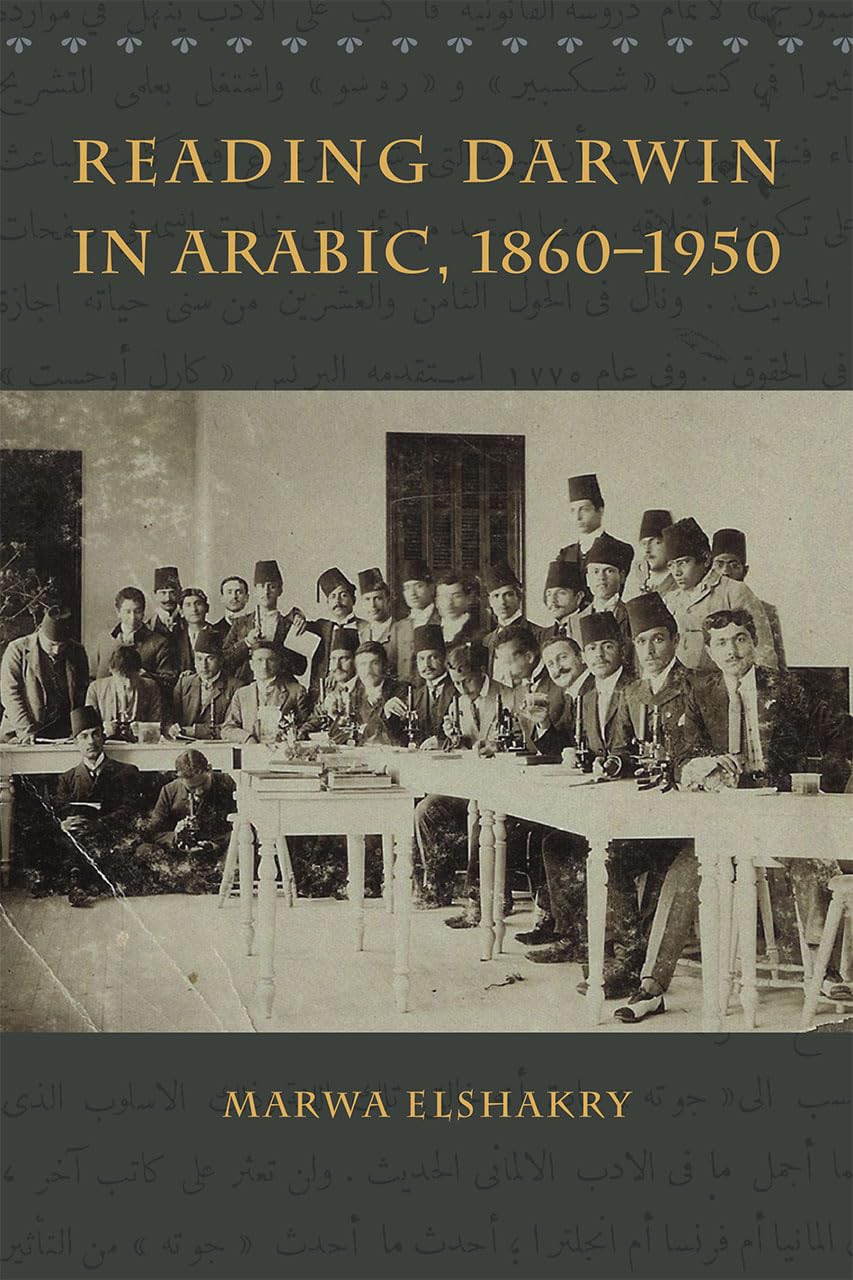



In Reading Darwin in Arabic , Marwa Elshakry questions current ideas about Islam, science, and secularism by exploring the ways in which Darwin was read in Arabic from the late 1860s to the mid-twentieth century. Borrowing from translation and reading studies and weaving together the history of science with intellectual history, she explores Darwin’s global appeal from the perspective of several generations of Arabic readers and shows how Darwin’s writings helped alter the social and epistemological landscape of the Arab learned classes. Providing a close textual, political, and institutional analysis of the tremendous interest in Darwin’s ideas and other works on evolution, Elshakry shows how, in an age of massive regional and international political upheaval, these readings were suffused with the anxieties of empire and civilizational decline. The politics of evolution infiltrated Arabic discussions of pedagogy, progress, and the very sense of history. They also led to a literary and conceptual transformation of notions of science and religion themselves. Darwin thus became a vehicle for discussing scriptural exegesis, the conditions of belief, and cosmological views more broadly. The book also acquaints readers with Muslim and Christian intellectuals, bureaucrats, and theologians, and concludes by exploring Darwin’s waning influence on public and intellectual life in the Arab world after World War I. Reading Darwin in Arabic is an engaging and powerfully argued reconceptualization of the intellectual and political history of the Middle East. “Thoroughly researched. . . . [A] densely argued and fascinating book [that] gives extensive coverage to such matters as missionary ambitions and strategies in the Middle East, Muhammad Abduh’s attempts to reform al-Azhar as a teaching institution, the rise of Pharaonism as a cultural movement, the growing sense of an Islamic civilization with a history, the eleventh-century Sufi al-Ghazali’s overweening presence in philosophical debates, and Arab interest in Atatürk’s reforms.” -- Robert Irwin ― Times Literary Supplement "Rewarding. . . . Reading Darwin in Arabic is about more than its title suggests. It describes the intellectual ferment in Egypt as the country grappled both with Darwinism and colonial rule, and an Islamic liberalism shone briefly before being all but extinguished by the brutal ideologies of the twentieth century." -- Christopher de Bellaigue ― New York Review of Books “Elshakry’s book is a remarkable feat of scholarship that builds on an impressive base of sources. . . . I believe Reading Darwin in Arabic will serve as a beacon of insight and inspiration for scholars of the Middle East and historians of modern science.” -- Harun Küçük, Max Planck Institute for the History of Science ― Science "A fresh perspective on the reception of Darwinism. While the title of her book suggests a focus on the impact of Darwin’s Origins of Species on Arabic readers, it is, in fact, a work relevant to anyone interested in the reception of scientific ideas on a global scale. . . . A solid contribution to knowledge, and one that will remain a cornerstone of the intellectual history of the Arabic reading world." -- Andrew Bednarski, Gonville and Caius College ― Studies in History and Philosophy of Biological and Biomedical Sciences "Elshakry’s wonderfully rich book adds a great deal to our knowledge concerning the reception of modern science by Arab and Muslim intellectuals." -- John Kelsay, Florida State University ― Quarterly Review of Biology "Even as Christian apologists combed scripture for Biblical refutations of Darwin, Islamic scholars as high up the intellectual ladder as Egypt’s grand mufti, Muhammad 'Abduh, 'had little difficulty reconciling modern principles of evolution with revelation,' Elshakry observes in this thorough study of the question of the compatibility of Darwin’s ideas with Islamic thinking." -- Tom Verde ― AramcoWorld "With the limited scholarship focusing on science translation between the Global North and the Global South, Elshakry’s Reading Darwin in Arabic is a much welcome contribution to the existing literature on the globalization, translation and popularization of science, especially in colonial and postcolonial contexts. Reading Darwin is an invaluable resource for historians of science and intellectual historians of the Middle East. It is also a crucial contribution to science-and-religion studies." -- Soha Bayoumi, Harvard University ― Endeavour "Elshakry’s Reading Darwin in Arabic is a tour-de-force. Without question, Elshakry has made an invaluable contribution to the global and cultural histories of decolonization."Maurice Jr. M. Labelle (University of Saskatchewan) -- Maurice Jr. M. Labelle, University of Saskatchewan ― H-Net “This pathbreaking book opens up a new world of understanding about the encounters of science in an era of imperial rivalries and nat