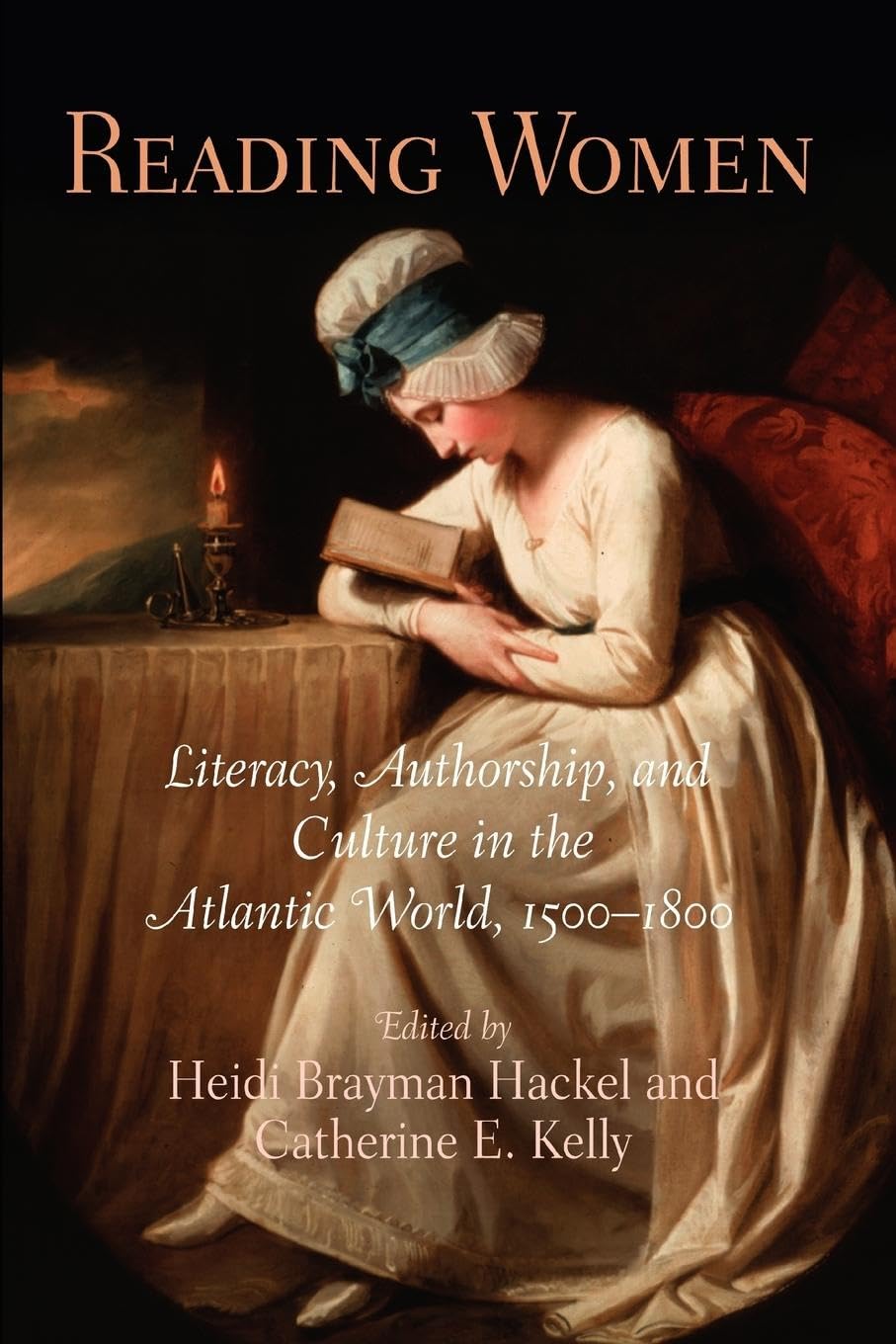
Reading Women: Literacy, Authorship, and Culture in the Atlantic World, 15-18 (Material Texts)
$29.95
by Heidi Brayman Hackel



In 1500, as many as 99 out of 100 English women may have been illiterate, and girls of all social backgrounds were the objects of purposeful efforts to restrict their access to full literacy. Three centuries later, more than half of all English and Anglo-American women could read, and the female reader was emerging as a cultural ideal and a market force. While scholars have written extensively about women's reading in the nineteenth and twentieth centuries and about women's writing in the early modern period, they have not attended sufficiently to the critical transformation that took place as female readers and their reading assumed significant cultural and economic power. Reading Women brings into conversation the latest scholarship by early modernists and early Americanists on the role of gender in the production and consumption of texts during this expansion of female readership. Drawing together historians and literary scholars, the essays share a concern with local specificity and material culture. Removing women from the historically inaccurate frame of exclusively solitary, silent reading, the authors collectively return their subjects to the activities that so often coincided with reading: shopping, sewing, talking, writing, performing, and collecting. With chapters on samplers, storytelling, testimony, and translation, the volume expands notions of reading and literacy, and it insists upon a rich and varied narrative that crosses disciplinary boundaries and national borders. "Destined to become a landmark study and a fixture in the bibliographies of feminist and textual scholars, literary and social historians, students of the English Renaissance and the American Republic alike." ― William Sherman, University of York "Highly recommended." ― Choice " Reading Women . . . generously offers important new historical, textual, and theoretical ways of accessing, describing, and interpreting early modern women's reading." ― Journal of American History Heidi Brayman Hackel is Associate Professor of English at University of California, Riverside and the author of Reading Material in Early Modern England: Print, Gender, and Literacy. Catherine E. Kelly is Associate Professor of History at the University of Oklahoma and author of In the New England Fashion: Reshaping Women's Lives in the Nineteenth Century. Introduction Heidi Brayman Hackel and Catherine E. Kelly The Virgin Mary pores over a book of devotion, oblivious to the angel standing before her. A merchant's wife titters and flushes as she reads a French romance, slipping towards sexual ecstasy as she fingers the pages. A matron in a gauzy empire dress reads a history of ancient Rome and ponders her nation's prospects. A mouse of a girl curls up in a window seat, lost in an enormous book. These are familiar images. In the 400 years since significant numbers of Western women began to read, such pictorial and textual representations of women reading have become part of our cultural wallpaper. They are the stuff of Renaissance paintings and nineteenth-century novels; they figure equally in exemplary lives and cautionary tales. In recent decades, these same images have gained new complexity and generated new questions, thanks to the work of a generation of feminist scholars who have illuminated the multiple, often conflicting, representations of the female reader. The essays collected in this volume aim to further their investigations both by turning toward more empirically based accounts of women's reading and by problematizing the dynamic relation between representation and recorded experience. We do not pretend to offer a definitive history of women reading, convinced as we are of the impossibility of such a narrative at this moment. Instead, the following essays aspire to advance a conversation across disciplinary fields and across national borders. They offer new data about the gendered realities of reading on both sides of the Atlantic, and they pose fresh questions about the relationship between those realities and the representations that were intended to shape them. Taken together, these essays help us track the dramatic emergence of girls and women as important participants in the production and consumption of texts and as statistically meaningful possessors of literacy. It is no exaggeration to call this process dramatic. In England in 1500, as many as 99 percent of women may have been illiterate, and girls of all social backgrounds were the objects of purposeful efforts to restrict their access to full literacy. Three centuries later in 1800, nearly half of English and Anglo-American women demonstrated alphabetic literacy, and the female reader had emerged as a cultural ideal and market force. By the middle of the nineteenth century, the U.S. Census reported that 90 percent of white men and women were literate. The protean expansion of a female readership shaped the history of publishing and the development of literary culture. We