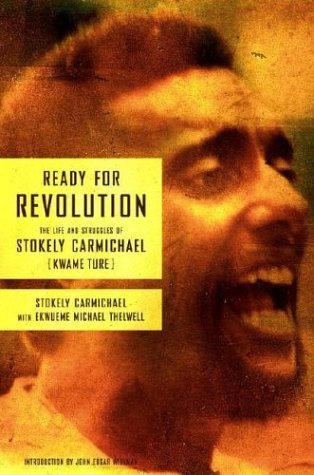
Ready for Revolution: The Life and Struggles of Stokely Carmichael (Kwame Ture)
$201.63
by Stokely Carmichael



The personal story of the civil rights leader's work and life, published to coincide with the fifth anniversary of his death, discusses his witness to and experiences with the prison farms and lynch mobs of Mississippi, the firefights and political activism of the African liberation wars, and the efforts of Black Power and Pan-Africanism. 40,000 first printing. Stokely Carmichael (known as Kwame Ture later in his life) died before his autobiography, Ready for Revolution: The Life and Struggles of Stokely Carmichael , could be completed, so much of the text was stitched together from extensive taped sessions by his long-time friend, Ekwueme Michael Thelwell. What remains is a sometimes uneven but always stirring record one of the most fascinating and controversial figures of the Twentieth Century. Carmichael was born in Trinidad, but his life as an activist began with his immersion in the Civil Rights movement at the Bronx High School of Science and then Howard University in the 1950s and 60s. At Howard he joined the Nonviolent Action Group (NAG) and later, the Student Nonviolent Coordinating Committee (SNCC), through which he drove voter registration efforts in Mississippi and Alabama. Later, as chairman of the SNCC he moved beyond the teachings of nonviolent resistance and forged the Black Power movement, authoring one of its key documents, "Toward Black Liberation" with Thelwell. He became a nationally recognized figure, reviled by leaders on both the left and the right for his apparent abandonment of integration. Yet his vision for black self-determinism would empower a generation of African-American artists, scholars, and leaders to embrace a new vision of African and African-American identity that is still transforming black culture. Eventually, Carmichael settled in Guinea, where he became a member of the ruling party and spent his later years promulgating his vision for Pan-African revolution. In the introduction to Ready for Revolution , Thelwell admits that, in keeping the story faithful to the recordings, he left it essentially a "first draft" of Carmichael's vision. Thelwell's intrusions in the text, whether his own points or thoughts of others whom he interviewed are bracketed--while this formal approach honors Carmichael's words, the passages are often distracting and would have been better left as endnotes. Further, Thelwell seems to let Carmichael's original text stand where some pruning would have been beneficial, notably in Carmichael's overly detailed recounting of his school days. That said, Thelwell has done a great service to African-American studies by shepherding Carmichael's controversial, quirky, and uncompromising autobiography into print. --Patrick O'Kelley As a Freedom Rider, student movement organizer, Black Panther, and Pan-Africanist, Carmichael was an extremely important figure in the civil rights movement. His legacy, however, has been marred by accusations of misogyny and by those who interpret his black nationalism as antiwhite hostility. His autobiography, published posthumously with the help (and illuminating commentary) of fellow activist Thelwell, is a response to such charges and an attempt to define his legacy. It's also a fascinating read. Carmichael's life story begins with the steel-drum-band soundtrack of his childhood in Trinidad and takes us through the Bronx, politically charged Howard University, Mississippi jails, and the South Side of Chicago--a where's where of the civil rights movement--before reaching Guinea, where he continued his Pan-African efforts for 30 years until his death in 1998. Malcolm X, Fidel Castro, and Toni Morrison are described reverently. Often whimsically conversational in tone, Carmichael emerges as a passionate humanist and social revolutionary, determined to the end, yet less abrasive than his critics would have us believe. Brendan Driscoll Copyright © American Library Association. All rights reserved "Ready for Revolution" captures Carmichael's electrifying moments in the national spotlight. -- The New York Times Book Review, November 23, 2003 Essential . . . [this book] should become a standard text in American history courses . . . [It] unearths pieces of dramatic, still troubling history. -- Sun-Sentinel (Fort Lauderdale, FL), December 7, 2003 Manisha Sinha, Author of The Counterrevolution of Slavery One of the most historically significant autobiographies from the civil rights era. No historian of the civil rights movement will be able to write about this period without consulting this indispensable book. Written in the language and from the heart of African America, it is also an immense stylistic achievement. -- Review This chronological accounting offers an intimate, step-by-step analysis of the entire Civil Rights movement . . . [an] inspirational autobiography. -- The Washington Informer [Ready for Revolution allows] Carmichael to tell his story and finally take his rightful place in history. -- Ch