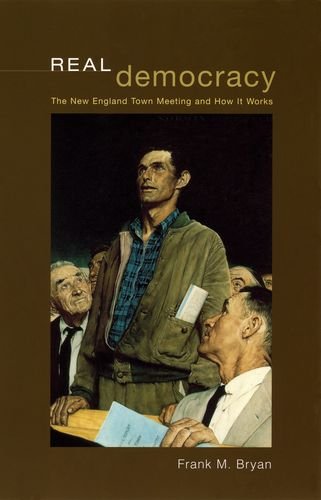
Real Democracy: The New England Town Meeting and How It Works (American Politics and Political Economy Series)
$56.00
by Frank M. Bryan



Relying on an astounding collection of more than three decades of firsthand research, Frank M. Bryan examines one of the purest forms of American democracy, the New England town meeting. At these meetings, usually held once a year, all eligible citizens of the town may become legislators; they meet in face-to-face assemblies, debate the issues on the agenda, and vote on them. And although these meetings are natural laboratories for democracy, very few scholars have systematically investigated them. A nationally recognized expert on this topic, Bryan has now done just that. Studying 1,500 town meetings in his home state of Vermont, he and his students recorded a staggering amount of data about them—238,603 acts of participation by 63,140 citizens in 210 different towns. Drawing on this evidence as well as on evocative "witness" accounts—from casual observers to no lesser a light than Aleksandr Solzhenitsyn—Bryan paints a vivid picture of how real democracy works. Among the many fascinating questions he explores: why attendance varies sharply with town size, how citizens resolve conflicts in open forums, and how men and women behave differently in town meetings. In the end, Bryan interprets this brand of local government to find evidence for its considerable staying power as the most authentic and meaningful form of direct democracy. Giving us a rare glimpse into how democracy works in the real world, Bryan presents here an unorthodox and definitive book on this most cherished of American institutions. "Simultaneously nostalgic and up-to-the-minute. Bryan's book arrives as interest in local civic capital and 'deliberate democracy'—as contrasted with the old-fashioned adversarial style—is surging." -- Christopher Shea ― Boston Globe "And now the irrepressible Bryan has made a major contribution to his field (and his country, which is Vermont) with Real Democracy , his magnum opus, the most searching and sympathetic book ever written about the town meeting democracy of New England. The book is a veritable four-leaf clover of academia: a witty work of political science written from a defiantly rural populist point of view. If the Green Mountains had a face, it would be Frank Bryan. With Real Democracy , he has given his state, and us outlanders as well, the most detailed and affectionate portrait of a town meeting, which is, as Bryan says, 'where you learn to be a good citizen'." -- Bill Kauffman ― The American Conservative Published On: 2004-09-13 "[Bryan] writes tellingly and thoroughly about Vermont's 210 annual town meetings over three decades . . . Bryan employs many of the sophisticated methodologies of political science to demonstrate that the New England town meeting is not merely a traditional method by which early Americans governed themselves. It still works well. . . . Obviously, New England can't be transferred to Iraq and Afghanistan, but its lessons are still relevant." -- Robert I. Rothberg ― Christian Science Monitor "'At a New England town meeting,' Bryan proclaims, '[Adolf Hitler] would have at once been recognized as a flaming jackass and subtly ostracized into impotence.' The serious point buried in his exuberant hyperbole is the lesson at the heart of this immensely readable and valuable book." ― Yankee Magazine Relying on an astounding collection of more than three decades of firsthand research, Frank M. Bryan examines one of the purest forms of American democracy, the New England town meeting. At these meetings, usually held once a year, all eligible citizens of the town may become legislators; they meet in face-to-face assemblies, debate the issues on the agenda, and vote on them. And although these meetings are natural laboratories for democracy, very few scholars have systematically investigated them. A nationally recognized expert on this topic, Bryan has now done just that. Studying 1,500 town meetings in his home state of Vermont, he and his students recorded a staggering amount of data about them—238,603 acts of participation by 63,140 citizens in 210 different towns. Drawing on this evidence as well as on evocative "witness" accounts—from casual observers to no lesser a light than Aleksandr Solzhenitsyn—Bryan paints a vivid picture of how real democracy works. Among the many fascinating questions he explores: why attendance varies sharply with town size, how citizens resolve conflicts in open forums, and how men and women behave differently in town meetings. In the end, Bryan interprets this brand of local government to find evidence for its considerable staying power as the most authentic and meaningful form of direct democracy. Giving us a rare glimpse into how democracy works in the real world, Bryan presents here an unorthodox and definitive book on this most cherished of American institutions. Frank M. Bryan is a professor of political science at the University of Vermont. He is the author, coauthor, or editor of eleven books, including Politics in the Rura