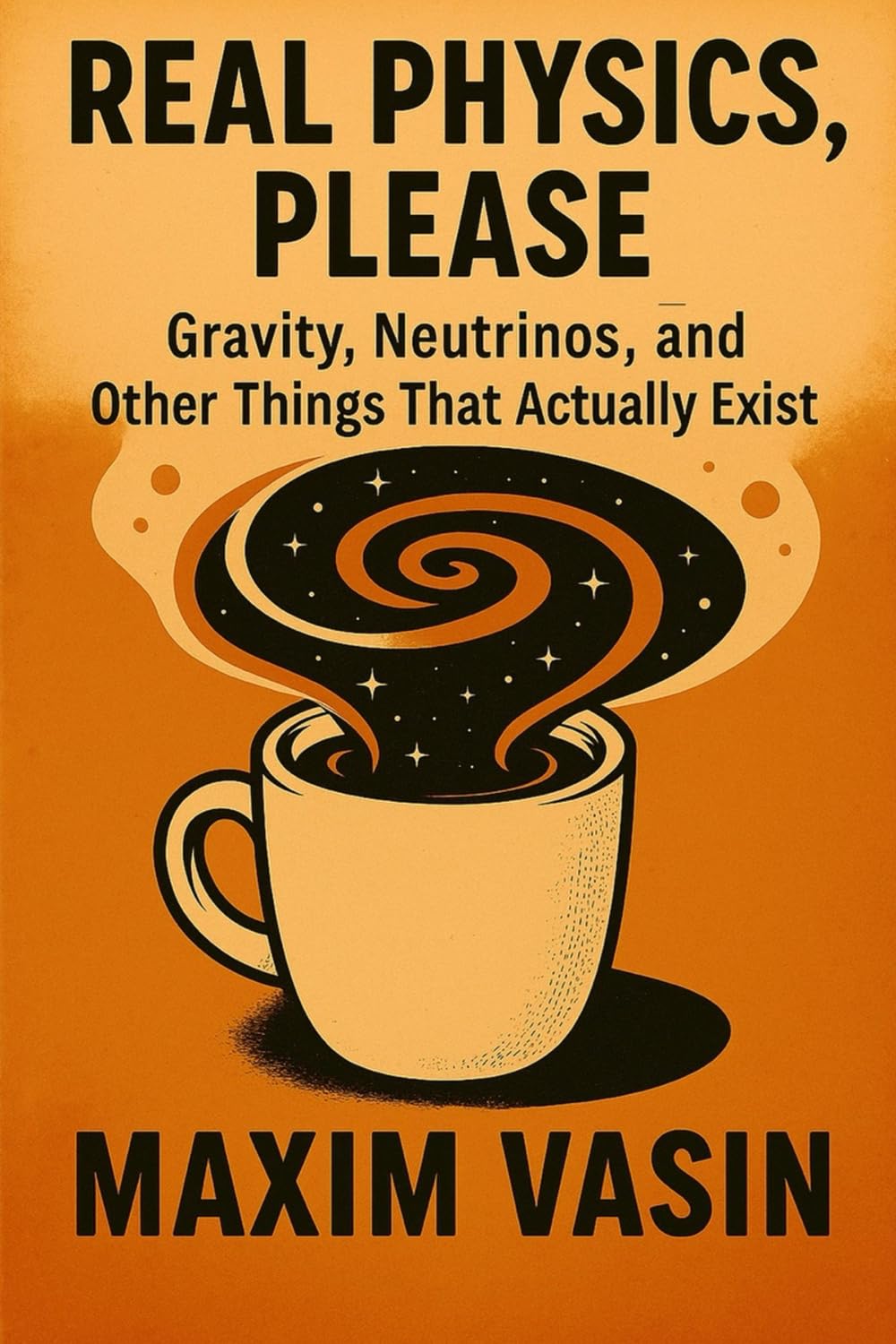
Real Physics, Please: Gravity, Neutrinos, and Other Things That Actually Exist
$14.99
by Maxim Vasin



Real Physics, Please is a clear-eyed tour through the parts of physics that actually tether to reality—gravity, neutrinos, radiation, nuclear structure, and the messy, data-driven business of learning what the Universe is doing. It’s written for curious readers who like big ideas, but who also want those ideas to cash out in something testable, falsifiable, and not held together by vibes. The book opens with a friendly roast of modern physics culture: how elegant stories can harden into dogma, how “consensus” can become a substitute for explanation, and how certain fashionable conjectures survive by being unreasonably hard to disprove. If you enjoy sharp, grounded critique in the spirit of Hossenfelder, Smolin, or Woit—but without the academic throat-clearing—you’ll feel at home. From there, the tone shifts from critique to construction. Chapters 2–5 lay out a coherent alternative framework built from simple mechanical and geometric intuitions. You’ll meet “subtronic” systems—minimal internal structures proposed to underlie familiar particles—and follow the consequences into several domains that are usually treated as separate: radioactive decay, nuclear binding, and the origin and role of the cosmic microwave background. The central theme is that physics should explain not only what equations predict, but what is physically happening, step by step, in terms that can be connected back to observation. Along the way, the book revisits notorious puzzles—energy bookkeeping in cosmology, what “randomness” in decay really means, why some nuclei are stable while others aren’t, and how micro-scale structure might echo into cosmic-scale behaviour. It proposes mechanisms, sketches models, and—crucially—keeps asking: “What would we measure to check this?” You won’t need advanced mathematics to follow the argument, but you will get enough structure to see how the pieces fit and where the claims can be challenged. Chapter 6 is a sketchpad for what comes next: open questions, test ideas, and practical directions for tightening the model—an invitation rather than a verdict. Whether you end up convinced, sceptical, or happily provoked, the goal is the same: to replace hand-waving with handles. If you want wonder without mysticism—physics that treats reality as the boss and theory as the tool—pour a cup and dig in.