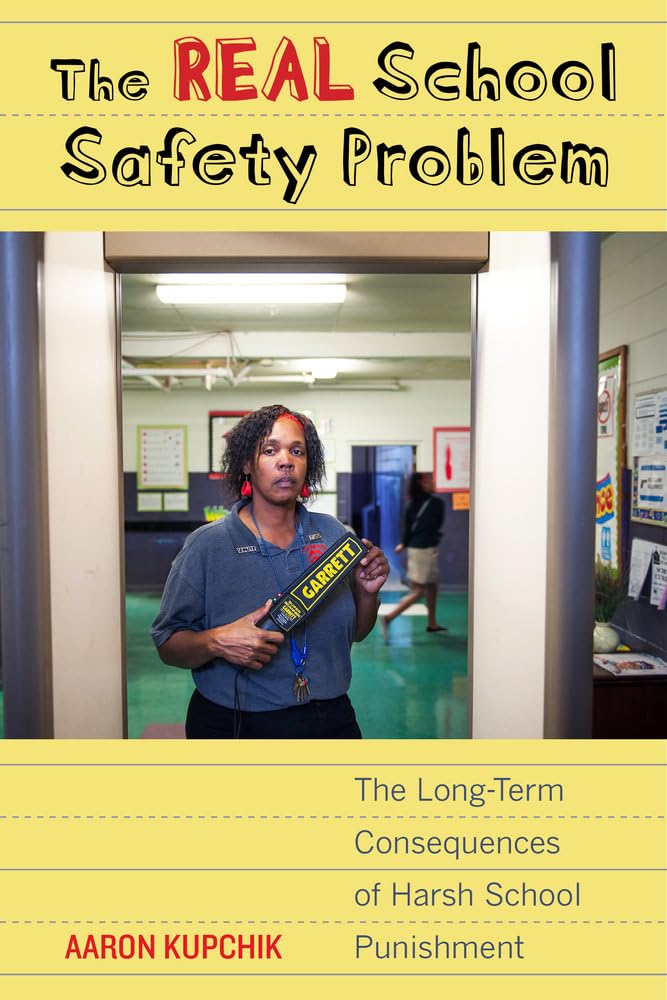
Real School Safety Problem: The Long-Term Consequences of Harsh School Punishment
$12.55
by Aaron Kupchik



Schools across the U.S. look very different today than they did a generation ago. Police officers, drug-sniffing dogs, surveillance cameras, and high suspension rates have become commonplace. The Real School Safety Problem uncovers the unintended but far-reaching effects of harsh school discipline climates. Evidence shows that current school security practices may do more harm than good by broadly affecting the entire family, encouraging less civic participation in adulthood, and garnering future financial costs in the form of high rates of arrests, incarceration, and unemployment. This text presents a blueprint for reform that emphasizes problem-solving and accountability while encouraging the need to implement smarter school policies. "Aaron Kupchik turns our common notions concerning the threat of school violence on their head. . . . this book is best viewed as an introductory conversation about many new ideas concerning the broader harms of excessive school punishment." ― Punishment & Society "In this well-researched and thoughtful analysis, Aaron Kupchik identifies the factors that have contributed to the over-policing of children in schools and offers sensible solutions for keeping children and schools safe. We are living at a time when fear and anxiety exert too much influence over our policies."&;Pedro A. Noguera, Distinguished Professor of Education, Graduate School of Education and Information Studies, University of California, Los Angeles "Professor Kupchik provides a clear and compelling account of what works, and what doesn't, in promoting safer, more equitable schools. In writing that is both grounded in data, and clear and accessible, he challenges the myth that school policing and school exclusion are effective or necessary in maintaining school safety. His work shows us how these approaches harm students of color in particular, and create long-term problems for our schools and society. A must-read book that focuses on the real problem in school safety--the over-reliance on punishment, and the under-reliance on problem-solving and caring."&;Russell J. Skiba, Director, Equity Project, Indiana University Center for Evaluation and Education Policy "In this well-researched and thoughtful analysis, Aaron Kupchik identifies the factors that have contributed to the over-policing of children in schools and offers sensible solutions for keeping children and schools safe. We are living at a time when fear and anxiety exert too much influence over our policies."—Pedro A. Noguera, Distinguished Professor of Education, Graduate School of Education and Information Studies, University of California, Los Angeles "Professor Kupchik provides a clear and compelling account of what works, and what doesn't, in promoting safer, more equitable schools. In writing that is both grounded in data, and clear and accessible, he challenges the myth that school policing and school exclusion are effective or necessary in maintaining school safety. His work shows us how these approaches harm students of color in particular, and create long-term problems for our schools and society. A must-read book that focuses on the real problem in school safety--the over-reliance on punishment, and the under-reliance on problem-solving and caring."—Russell J. Skiba, Director, Equity Project, Indiana University Center for Evaluation and Education Policy Aaron Kupchik is Professor of Sociology and Criminal Justice at the University of Delaware. His previous books include Homeroom Security: School Discipline in an Age of Fear , Judging Juveniles: Prosecuting Adolescents in Adult and Juvenile Courts, and Criminal Courts . The Real School Safety Problem The Long-Term Consequences of Harsh School Punishment By Aaron Kupchik UNIVERSITY OF CALIFORNIA PRESS Copyright © 2016 The Regents of the University of California All rights reserved. ISBN: 978-0-520-28420-3 Contents List of Illustrations, ix, Acknowledgments, xi, 1. Introduction, 1, 2. Effective School Crime Prevention, 19, 3. Extending Inequality, 37, 4. Hurting Families Written with Thomas J. Mowen, 56, 5. How Schools Teach Bullying Written with Katie A. Farina, 73, 6. Civic Participation in the Future Written with Thomas J. Catlaw, 87, 7. Financial Costs of School Security and Punishment, 101, 8. Conclusion, 118, Appendix, 129, Notes, 143, Index, 161, CHAPTER 1 Introduction Schools across the United States are in a school safety crisis. But it's not the one that most might imagine it to be. The crisis is not that our schools are at risk of another mass shooting like those at Columbine or Sandy Hook. And it's not that children are out of control, with violence and theft rampant in schools. Such situations are horrifying (particularly mass shootings) and devastating, and we ought to do what we can to prevent them. But they do not exist at crisis levels. The crisis — the real school safety problem — is that we have im