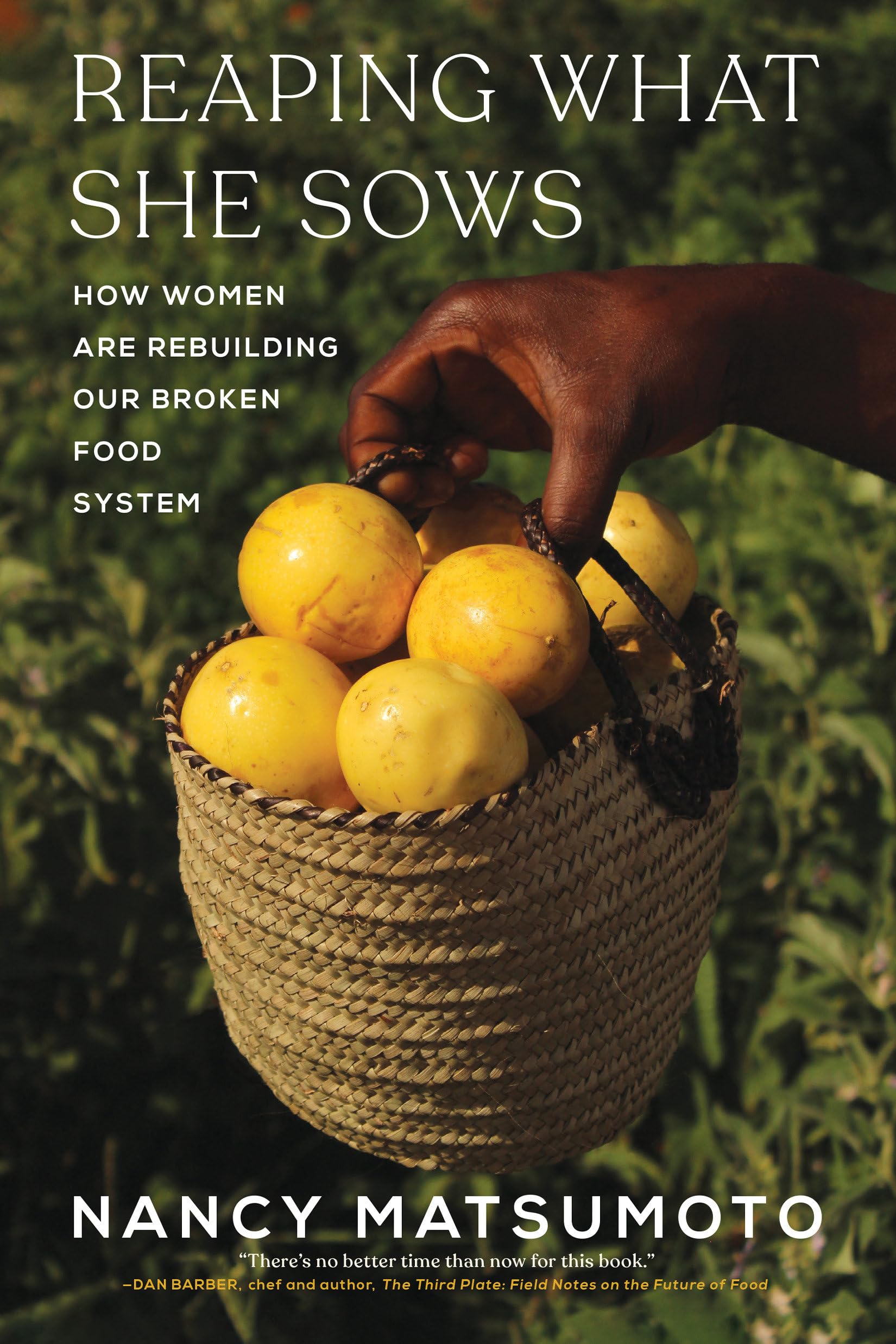
Reaping What She Sows: How Women Are Rebuilding Our Broken Food System
$22.67
by Nancy Matsumoto



A James Beard Award winner celebrates the women heroes who are fighting against the Big Food system—and asks the question: How should we eat? When the Covid-19 pandemic ripped through global food supply chains, it threatened the livelihoods of farmers, created shortages in supermarkets, and revealed a startling truth to consumers: the food system is broken, and large corporations did the breaking. An idea began to take hold–what if we could return to a time when our needs were met by the farmers in our own communities, rather than a commodity, Big Food system that favors profit above all else? With in-depth, on-the-ground reporting, Nancy Matsumoto introduces readers to the women changemakers who are building local and regional supply chains, from the maverick farmers, millers, and bakers bringing back local grain economies; the brewers, distillers, and winemakers who are regenerating land and ecosystems; indigenous and diasporic seed savers, and many more changemakers. Reaping What She Sows offers a blueprint for what eating enjoyably, sustainably, and ethically looks like today. Essential for those who are concerned about climate change, their own health, and the lack of choice and transparency in the global food supply chain. Hello All! I am a James Beard award-winning author who is very excited to tell you about my new book, Reaping What She Sows: How Women are Rebuilding Our Broken Food System . It's due out on October 28, 2025, but available for pre-order now! This is a book I have wanted and needed to write for some time now because of the urgency of its message. If you care about your own and your family's health, the health of the planet, combatting climate change, and feeding the world more fairly and equitably, this book is for you. If you would like to see how women changemakers are leading the way with approaches that are collaborative, innovative, and community based, this book is for you. Reaping is based on more than one hundred interviews I did with women around the world, mostly in North and Central America, who are on the front lines of creating healthier regional and local food systems. You'll meet the women who are re-localizing grainsheds across the land, introducing more delicious and nutritious whole grains into our diets; women who are creating direct markets and short supply chains for small- and medium-sized family fishers, kelp and shellfish farmers; women brewing beer, distilling mezcal and making wine in a way that regenerates rather than depletes ecosystems; and a tight-knit group of New England dairy farmers who are sharing resources and knowledge to establish a humane and healthy pasture-based system. You'll meet indigenous and disaporic seed savers who are trying to bring back biodiversity in an era of Big Seed dominance, and the Southern Black women agricultural leaders who are building on four hundred years of mutual aid and cooperative activity born of necessity. Please pre-order your book now, and stay tuned for updates! Nancy Matsumoto is a Toronto- and New York City-based writer and editor who covers food, agriculture, and the environment. With Michael Tremblay, she is the author of the book Exploring the World of Japanese Craft Sake: Rice, Water, Earth, which won a James Beard Media Award. Her articles have appeared in The Wall Street Journal, NPR, Saveur, Food & Wine, and Civil Eats. INTRODUCTION ON AN EARLY SEPTEMBER AFTERNOON, I stand with Noreen Thomas on the edge of the pancake-flat, twelve-hundred-acre Moorhead, Minnesota, farm that has been in the Thomas family for close to one hundred fifty years. Since being certified organic in 1997, it has produced high-quality organic grains, garden produce, and pasture-raised eggs. Thomas points to the bird habitat buffer she is encouraging with a late-Au- gust hay cutting, which will provide ample protection for ground-nesting meadowlarks. The bright-yellow-bellied birds’ numbers had for years been in steep decline due to loss of habitat and mortality caused by intensive sin- gle-crop farming of corn, soy, or sugar beets, and the chemical fertilizers and pesticides that mode of farming relies on. Today, the birds’ resurgent presence on Doubting Thomas Farms is a sign of ecosystem health. Not only do they add beautiful color and song to the landscape, they are also the first defense against pests such as caterpillars and grasshoppers, keep- ing their numbers in check. In another part of the farm, Thomas shows me a trial field of perennial sunflowers, part of a set of practices that are making the surrounding land and waters healthier and more climate re- silient, and filling a gap in the market after the Russia–Ukraine war made sunflower oil harder to come by. Doubting Thomas is an outlier in Clay County and in Minnesota, where only one percent of farms are certified organic. It is a tiny island of biodiversity in a vast golden sea of genetically modified, chemically treated monocrops that ripp