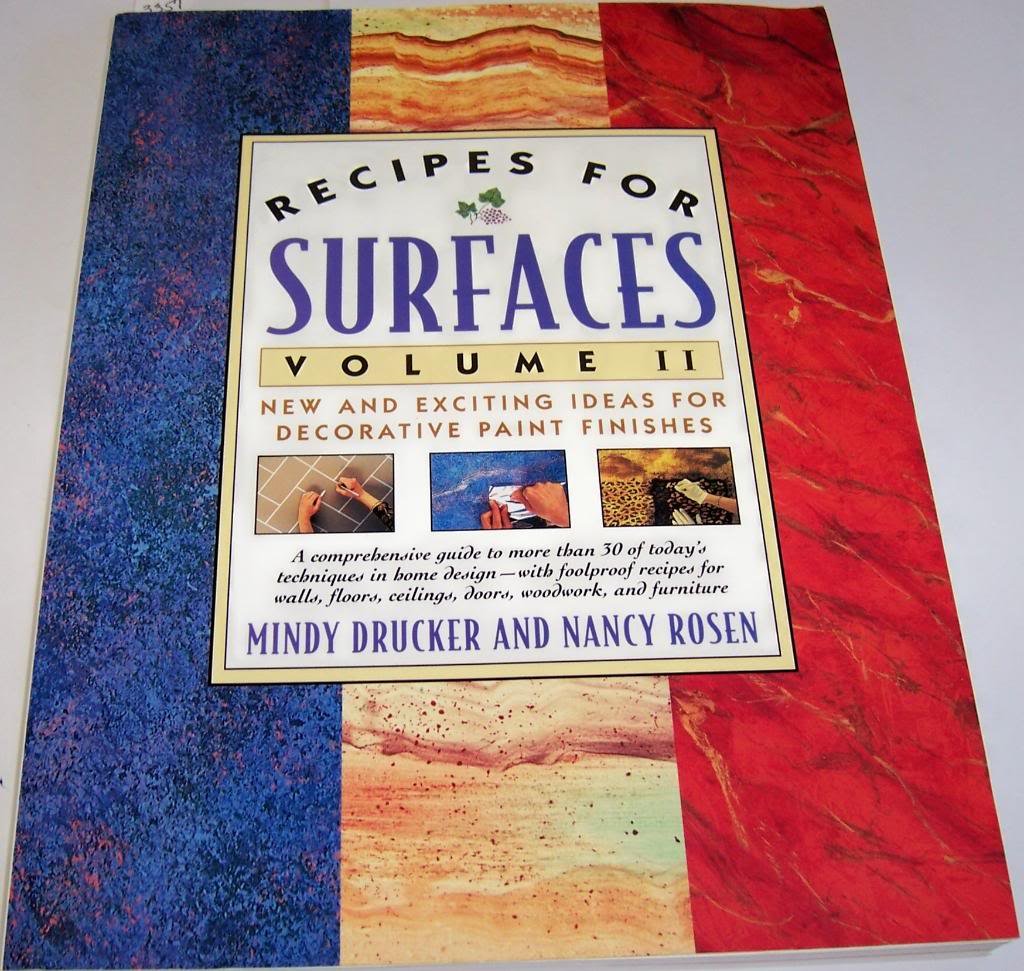
Recipes for Surfaces: Volume II: New and Exciting Ideas for Decorative Paint Finishes
$6.96
by Mindy Drucker



Offering the same clear, step-by-step format that made the first volume a favorite among craftspeople, a guide to decorative painting shows how to transform floors, furniture, and walls into beautiful works of art. Original. 30,000 first printing. BOMC Crafter's Choice, BH&G, & Newbridge Alt. Mindy Drucker co-wrote the original Recipes for Surfaces. She is a freelance wirter specializing in home design and decoration topics. Her work has appeared in Colonial Homes, House Beautiful's Home remodeling, Victoria, and other publications. She lives in New Jersey. CHAPTER ONE COLOR: THE FLAVOR IN EVERY RECIPE Sweet success with decorative painting comes from a mix of many ingredients, but none is more important than color. It's easy to see why. Color can transform the character of a finish, taking it from subtle to bold, traditional to contemporary formal to casual. In the introduction to this book, there are a host of ideas on how to use painted finishes with today's most popular decorating styles. The key to doing this is knowing which hues can help you capture the look and feel of a style. That's how the colors for the finishes in this book were chosen -- based on current design trends, In these pages, you can find the same looks you love in stores and magazines, and then use the color suggestions and guidance supplied to achieve these looks much more affordably. Don't forget that you can also use the "mix-and-match" principle: Maybe a finish you like isn't shown in colors that suit your decor; but another finish is. You can take the formulas for the other finish to the paint store, and have its colors made up for you. Be sure, however, to follow "paint-system" and "paint-consistency" requirements for the recipe you'll execute. (For more on paint systems and consistency, see Chapter Two, Paints and Tools.) There is, of course, no reason to limit yourself to colors pictured here. In fact, the best way to think of all the recipes is as "serving suggestions" much like the recipes you might find on a box of pasta. There are so many variations; we have only scratched the surface of the great array of colors and patterns decorative painting makes available to us. Sometimes, so much choice can be a little unnerving. You're probably well acquainted with the challenge it can be just to pick standard paint colors for a room -- coordinating with elements already in place, dealing with the pressure of knowing you'll have to live with your choice for some time. And even if you narrow your options to safe-and-neutral white, there are all the subtle shades that fall under that heading. With decorative painting, it can be even more challenging. You must pick more than one color for each surface and make sure those colors work well together. To better your odds of successful selection -- whether you plan to buy your paint and glaze ready-mixed or mix them yourself -- it pays to know something about color: the way colors work together, the interior design rules governing them, even how they influence the way you feel. The best place to begin is with a quick look at the concepts known as "color theory" and how they work in interior design. UNDERSTANDING COLOR When it comes to identifying pleasing color schemes, our earliest paint-box lessons still apply: Any hue can be made by combining the three primary colors -- red, yellow, and blue -- plus varying amounts of black and white. By mixing pairs of primaries, you form the three secondary colors: red and yellow make orange; yellow and blue make green; blue and red make violet. Then, by blending the secondaries, you get the tertiaries: olive, for one, which comes from mixing green with violet. Today, however, thanks to technology, we should probably qualify the basic rule to say that almost any color can be created from the primaries. In reality, the more colors you combine, the less vibrant your result will be. So manufacturers now produce a wide range of colors whose brilliance would be hard to match by starting with the primaries. COLOR, HARMONY To grasp the relationships among colors, you can use the color wheel, pictured here. Like the face of a clock, it has 12 parts. You'll find the primary colors at 12 o'clock (yellow), four o'clock (red), and eight o'clock (blue). The secondary colors are at two o'clock (orange), six o'clock (violet), and 10 o'clock (green). In the remaining six spaces are the intermediate colors, so called because they lie between the primary and secondary colors. From the position of colors on the wheel, you can identify harmonious blends. Among recommended combinations are similar colors, such as orange and yellow, which appear near each other on the wheel. Other options are complementary colors, such as red and green, which appear opposite each other. Complementaries serve a special purpose in decorating: They tone each other down to help balance a scheme. A color also blends well with the colors flanking its complem