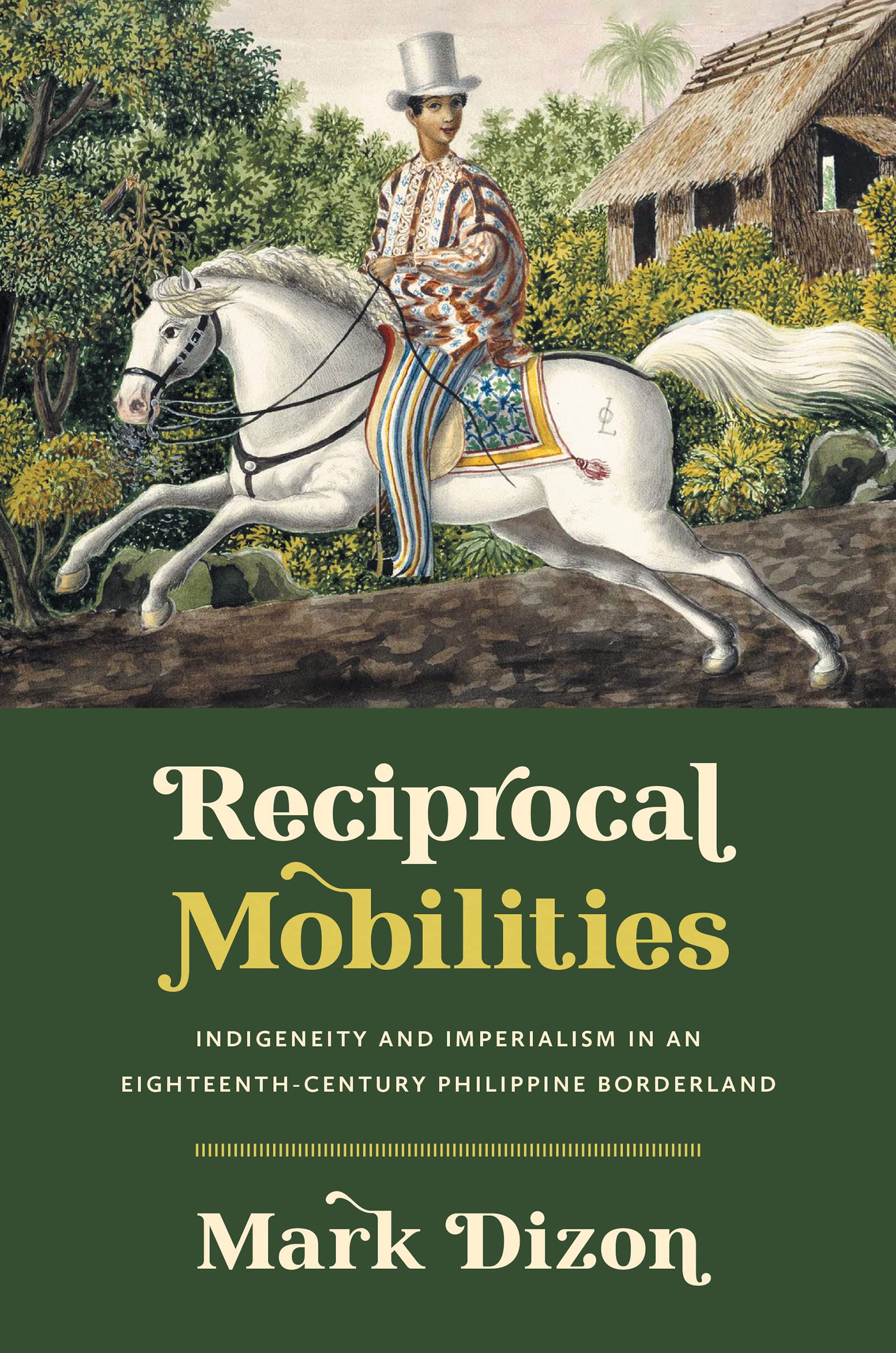
Reciprocal Mobilities: Indigeneity and Imperialism in an Eighteenth-Century Philippine Borderland (The David J. Weber Series in the New Borderlands
$29.95
by Mark Dizon



Throughout the eighteenth century, independent Indigenous people from the borderlands of the Philippines visited the centers of Spanish colonial rule in the archipelago. Their travels are the counternarratives to one-dimensional stories of Spanish conquest of, and Indigenous resistance in, interior frontiers. Indigenous inhabitants on the island of Luzon constantly moved about—visiting allies and launching raids—and thus shaped history in the process. Their mobility allows us to glimpse their agency in colonial interactions in the early modern period. The landscape contains the traces of how they moved as well as how they channeled and impeded mobility in the borderlands. Mark Dizon views the colonial interactions in Philippine borderlands through the lens of reciprocal mobilities. Spanish mobilities of conquests and conversions had their counterpart in Indigenous visits and ambushes. Colonial encounters were not isolated individual events but rather a connected web of approaches, rebuffs, rapprochements, and dispersals. They took place not only in the exploration of remote forests and mountains but also in conjunction with Indigenous travels to colonial cities like Manila. Indigenous people of the borderlands were not immobile, timeless actors; they created history in their wake as they journeyed through the borderlands and beyond. “Meticulously researched and beautifully written. . . . [A]n excellent exploration of the intricate relationships and mobilities that underpinned colonial control in Northern Luzon, with an inspired thematic approach to interconnection at the local level . . . [that] highlights the value of studying geographical spaces that have never before been the central focus of Philippine history and shows how doing so changes our understanding of the colonial period.”— American Historical Review “Any historian of the Philippines will tell you that the farther and higher you get from Manila, and the further back in time you go, the more difficult it is to find the requisite source materials. Mark Dizon has managed to do both. . . . It’s quite an achievement and makes for a very interesting and thought-provoking read.”— Journal of Southeast Asian Studies “Dizon’s pathbreaking book paves the way for a broader and comparative study on borderlands that includes other regions in Southeast Asia and the Philippines.”— Hispanic American Historical Review “Very readable and thoroughly researched. . . . Dizon’s book abounds with examples that highlight the paradoxes, transience, and expediency of a world characterized by borderland mobility. . . . Dizon’s achievement . . . reads the contradictory and oftentimes conflicting accounts of settlement and conversion during this period with nuance, rigor, and originality. It replaces earlier works by William Henry Scott and Felix Keesing as a standard reference for ethnohistory in the colonial period, and it prepares a generation of historians for a broader dialogue that opens up national histories to a larger reflection around the legacies and truncated episodes of empire and globalization.”— Eighteenth Century Studies “By treating mobilities as ‘reciprocal,’ the book aims to challenge the notion of unidirectional conquest by ‘active’ colonizers fanning out to conquer ‘passive’—and stationary—locals. . . . The book is full of illustrative cases of the reciprocal mobilities Dizon is tracking and is written to be easily accessible to a wide readership, from university students to more seasoned researchers.”— Philippine Studies “ Reciprocal Mobilities exemplifies how diplomatic ceremonies and travel practices gave rise to forms of mutual codification, far from a pattern of unilateral submission. . . . Dizon’s study also meticulously traces a series of ways in which local communities adapted to the Spanish presence. . . . [A] rich and stimulating stud[y].”— Mélanges de la Casa de Veláquez “Dizon allows us to see a frontier of the Spanish imperium in a place that is not as commonly studied as the contours of Latin America. This allows us to get a different view of what Spanish colonials might have intended, but also of how local peoples responded to pressures on the land through their own active agency.”—Eric Tagliacozzo, author of In Asian Waters: Oceanic Worlds from Yemen to Yokohama “This book will not only stimulate a reconsideration of the ways power was constructed and re-elaborated in the Philippines during the period of Spanish rule, it will also help to situate the Philippines on the map of borderlands studies.”—Ryan Crewe, author of The Mexican Mission: Indigenous Reconstruction and Mendicant Enterprise in New Spain, 1581–1600 “This book will not only stimulate a reconsideration of the ways power was constructed and re-elaborated in the Philippines during the period of Spanish rule, it will also help to situate the Philippines on the map of borderlands studies.”—Ryan Crewe, author of The Mexican Mission: Indigenous Reconstru