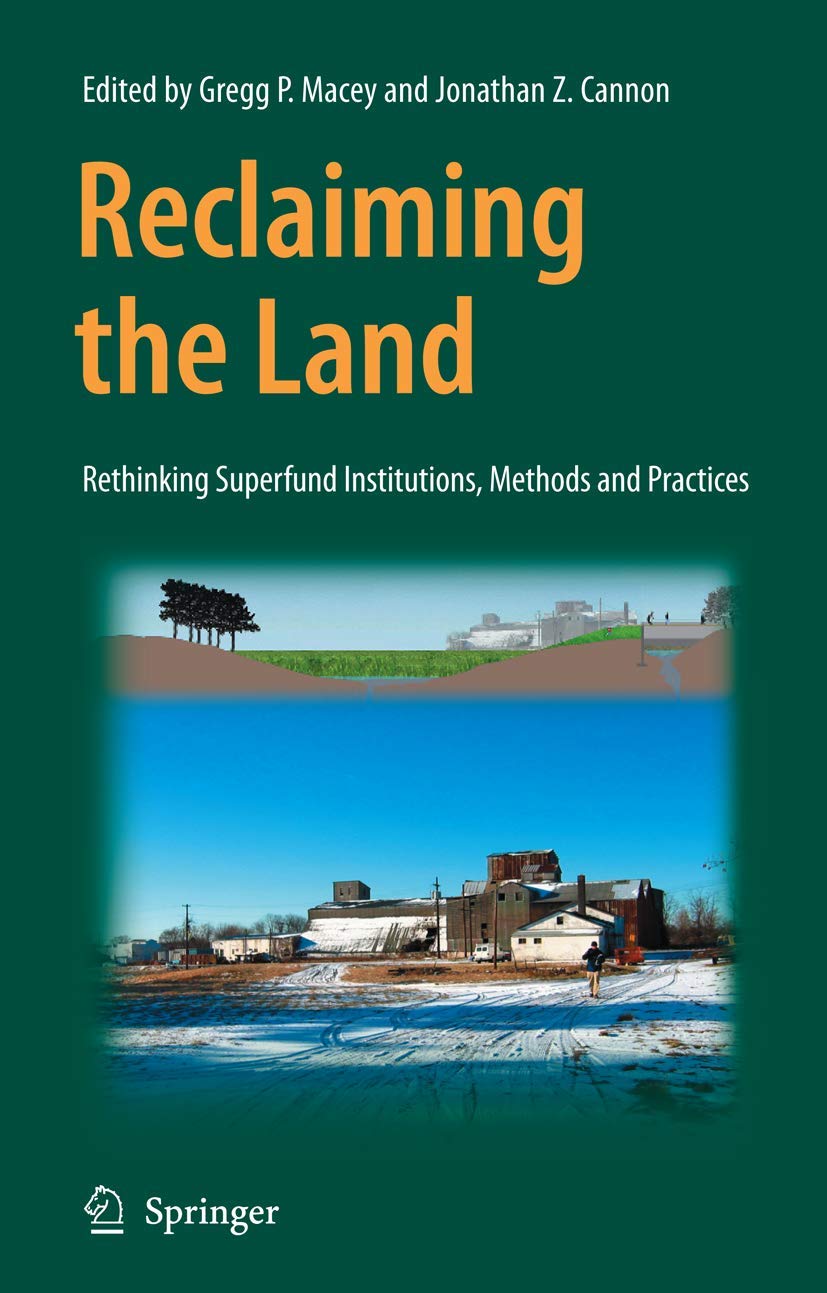
Reclaiming the Land: Rethinking Superfund Institutions, Methods and Practices
$70.89
by Gregg Macey



Marianne Horinko Executive Vice President, Global Environment and Technology Foundation On August 7, 1978, President Carter declared a state of emergency in the community of Love Canal, New York. The President urged residents of Love Canal to evacuate, not because of a recent catastrophic event, but because of something that occurred in the 1940's and 1950's. This Niagara Falls community had been developed on land that was formerly used as a landfill. Although the landfill was closed in 1953, it had been a dumping ground for tons of chemical wastes, and that waste would eventually create an environment extremely dangerous to human health. The image of chemicals seeping into the basements of American homes would produce widespread panic, but would also raise the environmental consciousness of a nation, and produce a legislative response that was equal to the task. Americans celebrated the first Earth Day in April, 1970. Throughout the rest of the decade, we passed legislation intended to fulfill the promise of that day: to create a clean and safe environment. However, there were still holes in our environmental protection in 1978, evidenced by the problems at Love Canal. In response, Congress passed the Comprehensive Environmental Response, Compensation, and Liability Act (CERCLA) or, as many people call it, Superfund. Passed in 1980, this law was intended to address problems like the ones faced at Love Canal. "This excellent collection provides a range of perspectives on making the Superfund program work even better for the American people. The unifying concept of adaptive management offers broad, generally applicable ways of improving cleanup and reuse of many types of contaminated sites." --- Carol M. Browner, Principal, The Albright Group and Former Administrator, United States Environmental Protection Agency "From Love Canal to the present day, no topic has cast a longer shadow across the American environmental landscape than the Superfund program and the challenge of cleaning up toxic waste sites. Reclaiming the Land covers the full range of Superfund issues with both historical perspective and a dynamic set of forward-looking reform proposals. It is essential reading for anyone and everyone in the environmental arena." --- Daniel C. Esty, Professor, Yale University "This book represents the most comprehensive critical analysis of how the Superfund program can remain a relevant and meaningful part of this nation's environmental arsenal. Rather than maintaining the status quo, adapting to the changed conditions in which this vital statute is implemented now and in the future is the only logical way to proceed. We owe it to the communities this law was designed to protect to seriously consider these recommendations." --- Elliott P. Laws, Counsel, Pillsbury Winthrop and Former Assistant Administrator, Solid Waste and Emergency Response, United States Environmental Protection Agency Nearly thirty years after creation of the most advanced and expensive hazardous waste cleanup infrastructure in the world, Reclaiming the Land provides a much-needed lens through which the Superfund program should be assessed and reshaped. Focusing on the lessons of adaptive management, it explores new concepts and tools for the cleanup and reuse of contaminated sites, and for dealing with the uncertainty inherent in long-term site stewardship. Its contributors include scholars and practitioners representing many decades of experience with the Superfund program as well as a variety of disciplines. "This excellent collection provides a range of perspectives on making the Superfund program work even better for the American people. The unifying concept of adaptive management offers broad, generally applicable ways of improving cleanup and reuse of many types of contaminated sites." - Carol M. Browner, Principal, The Albright Group and Former Administrator, United States Environmental Protection Agency "From Love Canal to the present day, no topic has cast a longer shadow across the American environmental landscape than the Superfund program and the challenge of cleaning up toxic waste sites. Reclaiming the Land covers the full range of Superfund issues with both historical perspective and a dynamic set of forward-looking reform proposals. It is essential reading for anyone and everyone in the environmental arena." - Daniel C. Esty, Professor, Yale University "This book represents the most comprehensive critical analysis of how the Superfund program can remain a relevant and meaningful part of this nation's environmental arsenal. Rather than maintaining the status quo, adapting to the changed conditions in which this vital statute is implemented now and in the future is theonly logical way to proceed. We owe it to the communities this law was designed to protect to seriously consider these recommendations." - Elliott P. Laws, Counsel, Pillsbury Winthrop and Former Assistant Administrator, Solid Waste and Emergency Respons