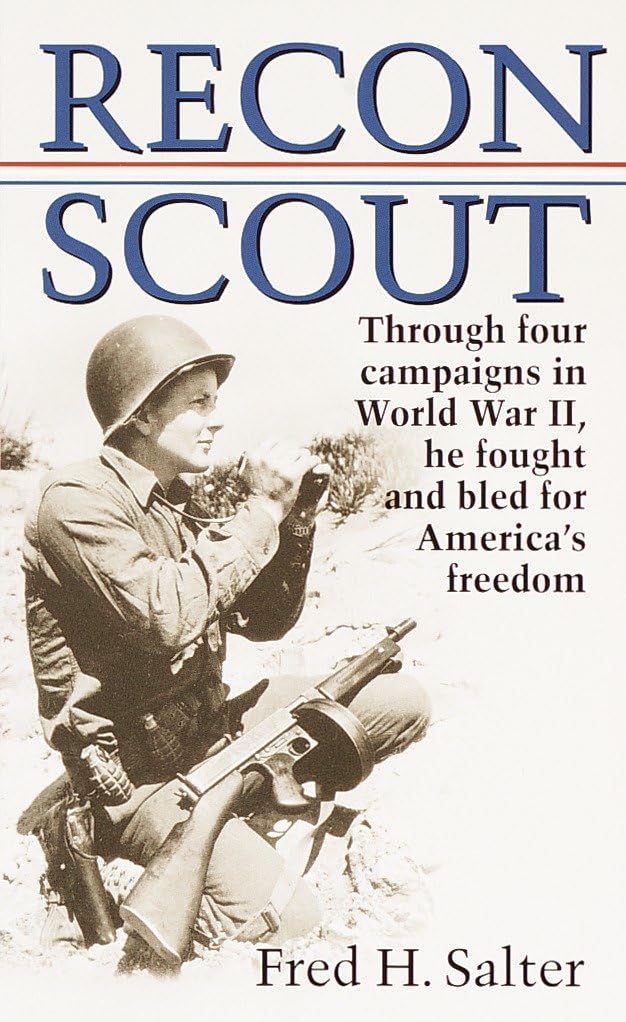



HE LIVED ON THE ABYSS OF DEATH AS A RECON SCOUT IN WORLD WAR II. From Africa’s Sahara Desert, where he met Churchill, to the plains of Tunisia, where he served under Patton, Fred Salter executed daring nightly solo missions, risking his life to gather the vital intelligence the U.S. Army desperately needed. After the battlefields of Sicily came the long, grueling effort to wrench Italy from the grip of the Nazis, and the bloody nightmare of Monte Cassino, the longest battle Americans fought during the war. Salter spares no one, least of all himself, in this tough, clear-eyed account. Refusing to shy away from the horrors and fears of combat, he shares experiences–tragic and glorious–that will haunt him forever. THE ABYSS OF DEATH AS A RECON SCOUT IN WORLD WAR II. From Africa s Sahara Desert, where he met Churchill, to the plains of Tunisia, where he served under Patton, Fred Salter executed daring nightly solo missions, risking his life to gather the vital intelligence the U.S. Army desperately needed. After the battlefields of Sicily came the long, grueling effort to wrench Italy from the grip of the Nazis, and the bloody nightmare of Monte Cassino, the longest battle Americans fought during the war. Salter spares no one, least of all himself, in this tough, clear-eyed account. Refusing to shy away from the horrors and fears of combat, he shares experiences tragic and glorious that will haunt him forever. HE LIVED ON THE ABYSS OF DEATH AS A RECON SCOUT IN WORLD WAR II. From Africa's Sahara Desert, where he met Churchill, to the plains of Tunisia, where he served under Patton, Fred Salter executed daring nightly solo missions, risking his life to gather the vital intelligence the U.S. Army desperately needed. After the battlefields of Sicily came the long, grueling effort to wrench Italy from the grip of the Nazis, and the bloody nightmare of Monte Cassino, the longest battle Americans fought during the war. Salter spares no one, least of all himself, in this tough, clear-eyed account. Refusing to shy away from the horrors and fears of combat, he shares experiences-tragic and glorious-that will haunt him forever. Fred H. Salter led a life after World War II almost as adventurous as the years he spent in the Recon. After wandering through nearly every state and province in the United States and Canada, he married and tried to settle down but to no avail. Eventually the young married couple returned to Fred’s beloved Alaska. When their three sons left home, he and his wife resumed their tumbleweed way of life. To fulfill a boyhood dream, the past few years he has lived on a mountain farm in the Swan Range of the Rocky Mountains, east of Kalispell, in northwest Montana. Every summer, he makes a trek back to his old log cabin on the shores of Auke Bay, Alaska. He still calls Alaska home. Boots and Saddles The muffled sound of their boots on the cobblestones ahead told me it was a German patrol, not being overly cautious, because they were still behind their own lines. I dropped quietly to the gutter and lay prone with my Thompson submachine gun out in front of me. I knew that my buddy George, only a few yards behind me, followed my example. He had been in my squad for three campaigns. Night patrols weren't new to us, they were our way of life. The night being pitch black, I felt secure in the knowledge that the German patrol would pass by without discovering us. As they came directly abreast of our position, I heard their squad leader whisper a few words in German. The squad halted, and they began talking in low tones, as if they were discussing their plans for infiltrating our lines. Even though my face and hands were blackened and my head was covered with a dark wool knit cap, my outstretched hands clutched the Thompson and eased the safety off. At that moment, I noticed the glow of light on my wrist. I felt lit up like a Christmas tree. During the African campaign, I'd taken a beautiful luminous-dialed wristwatch from a Kraut soldier who had no further use for it. This watch was now exposed on my arm. I cherished the timepiece because it could be read so easily on my night patrols. Ordinarily I positioned it higher up on my wrist, concealed beneath the sleeve of my combat jacket. Now, that watch could be the death of me. I was afraid to move a muscle, for fear the trash and dry leaves under my arm would give my position away. I had two alternatives. I could swing my Thompson up fast and hope to get all the Krauts before they became aware we were in the gutter opposite them (this was doubtful), or lie still and hope none of them investigated the shiny fluorescent object in the ditch. We were not on a combat mission, just a two-man recon patrol. Our main objective was to obtain information about the enemy's movements along the Rapido River in front of our sector of Cassino on the 5th Army front in Italy. We'd crossed the river below the ford leading into Cassino from the south, and worked our way t