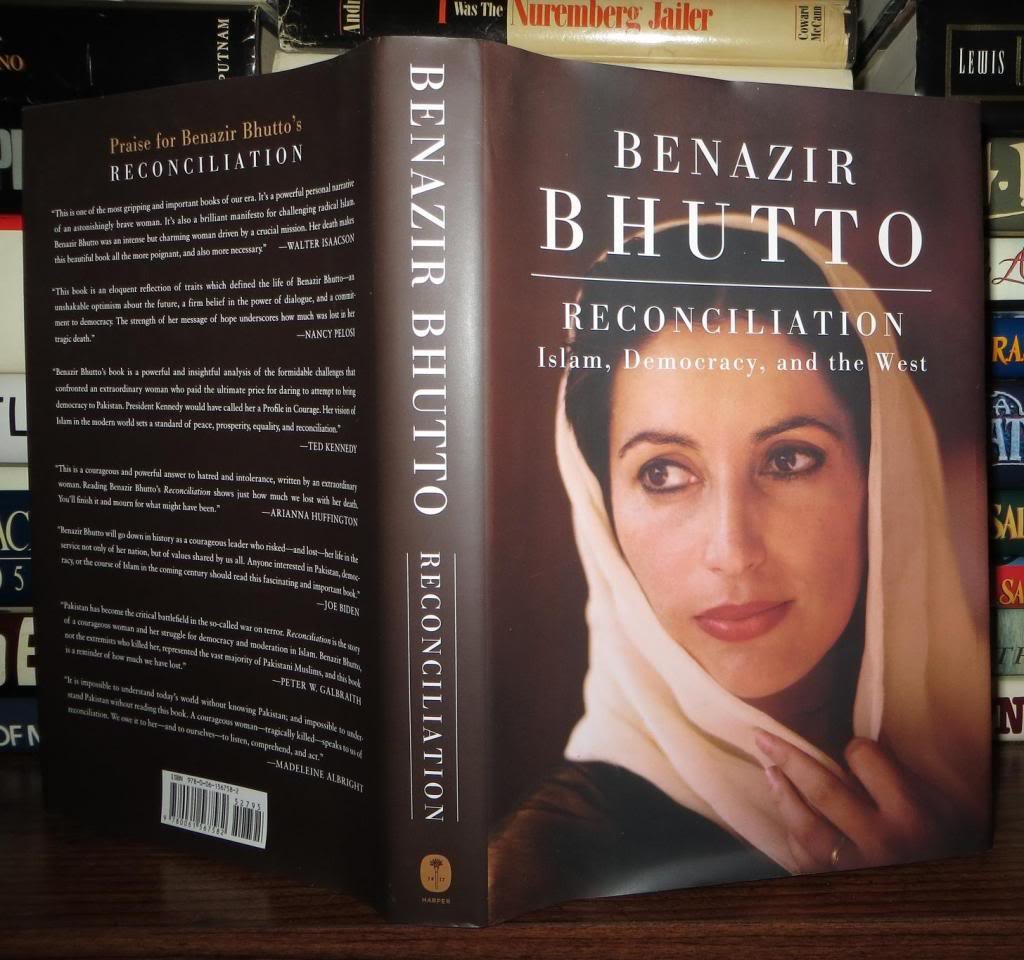



“It is impossible to understand today’s world without knowing Pakistan; and impossible to understand Pakistan without reading this book. A courageous woman—tragically killed—speaks to us of reconciliation. We owe it to her—and to ourselves—to listen, comprehend, and act.” — Madeleine Albright “One of the most gripping and important books of our era.” — Walter Isaacson Benazir Bhutto returned to Pakistan in October 2007, after eight years of exile, hopeful that she could be a catalyst for change. Upon a tumultuous reception, she survived a suicide-bomb attack that killed nearly two hundred of her compatriots. But she continued to forge ahead, with more courage and conviction than ever, since she knew that time was running out—for the future of her nation and for her life. In Reconciliation , Bhutto recounts in gripping detail her final months in Pakistan and offers a bold new agenda for how to stem the tide of Islamic radicalism and to rediscover the values of tolerance and justice that lie at the heart of her religion. She speaks out not just to the West but also to the Muslims across the globe. Bhutto presents an image of modern Islam that defies the negative caricatures often seen in the West. After reading this book, it will become even clearer what the world has lost by her assassination Just days prior to her assassination, the late former prime minister of troubled Pakistan completed the manuscript of this book, which held great personal importance to her. Its importance extends beyond the writer’s own sense of purpose and accomplishment, however, because it is a vastly significant document for anyone seeking to understand the nature of past and contemporary Islam and its current interface with the West. The reconciliation to which the book’s title refers is Bhutto’s chief thesis: “two critical tensions . . . must be reconciled to prevent the clash of civilizations”—the first of these tensions is internal to Islam (extremism vs. moderation) and the second involves Islam’s relations with the non-Islamic world (confrontation or cooperation). Her intense, learned discussion of the concept of jihad, her careful explication of the Qur’an’s true position on women’s equality, and her helpful pointing out of the theological differences between Sunni and Shia Muslims, among other relevant and eloquent analyses, lead her to insist that “democracy and Islam are not only compatible but mutually sustaining.” Within a chapter on the history of the relatively new country of Pakistan lies an autobiographical section in which the author details her terms in office as prime minister and the difficulties she was personally and purposefully handed by her adversaries. This book is an eloquent plea, a passionate admonition, that reconciliation as she has outlined it must indeed occur. --Brad Hooper “Gripping. . . . An urgent warning to her fellow Muslims and to Western democratic powers—a warning one hopes may now find greater resonance with both audiences. . . . A cry from the grave to save her faith, her homeland and East-West realtions from looming catastrophe. . . . Bhutto wrote the book with uncharacteristic bluntness, suggesting an awareness that both she and her country had little time left.” — Washington Post Book World “It is impossible to understand today’s world without knowing Pakistan; and impossible to understand Pakistan without reading this book. A courageous woman—tragically killed—speaks to us of reconciliation. We owe it to her—and to ourselves—to listen, comprehend, and act.” — Madeleine Albright “Benazir Bhutto will go down in history as a courageous leader who risked—and lost—her life in the service not only of her nation, but of values shared by us all. Anyone interested in Pakistan, democracy, or the course of Islam in the coming century should read this fascinating and important book.” — Joe Biden “Benazir Bhutto’s book is a powerful and insightful analysis of the formidable challenges that confronted an extraordinary woman who paid the ultimate price for daring to attempt to bring democracy to Pakistan. President Kennedy would have called her a Profile in Courage. Her vision of Islam in the modern world sets a standard of peace, prosperity, equality, and reconciliation.” — Senator Ted Kennedy “This book is an eloquent reflection of traits which defined the life of Benazir Bhutto—an unshakable optimism about the future, a firm belief in the power of dialogue, and a commitment to democracy.The strength of her message of hope underscores how much was lost in her tragic death.” — Nancy Pelosi “This is one of the most gripping and important books of our era. It’s a powerful personal narrative of an astonishingly brave woman. It’s also a brilliant manifesto for challenging radical Islam. Benazir Bhutto was an intense but charming woman driven by a crucial mission. Her death makes this beautiful book all the more poignant, and also more necessary.” — Walter Isaacson “This is a courageous and pow