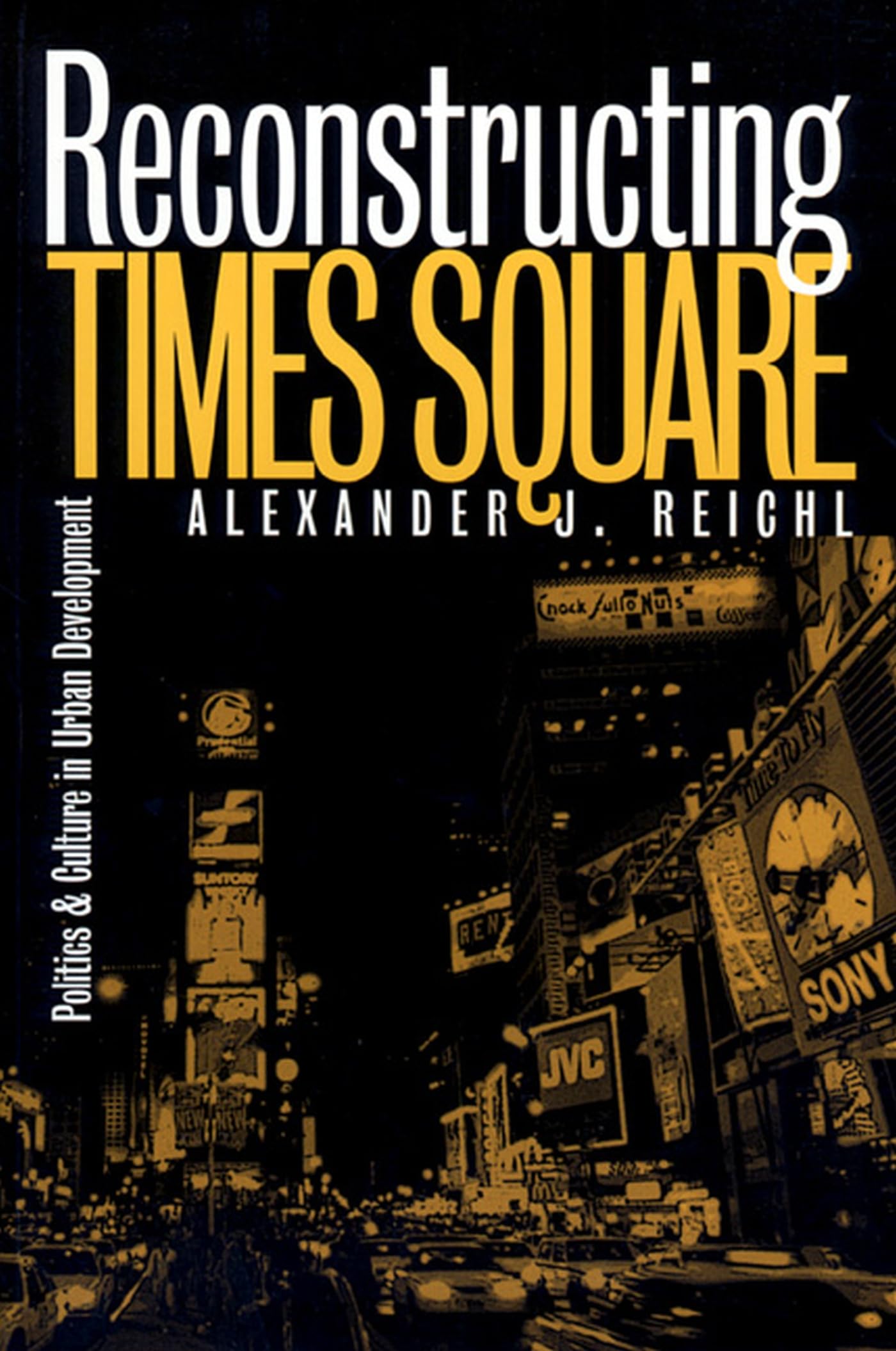
Reconstructing Times Square: Politics and Culture in Urban Development (Studies in Government and Public Policy)
$21.86
by Alexander J. Reichl



Choice Outstanding Title When the big ball drops on New Year’s Eve, thousands are there to witness that great glittering sight, while millions more watch on national television. Times Square may be the cultural hub of America, the “Crossroads of the World,” but its lights have not always shone as brightly as they do now. Once a glamorous theater district, Times Square and 42nd Street had degenerated into a neighborhood known for the winos and sex shops of “Midnight Cowboy” until New York’s business and arts communities stepped in. These advocates of urban revitalization exploited cultural and historic preservation arguments to transform a low-income entertainment district into a Disney-fied tourist mecca. Where Ratso Rizzo once kicked cars and “hookers” plied their trade, Mickey Mouse now greets visitors from atop a Disney superstore surrounded by rising office towers, theaters, and theme restaurants—all thanks to huge tax subsidies and government support. Alexander Reichl tells the fascinating story of how cultural politics and economic greed transformed the city’s physical and social environment with an ongoing multibillion-dollar redevelopment program, changing the district from a symbol of urban decline to one of urban renaissance. He explains the political significance of the historic preservation and arts-related approach to urban revitalization, showing how it was used to appeal to the upscale values of middle-class New Yorkers often hostile to urban renewal. He also examines the role of the Walt Disney Company in the project and demonstrates its power to redefine a premier public space. In telling the story of Times Square, Reichl reveals much about politics and power at the city level and their relationship to the development of urban space. He frames his lively narrative with an illuminating account of how historic preservation initiatives at all government levels have displaced large-scale federal urban renewal programs as the dominant approach to urban development, and he shows the importance of political discourse and cultural politics in mobilizing public support for urban redevelopment. Now that it has been reconfigured for the 21st century, Times Square provides a rich and multifaceted case for exploring the latest trends in urban renewal. Yet Reichl suggests much that has happened here is regrettable: the ousting of low-income citizens to serve commercial interests, the loss of a culturally diverse entertainment district, and the failure to address persistent class- and race-based segregation in a central urban area. By getting to the heart of the Great White Way, Reconstructing Times Square provides an important look at urban renewal—and politics—in a changing America. Using New York City's Times Square in the late 1990s, Reichl (political science, Loyola Univ.) provides insight into the economic, political, and social forces involved in city planning. He finds that Time Square's "reconstruction" has resulted from a collaborative effort of business, government, and community spawned by municipal actions dating back to 1967, during the era of John Lindsay. However, it was not until the administration of Mayor Ed Koch, when political allies and foes joined forces (citing historical preservation and the attraction of the area's being part of the theater district) that the movement to return Times Square to its great past while giving it a clean, modern infrastructure gained strength. This urban revitalization was unique in that corporate sponsors were able to convince the populace that restoring the grandeur of the good old days was the best urban renewal of all. Reichl presents many sociologists' viewpoints in a way that is readable and cogent. Highly recommended for public and academic libraries.AKevin Whalen, Somerset Cty. Lib., Bridgewater, NJ Copyright 1999 Reed Business Information, Inc. "This is a brilliant study of how cultural politics and economic greed combined in both words and deeds to transform the physical and social environment of New York City’s Times Square. Reichl vividly recounts how the city’s business and arts communities formed a novel progrowth coalition under the banner of historic preservation to promote the massive redevelopment of the Times Square/42nd Street district. His insights into the motivations and mechanics that drive such coalitions are powerful, penetrating, and subtle. An important and original contribution to urban political theory."— Richard DeLeon , author of Left Coast City: Progressive Politics in San Francisco, 1975–1991 "Exceptionally well written and a fine contribution to the literature."— Susan Fainstein , author of The City Builder "This is a brilliant study of how cultural politics and economic greed combined in both words and deeds to transform the physical and social environment of New York City's Times Square. Reichl vividly recounts how the city's business and arts communities formed a novel progrowth coalition under the banner of