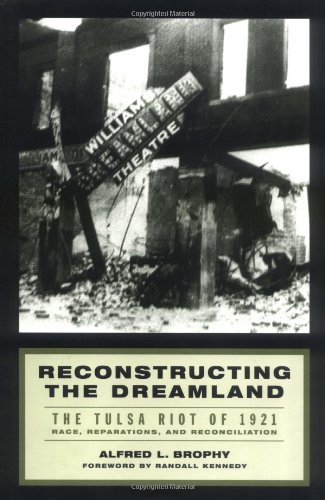
Reconstructing the Dreamland: The Tulsa Race Riot of 1921, Race Reparations, and Reconciliation
$40.33
by Alfred L. Brophy



The 1921 Tulsa Race Riot was the country's bloodiest civil disturbance of the century. Leaving perhaps 150 dead, 30 city blocks burned to the ground, and more than a thousand families homeless, the riot represented an unprecedented breakdown of the rule of law. It reduced the prosperous black community of Greenwood, Oklahoma, to rubble. In Reconstructing the Dreamland , Alfred Brophy draws on his own extensive research into contemporary accounts and court documents to chronicle this devastating riot, showing how and why the rule of law quickly eroded. Brophy offers a gut-wrenching portrait of mob violence and racism run amok, both on the night of the riot and the morning after, when a coordinated sunrise attack, accompanied by airplanes, stormed through Greenwood, torching and looting the community. Equally important, he shows how the city government and police not only permitted the looting, shootings, and burning of Greenwood, but actively participated in it. The police department, fearing that Greenwood was erupting into a "negro uprising" (which Brophy shows was not the case), deputized white citizens haphazardly, gave out guns and badges with little background check, or sent men to hardware stores to arm themselves. Likewise, the Tulsa-based units of the National Guard acted unconstitutionally, arresting every black resident they could find, leaving Greenwood property vulnerable to the white mob, special deputies, and police that followed behind and burned it. Brophy's revelations and stark narrative of the events of 1921 bring to life an incidence of racial violence that until recently lay mostly forgotten. Reconstructing the Dreamland concludes with a discussion of reparations for victims of the riot. That case has implications for other reparations movements, including reparations for slavery. In the spring of 1921, black Oklahomans seeking economic and political equality collided with a white society bent on keeping them down. The result was a devastating attack on the African American quarter of Tulsa called Greenwood, in which hundreds of buildings were destroyed and unknown numbers of people were killed. Legal scholar Alfred Brophy pieces together some of the puzzles surrounding this event, which many Oklahoma officials did their best to hide from history. Indeed, as he remarks, "Tulsa has denied the tragedy for so long that it is easy to forget it ever happened." Brophy examines the role of the police and National Guard in assisting the white attackers, that of the courts in exonerating them and instead attaching blame to the victims, and that of the media in whipping up ethnic hostility. He also asks what can be done, so many years after the fact, to redress past wrongs and "the complete breakdown of the rule of law," and he concludes that reparations are in order. Students of modern American history and of civil rights law will find much to ponder in Brophy's measured account of this shameful episode. --Gregory McNamee One of America's bloodiest civil disturbances is also one of its least known. On May 31,1921, Tulsa's African American community of Greenwood was the site of a violent riot that left more than 30 city blocks burned, thousands homeless, and up to 300 dead. Fearing that a young man was going to be lynched for assaulting a young white woman, members of Tulsa's African American community rallied at the courthouse. Seeing the large body of African Americans, some of whom had guns, in their part of town, whites armed themselves with all the weapons they could muster. A hail of fire erupted, and by the next day the National Guard and a mob of hastily deputized white citizens stormed the African American neighborhood of Greenwood, laying it to waste and incarcerating its residents in camps. These two works each seek to clarify what happened, but they take quite different approaches. Law professor Brophy served on the Tulsa Race Riot Commission, which was charged with determining exactly what happened and whether survivors should receive restitution. His book reflects his work on the commission, focusing on the legal issues surrounding the incident. He asserts that the riot was government-assisted and as such that the victims and their heirs are due compensation. This work fits very well into the growing national debate on reparations. Hirsch, the author of the best-selling Hurricane, seeks a broader audience in his book, which emphasizes events following the riot, including the thwarted attempts to rebuild Greenwood and how Tulsa and Oklahoma sought to come to terms with the riot. Although different in tone and approach, both books are very solid in their research and writing. Each is highly recommended, although Brophy's account will appeal to the more serious reader. Daniel Liestman, Florida Gulf Coast Univ., Ft. Myers Copyright 2002 Reed Business Information, Inc. "Recovers a largely forgotten history of black activism in one of the grimmest periods of race relations, emphasi