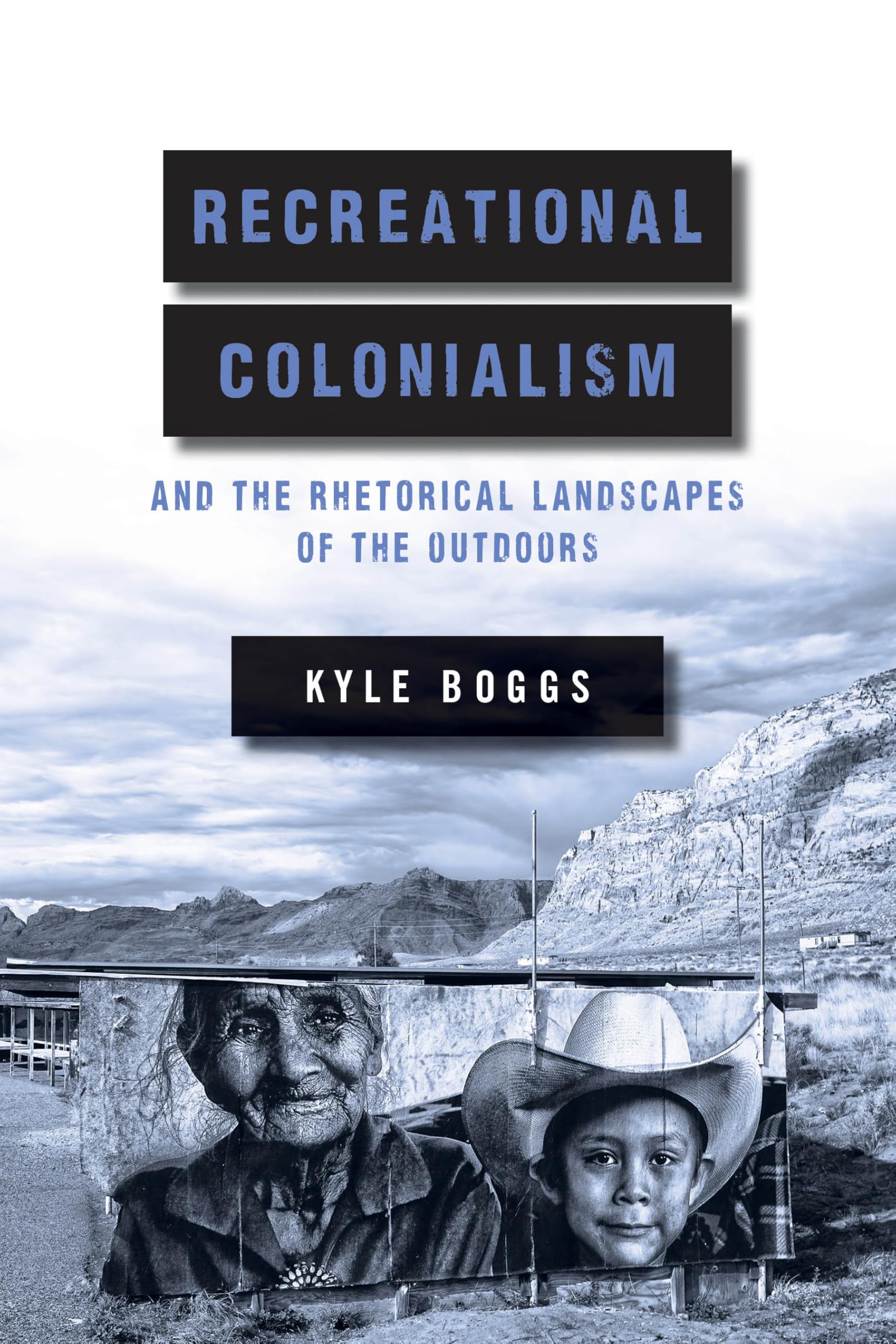
Recreational Colonialism and the Rhetorical Landscapes of the Outdoors
$34.95
by Kyle Boggs



In Recreational Colonialism and the Rhetorical Landscapes of the Outdoors, Kyle Boggs chronicles the struggle between Indigenous peoples who have rooted religious and cultural ties to outdoor sites across the US and elsewhere and the settlers who claim the right to freely recreate in those same places. Synthesizing theories of rhetoric, environmental studies, and settler colonialism, Boggs confronts the ways that settler colonial experiences and expectations have been narrated through rhetorical practices on these so-called public lands. Fusing journalism and personal narrative with scholarly research, Boggs’s argument comes to bear on his central case study of a northern Arizona ski development on a mountain held sacred by at least thirteen Indigenous tribes. In illuminating the striking ways that settler imaginaries are accommodated, performed, and sustained in the everyday, Boggs offers a powerful reminder that even during leisure activities (in this case, sports such as ultrarunning, rock climbing, and skiing), complex webs of power control who can access resources and land and who has the right to protect histories and cultures. “Boggs not only theorizes and critiques a new form of colonialism but also offers pathways, through reflexivity and comradeship, for outdoor enthusiasts to resist colonialism and support Indigenous sovereignty. An essential read for both scholars and practitioners of outdoor recreation.” ―Danielle Endres, author of Nuclear Decolonization: Indigenous Resistance to High-Level Nuclear Waste Siting “ Recreational Colonialism and the Rhetorical Landscapes of the Outdoors is a welcome addition to scholarship on settler colonialism in the US. Boggs doesn’t simply rely on arguments of governance jurisdiction or simple racism but instead interrogates relationships to land and place.” ―Adam J. Barker, author of Making and Breaking Settler Space: Five Centuries of Colonization in North America “Boggs provides a critical but compassionate explanation of the ways in which outdoor recreation and the discourse that surrounds it poses real harm to the rights and perceived legitimacy of Indigenous communities....A thorough and accessible conceptualization of recreational colonialism.” ―Julia B. Goolsby, Cultural Studies “I highly recommend Recreational Colonialism for its persuasive and well-placed critique....It is accessibly written, well argued, and draws together myriad surprising and resonant texts, providing readers with significant sustenance for reflection.” ―Dustin Greenwalt, Critical Studies in Media Communication “Boggs joins an emerging conversation of writers bringing a scholarly lens and critique to outdoor recreation and the industries that support it....His responsible and clearly articulated research methods could serve as an especially useful model for non-Indigenous researchers engaging in any kind of community listening and writing.” ―Joseph Whitson, Journal of Political Ecology “Engaging literatures of settler colonialism and outdoor recreation, Boggs effectively sutures the two to develop a critical framework....his skillful examination fills a gap in prior research even as it lays the groundwork for future scholarship.” ―Samantha Senda-Cook, H-Net Reviews Kyle Boggs is Associate Professor of Rhetoric and Community Engagement in the Department of Humanities and Cultural Studies at Boise State University. “Recreational colonialism” attends to the ways in which place-based belongings are constituted by settler people through outdoor recreation; it also invites us to confront and challenge white supremacy, heteropatriarchy, and capitalism as they have been narrated through rhetorical practices on so-called public lands. I deploy “recreational colonialism” provocatively to disrupt the idea that outdoor recreation is politically innocent or that good intentions somehow counteract the ongoing legacies of settler colonialism which continue to benefit settlers in direct and indirect ways. By forging new connections between material-discursive theories of rhetoric, environmental studies, and settler colonialism, I examine some of the striking ways that settler imaginaries are accommodated, performed, and sustained in the everyday to reveal outdoor recreation and its spaces to be not just recreational but deeply entangled with the ongoing processes of settler colonialism. This book examines the often unarticulated ways in which outdoor recreational discourses function as a new language of colonialism. Some of this language is propagated by the outdoor recreation industry, in promotional materials, websites, and events. Some is woven into the writing of individuals as they recount their outdoor recreational experiences and desires; more is produced through public, legal, and policy driven discourses about controversies that involve outdoor recreation on lands held sacred in different ways by a variety of Indigenous tribes and nations. Part of this language is