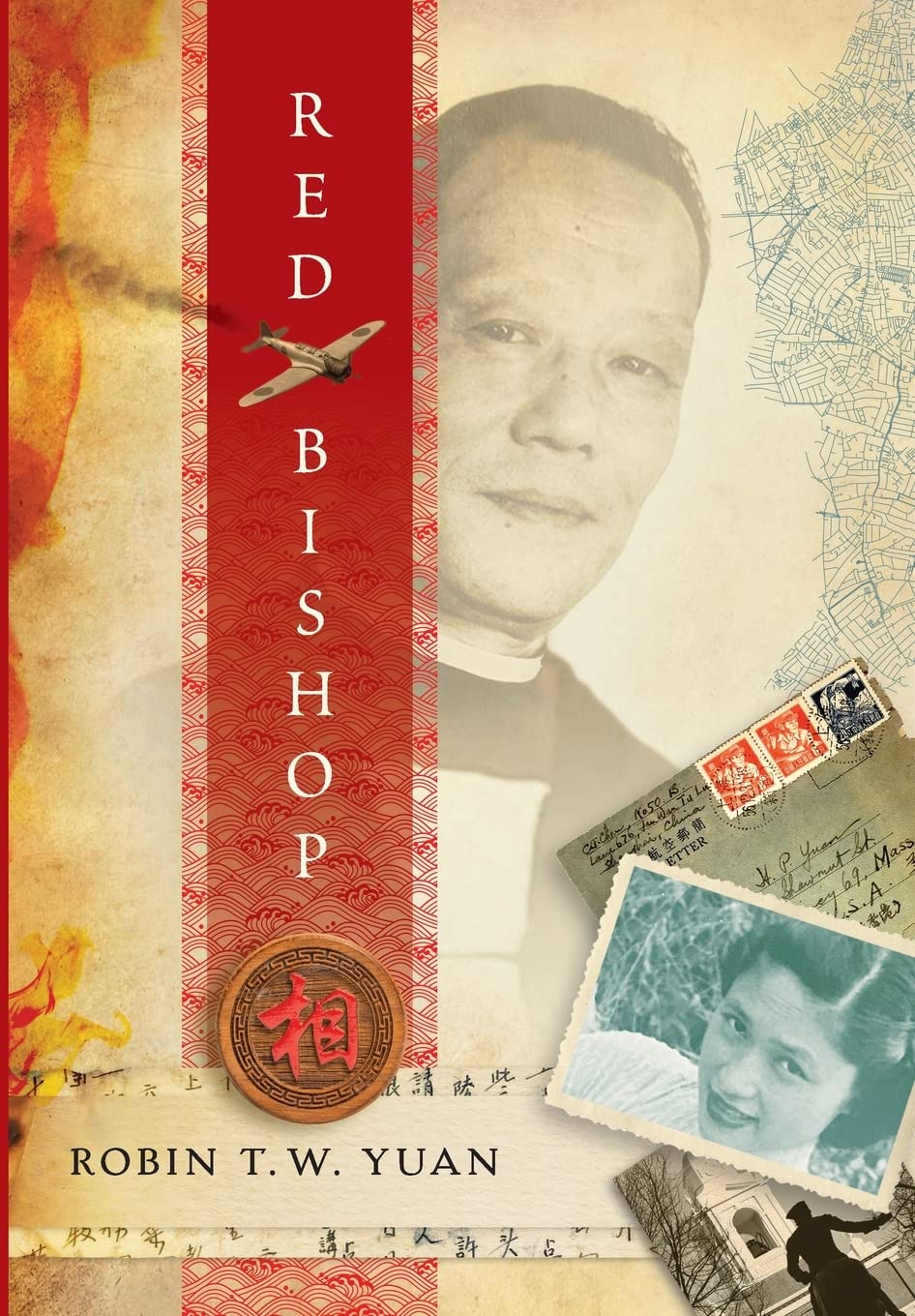



All his Confucian father wanted was for him to avoid common vices of petty gambling and cigarette smoking plaguing idle teenagers and to learn English to ensure a respectable position in Western-dominated, imperial China. The result of this son's conversion to Christianity while attending a mission school is the extraordinary life of Robin Chen, the last Presiding Bishop of the Anglican Church in China, colorfully told in the sweeping historical novel, RED BISHOP. His intricate and intimate story weaves through key historical events in cinematic description from the end of the Qing dynasty, through the Cultural Revolution, and up to the present aftermath. RED BISHOP immerses readers into early 20th century China and recreates the context to its current place in the geopolitical world order while giving life to the personal challenges of the bishop, his family, and the Christian church in China. "A historical novel focuses on the last Anglican bishop in China. In his book, Yuan tells the story of his grandfather Robin Chen, the last presiding bishop of the Anglican Church in China. The author charts Chen's intricate journey, ranging from his early childhood years and his conversion to Christianity as a schoolboy at an Anglican missionary school to his death under house arrest decades later. Using a vast amount of primary documentation, Yuan seeks to provide a more accurate and nuanced picture of the Cultural Revolution than the version found in propaganda periodicals of the time disseminating "idyllic pictures of a communal utopia with caring barefoot doctors, smiling farmers, and singing factory workers." The author lightly dramatizes the lives and struggles of his ancestors, predominantly Chen, whose peaceful and optimistic personality Yuan depicts perfectly throughout the poignant book. Equally well captured is the broader, changing world of 20th-century China, where Chen becomes a Christian leader in an avowedly atheist country. When he's wretched and oppressed, his faith never wavers, and when the government changes and he's suddenly valued (given a car and driver, a private phone in his home, health insurance, and—most importantly—extra coal for the winter), he uses his own money to allow poor children to go to school. Chen's travels in the service of both church and state are rendered in vivid detail. Although Yuan reminds his readers in a postscript that he's writing fiction, the book gives the strong impression of being the best biography Chen will ever get. The novel's blending of personalities and the seething politics of 20th-century China is seamlessly done, and its heroic portrait of its central character is always admiring but never saccharine. A detailed and moving tale about a heroic bishop in atheist China." — Kirkus Reviews "In his self-published book Red Bishop, Robin T. W. Yuan relates the faith journey of his grandfather Robin Chen, the last Presiding Bishop of the Anglican Chung Hua Sheng Kung Hui, and the repercussions for him and his family caught up in the cruel vicissitudes of 20th-century conflict on Chinese soil. Chen was labelled the Red Bishop, because, to ensure freedom of worship for mainland non-Catholic churches, he endorsed the "Christian Manifesto" negotiated with Premier Chou En-Lai. Robin Yuan's mother was the Bishop's elder daughter, Grace, who studied and then settled in the States. In his afterword, the author admits that, although the context is historical, his narrative is enhanced with material formatted to fit the storyline. . . In the 1960s, Han Su-Yin told the stories of her family; in 1991, Jung Chan told hers in Wild Swans. Robin Yuan, in Beverly Hills, now movingly tells his." — Christopher Hall, Church Times "This is an unusual book, both fascinating and compelling. . . because it informs educates, and inspires readers about topics largely unaddressed and/or misunderstood by Westerners. Reliably, readers of Red Bishop will have a much broader and more nuanced understanding of what it means to be Chinese, and of China herself. Indeed, it is written so thoughtfully from a Chinese perspective that the date of Pearl Harbor is written as December 8, 1941 — because that was the date when news of the attack was learned in China. Although the author firmly asserts that his book is a work of fiction, it neither reads, nor feels like fiction. To the contrary, at least for me, it not only is history, but a wonderful combination of anecdotes and details, coupled with a wise and sympathetic portrayal of broad geopolitical themes and trends. Two of the most important themes are: the history of Christianity within an atheistic Communist country; and correspondingly, China's own sociopolitical history — both internally, and in its relationship(s) with the West. Seemingly small acts of grace permeate this work of "creative non-fiction." It was stunning, and evocative, to read of the author's own family throwing away the grass they needed and had collected in order