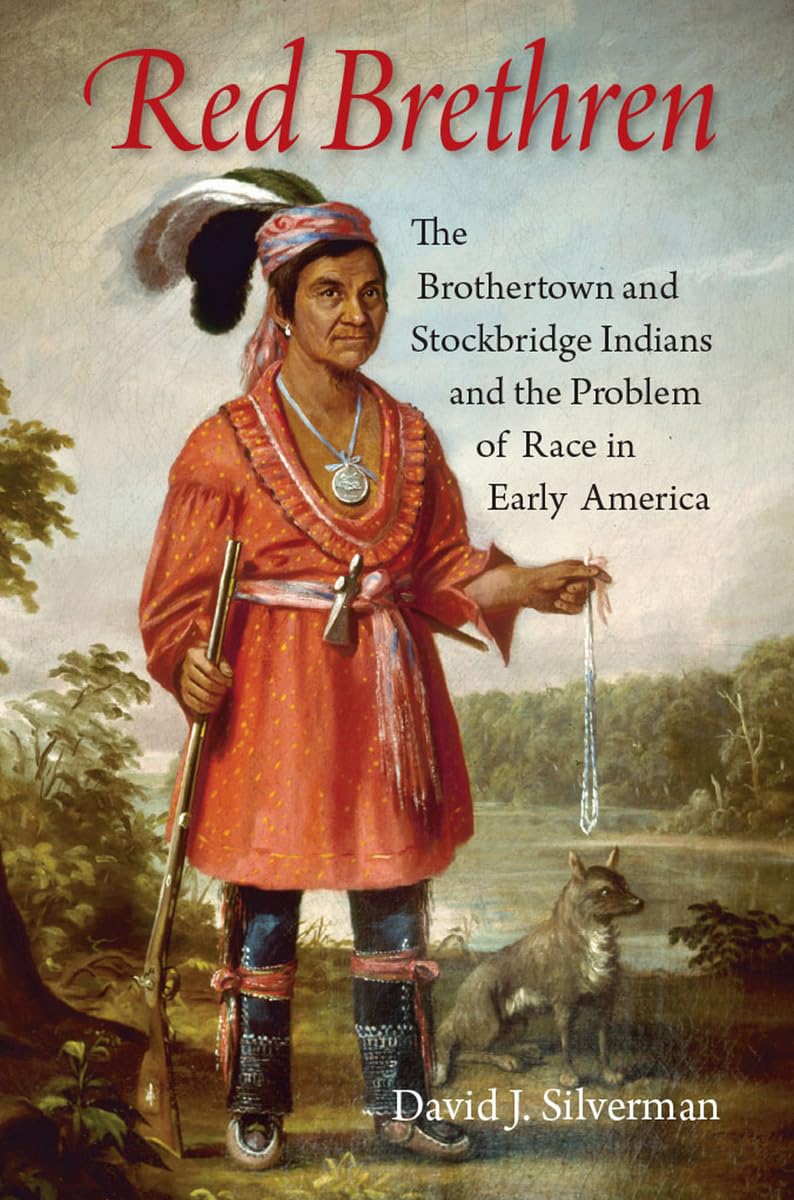
Red Brethren: The Brothertown and Stockbridge Indians and the Problem of Race in Early America
$33.93
by David J. Silverman



New England Indians created the multitribal Brothertown and Stockbridge communities during the eighteenth century with the intent of using Christianity and civilized reforms to cope with white expansion. In Red Brethren , David J. Silverman considers the stories of these communities and argues that Indians in early America were racial thinkers in their own right and that indigenous people rallied together as Indians not only in the context of violent resistance but also in campaigns to adjust peacefully to white dominion. All too often, the Indians discovered that their many concessions to white demands earned them no relief. In the era of the American Revolution, the pressure of white settlements forced the Brothertowns and Stockbridges from New England to Oneida country in upstate New York. During the early nineteenth century, whites forced these Indians from Oneida country, too, until they finally wound up in Wisconsin. Tired of moving, in the 1830s and 1840s, the Brothertowns and Stockbridges became some of the first Indians to accept U.S. citizenship, which they called "becoming white," in the hope that this status would enable them to remain as Indians in Wisconsin. Even then, whites would not leave them alone. Red Brethren traces the evolution of Indian ideas about race under this relentless pressure. In the early seventeenth century, indigenous people did not conceive of themselves as Indian. They sharpened their sense of Indian identity as they realized that Christianity would not bridge their many differences with whites, and as they fought to keep blacks out of their communities. The stories of Brothertown and Stockbridge shed light on the dynamism of Indians' own racial history and the place of Indians in the racial history of early America. By examining the origin and development of race consciousness among the Brothertowns and Stockbridges, David J. Silverman opens a window onto Native explanations of colonialism and its discontents for Indian peoples.... Red Brethren is a concise, well-researched, passionately written case study of the formation of racial identity among two Native groups. Silverman suggests that these northeastern Alongonquian communities' racial identities as Indians emerged from practical struggles―principally the need to resist relentless land pressure―with a strong assist from awakened religion. He is careful not to homogenize the process and draws subtle distinctions in how it unfolded among the Brothertowns and the Stockbridges. But while the development of racial consciousness might not have been uniform across every community, Silverman sees race emerging within particular regional landscapes. Red Brethren invites, and will doubtless reward, close comparison with other studies of race formation among other peoples, not only Indians, throughout early America. ― William and Mary Quarterly David Silverman's Red Brethren is a welcome addition to a growing historiography concerning race in early America. Covering two hundred years, from the middle of the seventeenth century through the 1850s, the book traces the interrelated stories of Brothertown and Stockbridge, two Christian Indian communities that migrated repeatedly, eventually settling in Wisconsin, in order to escape the pressures of Anglo-American expansion. The story that Silverman tells may at first appear to be one of cultural assimilation, for he describes Native peoples converting to Christianity, abandoning traditional subsistence cycles in order to embrace market agriculture, transforming communal land holdings into privately held lots, and even accepting federal citizenship by the mid-nineteenth century. But Silverman in fact illustrates how these actions reflected strategies of resistance in a world that increasingly defined Native peoples as inherently inferior. In essence, Silverman explores how Brothertown and Stockbridge Indians redefined racial ideologies meant to marginalize them while attempting to defend their own self-determination. The result is a wonderfully well-researched, readable, and insightful relation of American Indian history. Red Brethren is an excellent book that offers historical context for understanding the ways in which race undermined tribal sovereignty, unity, and land ownership. Its rich research in primary and secondary sources makes it useful for the expert scholar, and its readable narrative assures that it should find a place in both the undergraduate classroom and on the avocational historian's bookshelf. -- Brad Jarvis ― New England Quarterly In this compelling book David J. Silverman examines two multitribal Christian native groups, the Brothertown and Stockbridge Indians. Silverman's narrative spans two centuries and half a continent as he follows his subjects from the seventeenth century to the nineteenth century, from greater Long Island Sound to western Massachusetts, central New York, and finally the lakeshore of Wisconsin. In doing so, he draw