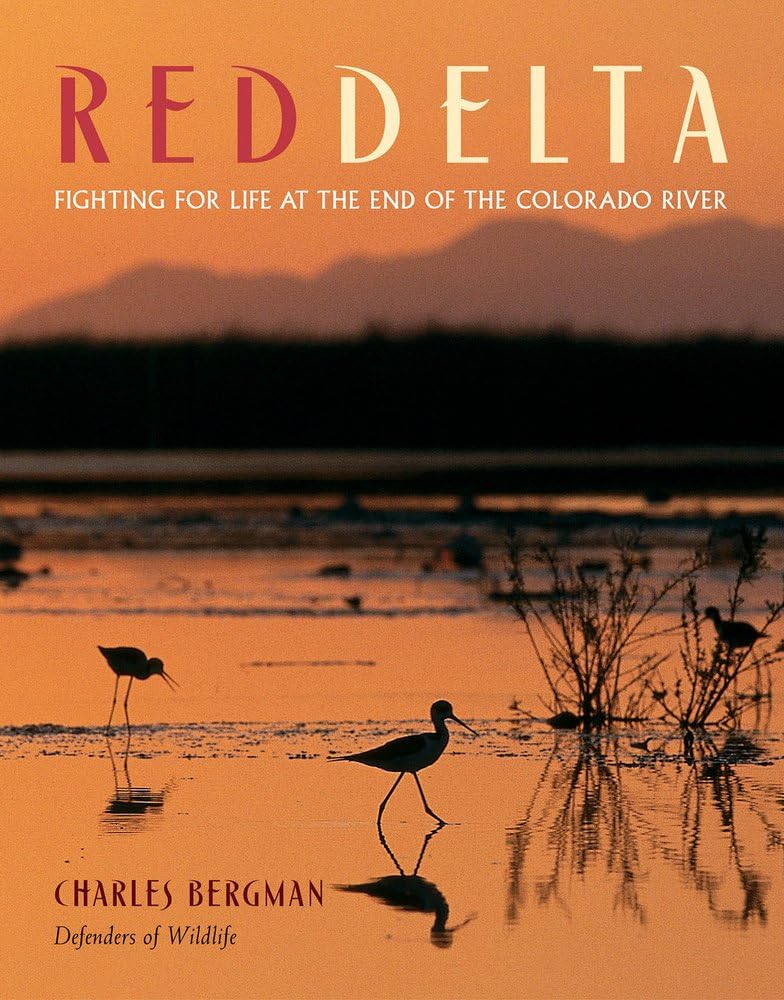



The powerful story of the delta's restored natural diversity with clear information on the "river of law" that governs water allotments to it. Water rights are fiercely protected in the desert American Southwest. In cases such as the Colorado River, which drains into Mexico's Gulf of California, these battles can sometimes trigger international arguments. Since the Water Treaty of 1944, the United States has claimed rights to 90 percent of the Colorado's water, reducing the river to a comparative trickle by the time it reaches Mexican soil and as a result adversely affecting the lush delta region. Academic Bergman (Wild Echoes: Encounters with North America's Most Endangered Species) spent three years studying and photographing the endangered delta. His book, developed with the assistance of the activist group Defenders of Wildlife, creates vivid impressions of the species and habitats of the delta's past and its possibly hopeful future. In the second part, Bergman outlines the legal and political strategies for overturning the Treaty of 1944 and encouraging, instead, laws recognizing that nature is not contained within the artificial boundaries of nations. As he notes, there is scientific evidence that, if water rations were more equitably distributed, the delta would flourish once again. Although his prose is occasionally weighed down by dry facts and figures, the author's passion for the environment and his empathy for the people of the delta shine through the text. This issue is more than just a local squabble, and Bergman's book belongs in all strong in-depth and comprehensive environmental collections Copyright 2002 Reed Business Information, Inc. the author s passion for the environment and his empathy for the people of the delta shine through the text. -- Library Journal, Nov 2002 A Washington State Book Award Winner 2003 Winner of the Benjamin Franklin in Science/Environment Finalist (Research Nonfiction) PEN USA 2003 Literary Awards Charles Bergmanis the author of two previously acclaimed books― Wild Echoes: Encounters with the Most Endangered Animals in North American and Orion’s Legacy: A Cultural History of Man as Hunter. He has written and photographed extensively on nature, and his work has appeared in such journals and magazines asSmithsonian,Audubon,National Geographic, andDefenders. While on a Fulbright Fellowship in Mexico, Mr. Bergman researched the U.S.–Mexico Water Treaty negotiations and other documents relevant to the story of the Mexican Delta of the Colorado River, using untranslated Spanish-language publications from Archivo Historico del Agua in Mexico, D.F. Mr. Bergman is a professor of English at Pacific Lutheran University and lives in Steilacoom, Washington. Excerpt from Introduction The small plane looks like a bee, painted brown and yellow. The paint is fading but the single engine is strong. It s a workhorse plane, a 1956 Cessna 182, Sandy Lanham s been flying for years. She is fifty-three "a good age," she says has brown hair and eyes, and prefers a mirror with a light coat of dust. It softens the focus, she says. She calls herself an environmental pilot and describes what she does as "flying to protect wildlife and save ground including the sea." It means she has has dedicated herself to helping researchers and environmentalists study wild regions along the border in the arid Southwest and throughout Mexico. Because she is enormously skilled and provides her services at reasonable rates flying can be very expensive Sandy is famous among researchers and conservationists in the region. She doesn t fly to get rich. She lives in a strawbale house in a canyon outside Tucson, which she says "boosts her soul" and gives reasons to feel grateful. She does it because "the work matters." She raises money and then makes research flights. Through her surveys she helps protect shorebirds and jaguars, pronghorn antelope and clams, blue whales and "All things big and small," she says. Recently the quality and value of her life of work, studying and protecting and Mexico, has been recognized with a MacArthur Fellowship, a "genius grant," which will help support her work. Sandy has been intimately involved in the new effort to study and restore the delta of the Colorado River in Mexico. She has helped researchers create a new map and a new attitude for one of the most neglected and abused landscapes in North America. She and I have been flying over the delta for a couple of hours already. She rolls the plane deftly into a tight turn. It bellies heavily into the sun-yellow morning air, and we begin a thrilling spiral upward into the sky. She wants to give me a wider view of the delta, which lies below us like a vast bowl between the Sonoran Desert to the east and the mountains on the Baja Peninsula to the west. In the south, the head of the Gulf of California gleams in the reflected desert sun, and hundreds of thousands of acres of farmlands stretch northward from Mexico into Cal