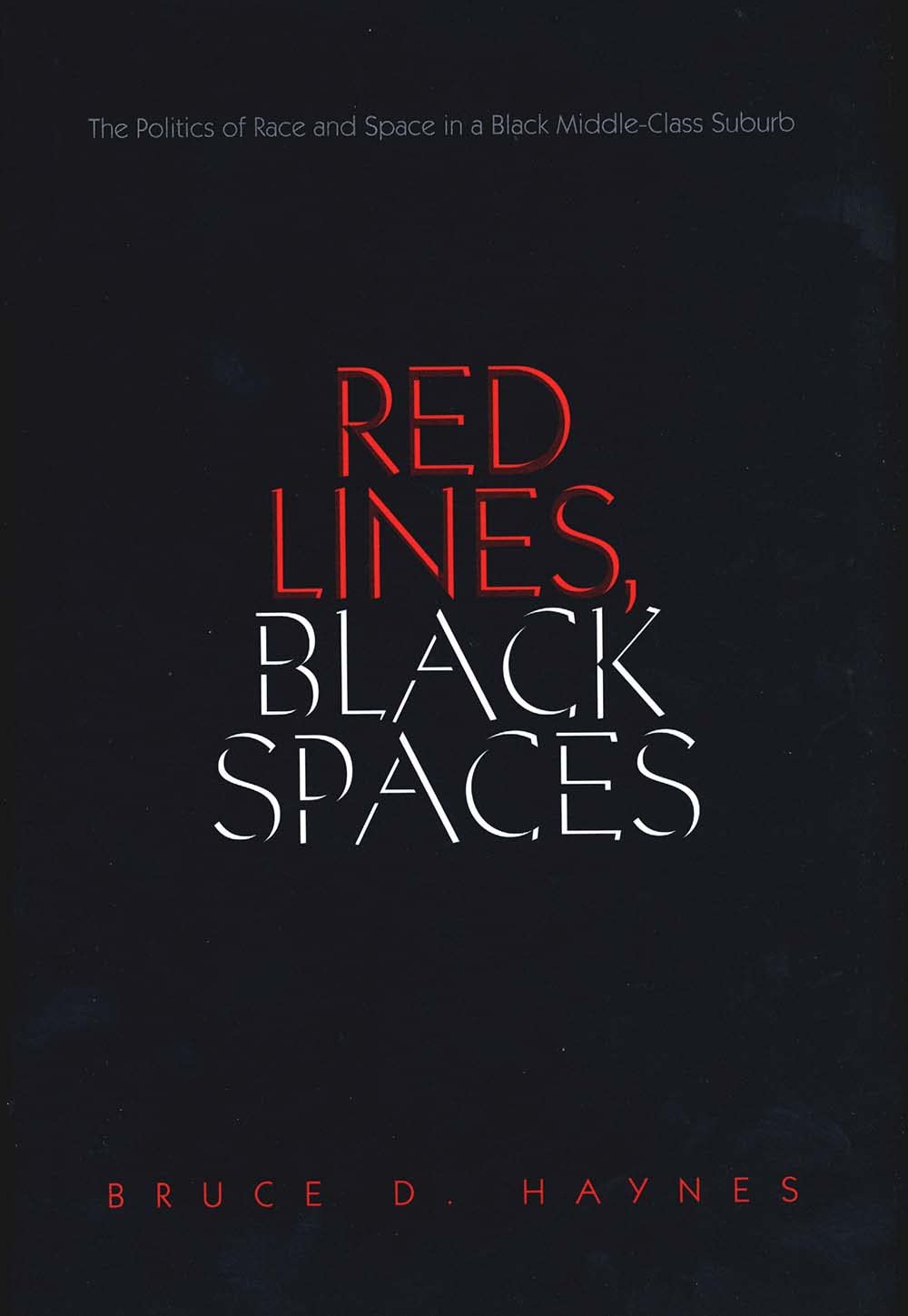
Red Lines, Black Spaces: The Politics of Race and Space in a Black Middle-Class Suburb
$21.00
by Bruce D Haynes



Runyon Heights a community in Yonkers New York has been populated by middle-class African Americans for nearly a century. This book--the first history of a black middle-class community--tells the story of Runyon Heights which sheds light on the process of black suburbanization and the ways in which residential development in the suburbs has been shaped by race and class. Relying on both interviews with residents and archival research Bruce D. Haynes describes the progressive stages in the life of the community and its inhabitants and the factors that enabled it to form in the first place and to develop solidarity identity and political consciousness. He shows how residents came to recognize common political interests within the community how racial consciousness provided an axis for social solidarity as well as partial insulation from racial slights and how the suburb afforded these middle-class residents a degree of physical and social distance from the ghetto. As Haynes explores the history of Runyon Heights we learn the ways in which its black middle class dealt with the tensions between the political interests of race and the material interests of class. Bruce D. Haynes is assistant professor of sociology at the University of California-Davis. Red Lines, Black Spaces The Politics of Race & Space in a Black Middle-Class Suburb By Bruce D. Haynes Yale University Press Copyright © 2006 Bruce D. Haynes All right reserved. ISBN: 9780300124545 Chapter One Race and Place in Industrial Yonkers Beginning in the middle of the nineteenth century, Yonkers experienceda period of unprecedented industrial expansion that affected both population growth and future residential development. It became a city of immigrants and migrants in search of work. During the second half of thenineteenth century, a racialization of Yonkers' housing and employmentmarkets took place; the development of black residential concentrationsamong both the working class and the middle class paved the way notonly for the formation of the so-called Negro ghetto in southwest Yonkers (Getty Square) but also for the east-side black home-owning communitythat would come to be known as Nepperhan. In Nepperhan, residents were brought together by both racial statusand class position: in the housing market, race determined which housingwas available, while class position determined residents' ability to purchase property. The development of segregated suburban housing marketslinked race and class in contemporary geographic space, creating andreinforcing racially based group boundaries. Transportation and Industrial Growth in Yonkers The industrial development of Westchester County was made possibleby advances in urban transportation in the 1840s. Jackson (1985) describes how the steam ferry, the omnibus, the horse car, the commuterrailroad, and later the cable car transformed the landscape of Americancities in the nineteenth century, allowing both people and freight to travel greater distances in a working day. East-Coast cities developed primarily along waterways. Situated onthe banks of the Hudson River and bordering the northwestern end ofNew York City, Yonkers was uniquely placed to take advantage of the advances of the nineteenth and early twentieth centuries in industry andtransportation. To the north, Yonkers adjoins the village of Hastings-on-Hudson and the town of Greenburg; to the east, the Bronx River. By the 1840s, regular ferry service carrying passengers and freight between New York and Yonkers promoted the expansion of industry andpopulation. River travel by steamboat was slow and costly, however, andwas thus restricted to well-to-do commuters. Cheaper, more efficienttransportation would be a prerequisite to working- and middle-class residential expansion away from the waterways and downtown industries. Before industrialization, farming was the main occupation for localworkers. Oats, wheat, hay, peaches, apples, potatoes, walnuts, pickles,chestnuts, and corn were produced locally and shipped to New York Cityalong the Hudson (Johnson and others 1962, 19). During the early nineteenth century, once extensive water power became available, Yonkersinaugurated light manufacturing, to make use of the extensive waterpower available. Beginning in the 1840s, the growth of railroads and of local industrycoincided with the arrival of two distinct groups of people in the burgeoning area: wealthy industrialists, who began purchasing vast tracts of farmland outside the central village, on which they built country estates, andskilled and unskilled laborers, most of them immigrants from southernand eastern Europe, who found work in local industry. Until the end of the nineteenth century, Yonkers was a walking city.Most industrial workers lived in the downtown areas, close to their workplaces. Commuting was a time-consuming as well as an expensive affair,and many local estates were built to serve as summer "country" homes.Tho