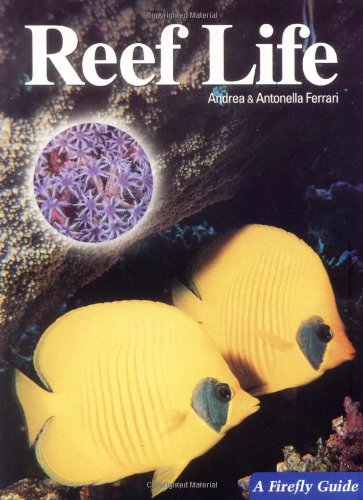



Nowhere on earth is there a more beautiful and more abundant life than that which exists on the coral reefs just below the surface of the ocean. Reef Life is filled with information and images that brings order to the multitude of living things that exist here and allows the reader to appreciate the diversity and the richness of the world under the sea. This handy guidebook will prove invaluable to the diver, tourist, student and naturalist. Each species of plant and animal is covered in detail: name, species, habitat, food, range, and a thorough description is provided for each entry. More than 400 species are covered and illustrated with 500 color photographs to provide a comprehensive look at this most magnificent world. This is an ideal book for anyone interested in marine life. It provides up-to-date information, clear color photographs in a handy format for use in the field or at a desk. Readers who need essential facts quickly will be pleased with the orderly presentation of information, the completeness of the entries and the accuracy of the information. The color photographs help in identifying species as well as providing a visual reference for the information presented. Reef Life is an ideal guide and reference for all levels of interest from school project to professional divers. Outrageous in color and form, the beasts that live in and around the reefs are captured in photographs on the pages of Reef Life. ( American Scientist 2002-08-15) Packed with color and go a little beyond the basic identification guides by looking at some issues ... and the complexity of ecosystems. (Sharon Wootton Everett Herald 2002-05-25) For those interested in learning about coral reefs and the "inexhaustible bustle of innumerable creatures in every shape and color," this guide is the ticket. (Robert E. Hoopes Wildlife Activist ) The sea equivalent of a Peterson Field Guide for birders. Keep in the galley. ( Ontario Sailor ) Although small in size, this work can compete with the most beautiful coffee-table book. (Robert J. Beyers Science Books and Films 2003-04-15) A visual delight full of photographs of brightly, even outrageously colored, species. (Elaine F. Jurries American Reference Book Annual ) Based in Italy but working around the globe, Andrea and Antonella Ferrari have been professional nature photographers for more than fifteen years. During the past decade they have devoted themselves almost exclusively to underwater photography in tropical seas. They are the authors of four books of photographs and their work has appeared in many newspapers and magazines. The Coral Reef The coral reef is an ecosystem without equal anywhere in the world. No other environment -- not even the densest tropical rain forest -- can convey so immediately such an impression of riches and vitality as is typical of an undisturbed and healthy reef. The transparency of tropical waters, their high luminosity at great depths, the inexhaustible bustle of innumerable creatures in every shape and color, the surprising and extremely delicate architecture of madreporic colonies never fail to astonish and fascinate even the most widely traveled observers. The first traces of coral reefs date back more than 500 million years. Their distribution is remarkably varied over time, responsive in turn to phases of great geographic expansion and contraction following climatic changes that occurred during the different geologic eras. Today the distribution of reefs is limited to tropical seas, where reefs extend over a total area of nearly 600,000 square kilometers (232,000 square miles). Coral formations develop primarily between the surface and a depth of 30 m (100 ft) but only in waters whose average winter temperature stays above 20°C (68°F). Other factors that limit the development of coral reefs are water salinity, which must be constant, and the intensity of ambient light. Why are these three factors -- temperature, salinity and sunny exposure -- so important? If we think carefully about the reef environment, we quickly realize that the structural elements that underlie this ecosystem -- those that help determine its appearance -- are the so-called corals or, more correctly, madreporic colonies. These are admirably complex structures whose imperceptible growth and extraordinary fragility represent the very foundation of the reef habitat. At the simplest level, these coelenterate organisms can be described as countless tiny polyps (simple gelatinous "sacs" with an opening on top, ringed by tentacles) consolidated into a hard and fragile calcareous structure built by the organisms themselves: an exoskeleton (external skeleton) whose often bizarre but always functional shapes create the scenery of the reef. There are hermatypic corals that are able to build reefs slowly as the colonies expand and propagate themselves and ahermatypic corals, whose flexible framework does not tend itself to composite structures (like go