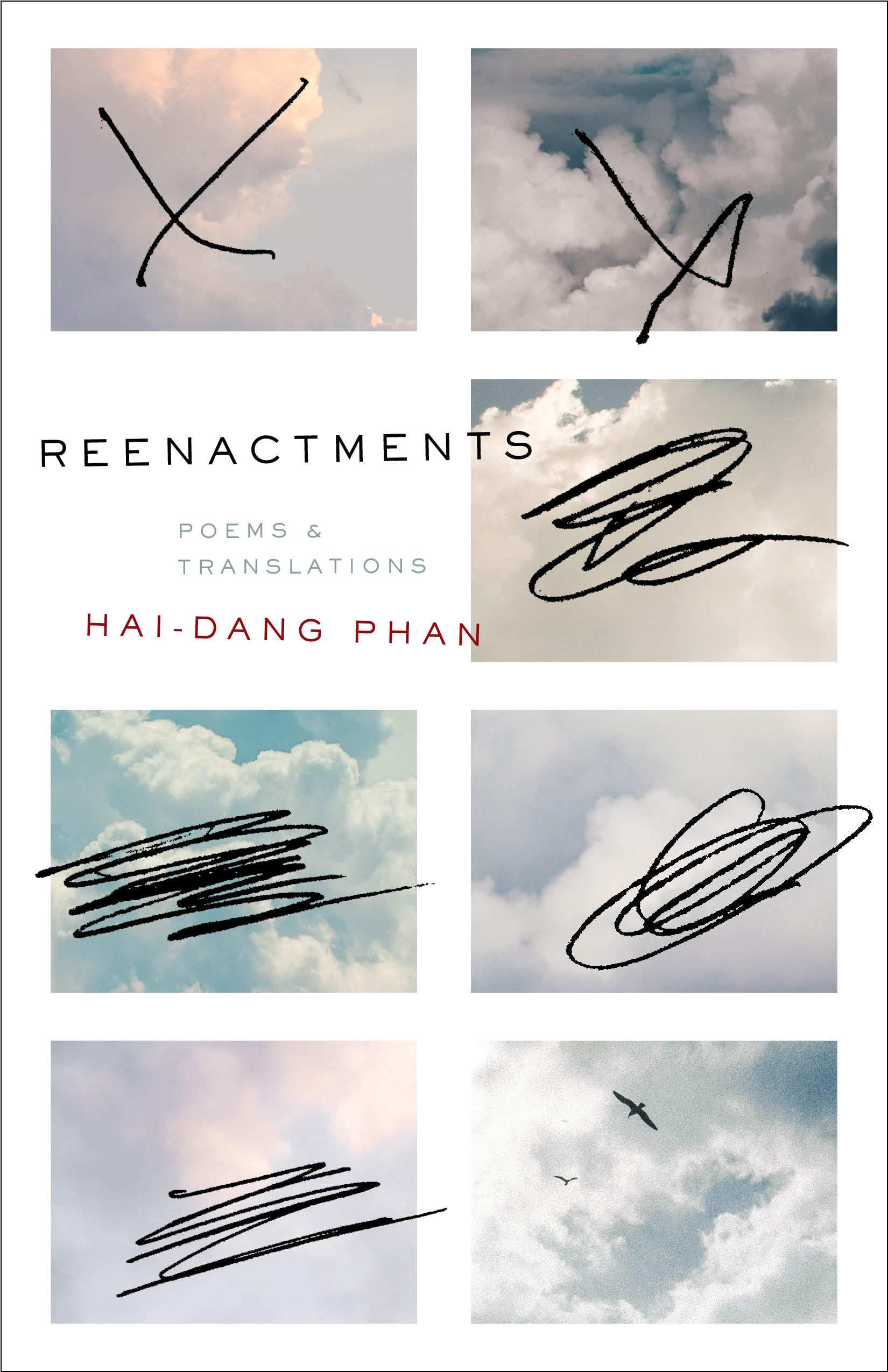



In Reenactments , Hai-Dang Phan grapples with the history, memory, and legacy of the Vietnam War from his vantage point as the son of Vietnamese refugees. Through a kaleidoscope of poetic forms, the past and present, the remembered and imagined, all intersect at shifting angles providing urgent perspectives on conflicts both private and public. Phan weaves throughout the collection stories of his family’s exodus from Vietnam, thoughtfully reenacting an American experience of immigration, dislocation, inheritance, and hope. And, in a fresh move, Phan widens the lens, incorporating translations of several Vietnamese poets. This moving debut marks a vital addition to the literature of immigration and a distinctive contribution to contemporary poetry. 2020-21 Tulsa Artist Fellowship Recipient "Must-Read Poetry: February 2019," The Millions "Featured on Tracy K. Smith's The Slowdown Show " "In Phan’s strong, enlightening debut collection, without flinching from pain or turning away from history's critical gaze, he binds his birth country, Vietnam, to his adopted one, the United States. . . Phan is a poet who should be read widely." ― Booklist "Phan's debut unflinchingly presents the trauma inherited through cultural memory as a kind of endless war reenactment. In these poems, even the most mundane setting is haunted by living ghosts. . . These poems are unadorned and ominous in their vision of memory, a clarion that never ceases to alarm or awe." ― Publishers Weekly “'To make things worse, they are extremely supportive of my choices' is such a strange and quintessentially immigrant utterance. . .What to do with the guilt we feel that our lives are often so much easier than the lives of our parents? How can any of our fears, anxieties, lonelinesses be worth mentioning when theirs have been so great? For you (and often, for myself), I prescribe Hai-Dang Phan’s 'My Father’s Norton Introduction to Literature, Third Edition (1981).'” ―Kaveh Akbar, The Paris Review "In the poem 'Get to Know Your Ghost,' Phan recommends you determine 'whether it is free Saturday night / or Sunday afternoon for a visitation.' This line, and the collection as a whole, is both gift and invitation. Phan’s vantage point is wide, but it won’t do all the work for you. You are going to have to 'do something painful each day.' You are going to have to ask the ghost something. And every something will begin to make all the difference." ―"Staff Picks: Sapphics, Scandals, and Skies," Spencer Quong, The Paris Review "Nimble, cerebral poems." ―Esther Lin, Kenyon Review "Phan’s mixture of original and translated work creates a unique debut that is both singular and anthological." ―Nick Ripatrazone, The Millions “In Phan’s strong, enlightening debut collection, without flinching from pain or turning away from history’s critical gaze, he binds his birth country, Vietnam, to his adopted one, the United States. In 'To a Human Skull,' he poses a metaphysical question, 'On quiet afternoons do you / search for the trace elements? / Would you recognize your / soul if you bumped into it?' As an immigrant, Phan expresses keen observations of America, some harsh, some poignant, others purely poetic, as in 'Archive Fever:' 'In the cracked and blazing lot / you stand like a sundial / searching for that good shirt / you wear like someone else’s life.' Phan brings gracefulness to lines presenting images that are harsh and cracking. 'Anniversary' is a two-stanza poem in which the living engage with the dead: 'Our prayers are perfunctory. / One of your sons dutifully uncoils a garden hose. / ‘Time to give the old man a bath.’ / Squalor of the living, splendor of the dead.' Phan is a poet who should be read widely.” ―Raúl Niño, Booklist "It is an ambitious addition to Vietnam War literature and a fearless contribution to the small, albeit energetic, body of verse by the new generation of Vietnamese American refugees. . . Aren’t we lucky to be indicted by a poet with a voice this strong?" ―Christos Kalli, World Literature Today "Phan’s poems interlace inherited public history with personal history, where minoritized Vietnamese identities negotiate with the majority’s narratives of America and the war. He navigates the reader through reenactments in the form of archival research, family memories and literal war reenactments, renewing our physical and emotional connection to the past. Phan’s transparent archival touch elevates his poetic narratives and distinguishes him from other Vietnamese American poets who write about coming of age in a Western world." ―"On Hai-Dang Phan's Reenactments: Poems and Translations ," Hyphen "Phan brilliantly threads translations of works by Vietnamese poets throughout the book. These translations become another form of retelling or re-envisioning as he connects his present to his family’s exodus from Vietnam to the United States. Yet this collection goes far beyond the indivi