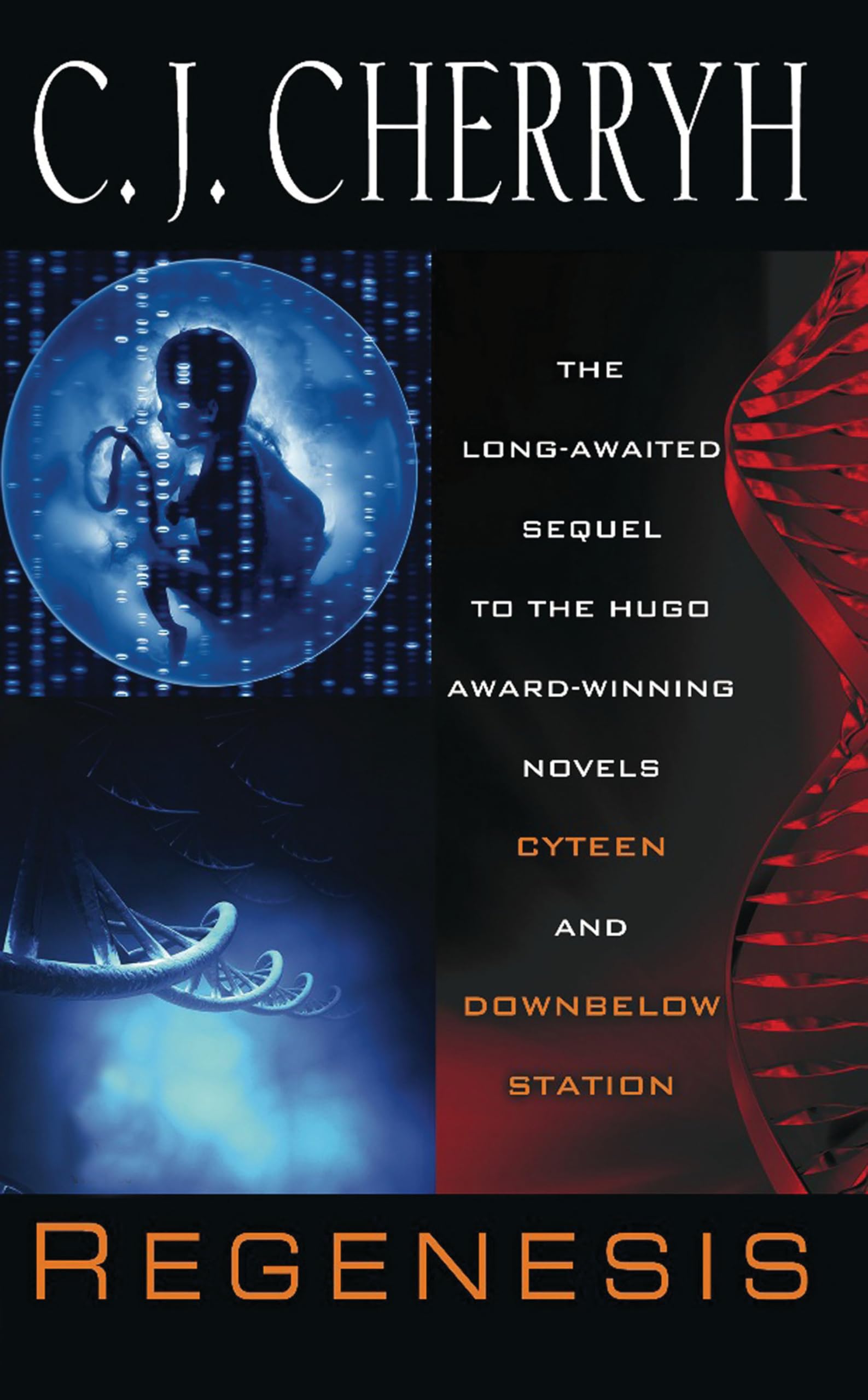



The long-awaited sequel to the Hugo award-winning novels Cyteen and Downbelow Station . The direct sequel to Cyteen, Regenesis continues the story of Ariane Emory, Personal Replicate, the genetic clone of one of the greatest scientists humanity has ever produced, and of her search for the murderer of her progenitor-the original Ariane Emory. Murder, politics, deception, and genetic and psychological manipulation combine against a backdrop of interstellar human factions at odds to confront questions that have remained unanswered for two decades... Who killed the original Ariane Emory? And can her Personal Replicate avoid the same fate? Praise for Regenesis : " Complex and rich, with beautifully rounded characters , this novel can stand alone, but will delight fans of Cyteen with extra layers of meaning that resonate between old and new." — Publishers Weekly (starred Review) "In Alliance-Union, there is lots of room between moral absolutes, and in this big book, lots of space for absorbing characters; for adventure, intrigue, and violence ; and for plausible extrapolations of current technologies and institutions." — Booklist “Cherryh’s storytelling talent remains unmatched for its clearness of execution and its exceptional readability. Highly recommended.” — Library Journal “Cherryh’s latest remains true to her original dystopian vision .” — Romantic Times “It has been twenty long years since Cyteen was first released and happily, the continuation Regenesis was worth the wait. A fine piece of work that displays Cherryh’s mastery of the storyteller’s art. ” — Monsters & Critics C. J. Cherryh planned to write since the age of ten. When she was older, she learned to use a typewriter while triple-majoring in Classics, Latin, and Greek. With more than seventy books to her credit, and the winner of three Hugo Awards, she is one of the most prolific and highly respected authors in the science fiction field. Cherryh was recently named a Damon Knight Memorial Grand Master by the Science Fiction Writers of America. She lives in Washington state. She can be found at cherryh.com. HISTORY OF UNION: The Post-War Period Novgorod Publications 2424 Union came out of the Company Wars with both territory and political integrity, not beholden to Earth or Alliance for either. The Treaty of Pell, which ended active hostilities between Union and Alliance, left Earth independent, though militarily reliant on Pell’s Star. The Company Fleet had defied Earth’s authority, rejected the Treaty of Pell, and continued acts of piracy, as apt to prey on Earth’s ships as on Union’s, and now lacking a safe port. The Treaty incidentally left the merchanter Council of Captains with more power than Pell’s Star Station held in the affairs of the Alliance. And the same Treaty ceded the greater expanse of human-explored space to the authority of Union . . . but placed merchant trade exclusively in the hands of the Alliance Council of Captains. It was an agreement equally unpopular on all sides—which spoke a great deal to its fairness—and it was immediately followed by a period in which all former combatants maneuvered for advantage, everyone dreading a resumption of hostilities, but most convinced that war would break out again, probably within a lifetime. The Hinder Stars, that bridge of closely lying, generally barren stars between Earth and Pell, became a zone of renewed interest for the Alliance, which governed that region. The Council of Captains, whose livelihood was their ships and their trade, looked to revitalize the mothballed stations on that route—stations that had collapsed economically with the advent of faster-than-light engines. Alliance thus moved to set itself as middleman between Earth and Union, and to profit from that trade . . . if it could re-establish viable populations to consume the goods it wanted to trade along the way. Union enjoyed the manufacture, mining, and prosperity of its own widely scattered stations, from Mariner and Viking to outlying Fargone, and it had the colonized world of Cyteen, with its major exports: the rejuv drug, embryos, genetically enhanced biologicals, azi workers, and concentrated foodstuffs. In the viewpoint of the merchanter captains of the Alliance, that was a somewhat reasonable model for what the Alliance could create around Pell’s World—Downbelow—by repopulating the abandoned starstations of the Hinder Stars, and revivifying trade with, not one, but two living worlds within their reach—Downbelow and Earth itself. It was a reasonable model in all save one respect: the Alliance plan for the Hinder Stars relied on recruitment of station citizens and the natural human birth rate to provide population. This meant luring the poorer of the residents of Pell and Earth to live in frontier conditions at outmoded, pre-FTL stations. The natural human birth rate is slow: that was one flaw in the plan; and, the second, the poorer residents of Pell Station,