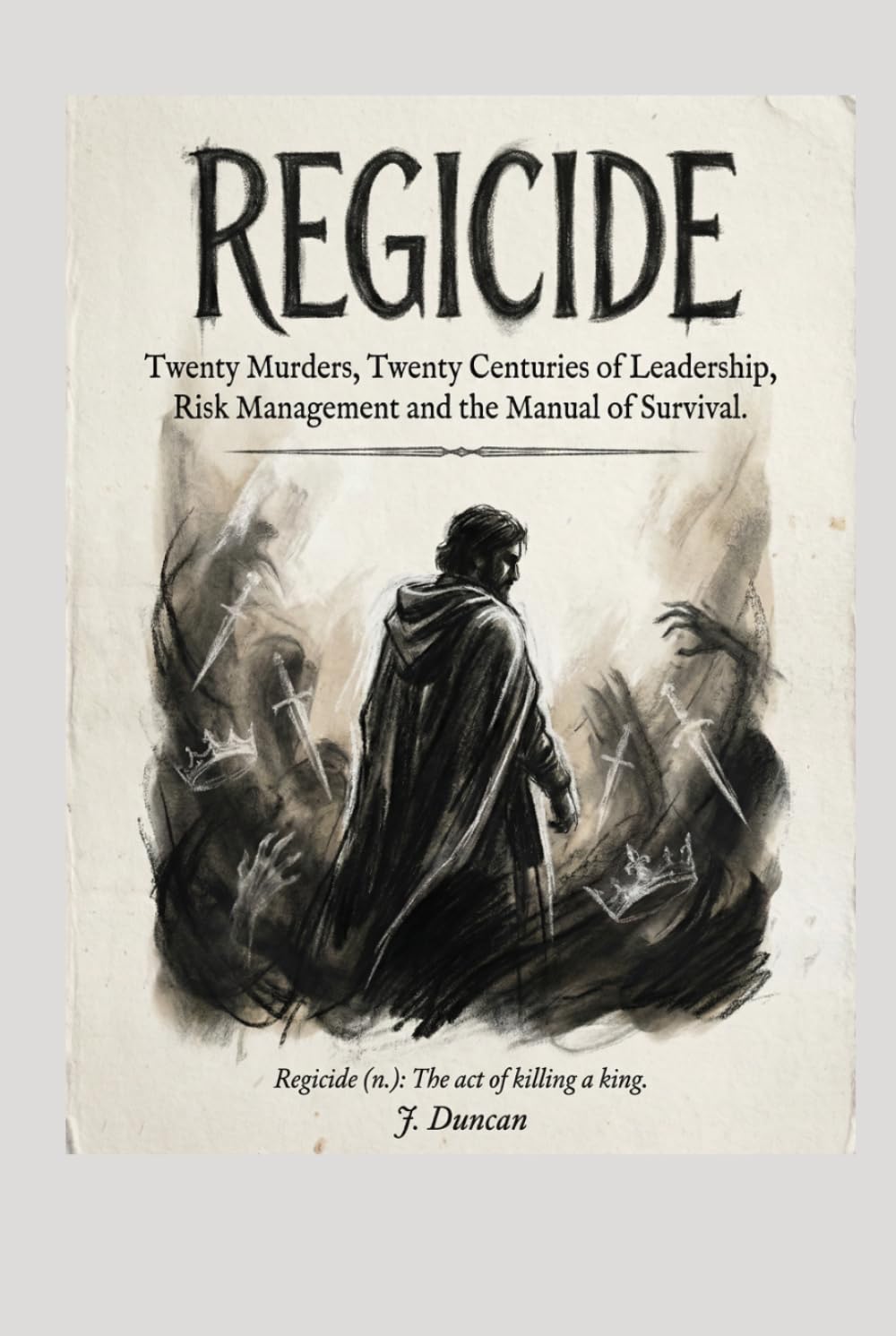



Twenty kings. Twenty centuries. Twenty murders that bent the arc of civilization. From Julius Caesar's assassination on the Ides of March to King Faisal's shooting in a Riyadh palace , the killing of a sovereign has never been merely the end of a life — it has always been the beginning of a transformation. Regicide traces one pivotal royal murder from each century between the 1st and the 20th, revealing the systemic failures, factional conspiracies, and human blind spots that brought down the most powerful leaders on earth. Each chapter opens with a Practitioner's Note — a raw, private-journal entry written in the voice of a modern leader applying the lesson to his own survival. Modeled on the blunt, unsentimental tone of Marcus Aurelius's Meditations, these notes distill each regicide into four brutal elements: The Error, The Blade, The Successor's Warning, and The Maxim — a single timeless law of power. Following each Note, the full historical chapter delivers the scholarly depth: the political context that made regicide thinkable, the anatomy of the conspiracy, the power vacuum that followed, and the institutional transformation the act set in motion. Spanning the Roman Empire, the Byzantine court, the Abbasid Caliphate, the Mongol Empire, medieval Europe, and the modern Middle East, Regicide is both a panoramic history of political violence and a practical manual on the fragility of power — as relevant to a boardroom in 2026 as it was to a throne room in 44 BCE. Featuring: Julius Caesar, Commodus, Caracalla, Constans, Valentinian III, Theodahad, Wamba, Leo IV, Al-Amin, Romanos II, Harold II, Malcolm III, Ögedei Khan, Wenceslaus III, Richard II, Henry III of France, Charles I, Peter III, Paul I, and King Faisal.