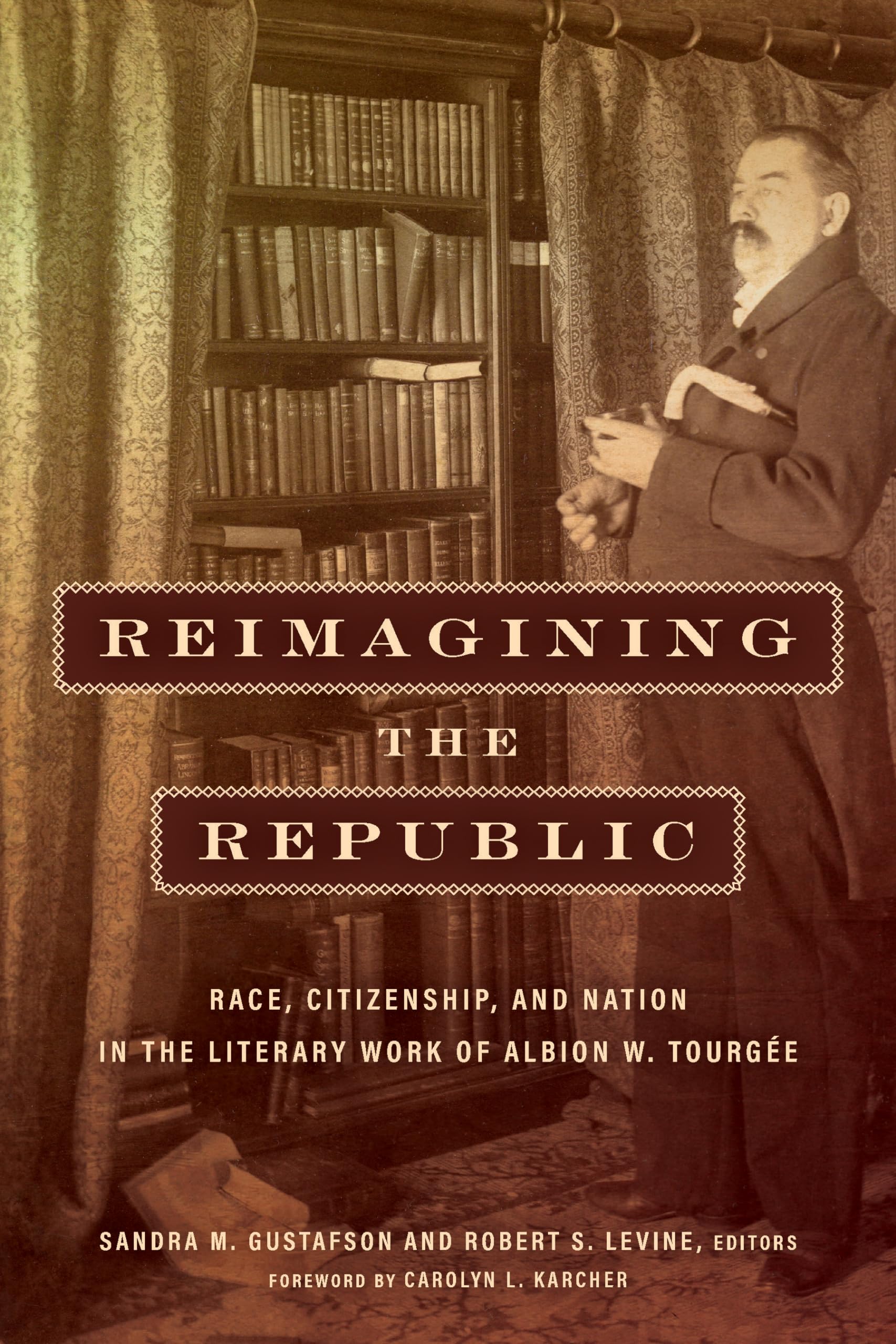
Reimagining the Republic: Race, Citizenship, and Nation in the Literary Work of Albion W. Tourgée (Reconstructing America)
$30.45
by Sandra M. Gustafson



Albion W. Tourgée (1838–1905) was a major force for social, legal, and literary transformation in the second half of the nineteenth century. Best known for his Reconstruction novels A Fool’s Errand (1879) and Bricks without Straw (1880), and for his key role in the civil rights case Plessy v. Ferguson (1896), challenging Louisiana’s law segregating railroad cars, Tourgée published more than a dozen novels and a volume of short stories, as well as nonfiction works of history, law, and politics. This volume is the first collection focused on Tourgée’s literary work and intends to establish his reputation as one of the great writers of fiction about the Reconstruction era arguably the greatest for the wide historical and geographical sweep of his novels and his ability to work with multiple points of view. As a white novelist interested in the rights of African Americans, Tourgée was committed to developing not a single Black perspective but multiple Black perspectives, sometimes even in conflict. The challenge was to do justice to those perspectives in the larger context of the story he wanted to tell about a multiracial America. The seventeen essays in this volume are grouped around three large topics: race, citizenship, and nation. The volume also includes a Preface, Introduction, Afterword, Bibliography, and Chronology providing an overview of his career. This collection changes the way that we view Tourgée by highlighting his contributions as a writer and editor and as a supporter of African American writers. Exploring the full spectrum of his literary works and cultural engagements, Reimagining the Republic: Race, Citizenship, and Nation in the Literary Work of Albion Tourgée reveals a new Tourgée for our moment of renewed interest in the literature and politics of Reconstruction. The “literary” Tourgée of this tour-de-force collection emerges kaleidoscopically, as both neglected and multi-faceted, a lifelong advocate for racial justice, historian of the afterlives of slavery, and a writer specializing in the still-unfinished history of emancipation. The 19 essays compellingly historicize Tourgée in all those spheres of influence through his hetero-generic writing career, from the 1870s through 1900. The result reveals Tourgée in little-known close interrelations with prominent Black and white writers of the time, and vice versa, opens out those literary networks to unexpected developments from a Tourgée vantage point. The unlikely result: nineteenth-century US literary history, with its ossified divides between antebellum romance and postbellum realism, even the revisionist divides between slavery and emancipation, can’t look quite the same again. A literary recovery project of canon busting and expansion at its best. ---Susan Gillman, Distinguished Professor of Literature, University of California, Santa Cruz In treating Tourgée’s novels in relation to changing social conditions, this collection shows literature and history as combined streams demonstrating the failure to improve the status of Black Americans. ― Choice Reviews Sandra M. Gustafson is Professor of English and Concurrent Professor of American Studies at the University of Notre Dame, as well as a faculty affiliate of Notre Dame’s Center for Civil and Human Rights and a Faculty Fellow at the Kroc Institute for International Peace Studies. She is the author of Imagining Deliberative Democracy in the Early American Republic and Eloquence Is Power: Oratory and Performance in Early America and editor of The Norton Anthology of American Literature , Vol. A. Robert S. Levine is Distinguished University Professor of English at the University of Maryland, College Park. His recent books are The Failed Promise: Reconstruction, Frederick Douglass, and the Impeachment of Andrew Johnson ; Race, Transnationalism, and Nineteenth-Century American Literary Studies ; and The Lives of Frederick Douglas . Levine is the general editor of The Norton Anthology of American Literature and the editor and co- editor of a number of volumes. Molly Ball is a Post-Doctoral Associate in American Studies at the University of Minnesota, Twin Cities. She has published on women’s slave narratives, seduction novels, and pedagogy, and her work has appeared in journals such as ESQ and Early American Literature . She is currently revising a book length project titled “Writing out of Time,” which examines how nineteenth-century populations deemed to have “no future” within the progressing nation both represent and dispute that temporal status through experiments with forward-moving narrative forms. Nancy Bentley is Donald T. Regan Professor of English at the University of Pennsylvania. Her publications include The Ethnography of Manners and Frantic Panoramas: Mass Culture and American Literature, 1870–1920 . She coauthored Volume 3 of The Cambridge History of American Literature (2005) and is currently writing a book entitled “New World Ki