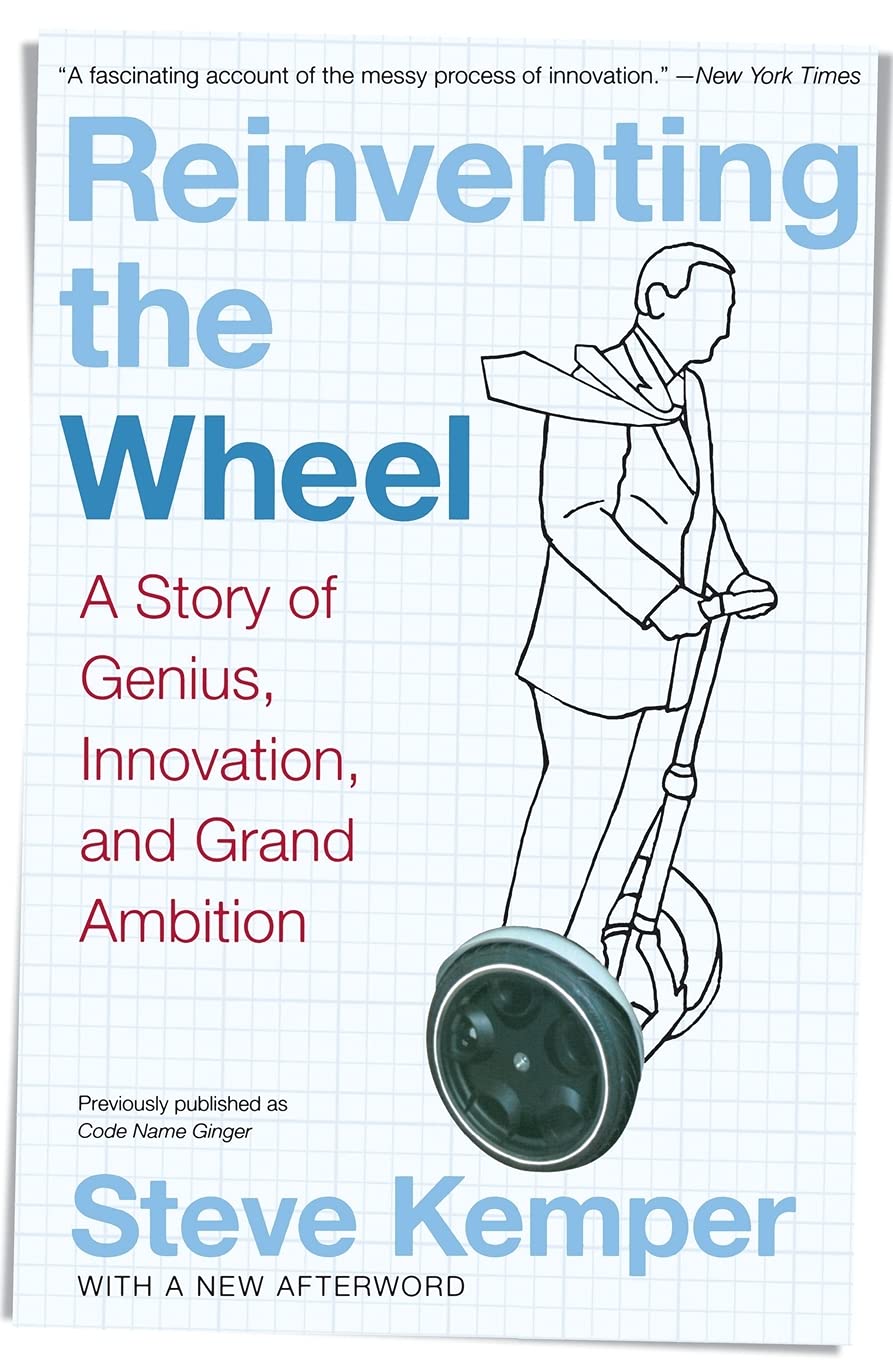
Reinventing the Wheel: A Story of Genius, Innovation, and Grand Ambition – Inside Dean Kamen's Technology Development and Entrepreneurial Power
$10.30
by Steve Kemper



Reinventing the Wheel is the riveting, behind-the-scenes story of the enigmatic and cocksure inventor Dean Kamen and the Segway Human Transporter. When Kamen invented the two-wheeled vehicle known to many by its code name, Ginger, he promised it would transform the face of personal transportation forever. But when this brilliant and driven inventor attempted to become an entrepreneur, a colossal power struggle ensued. Here, Steve Kemper takes you along for the wild ride. In Reinventing the Wheel , Kemper goes inside Kamen's world of technology development, where nerve and ingenuity collide with high finance and the bottom line. Reinventing the Wheel is the riveting, behind-the-scenes story of the enigmatic and cocksure inventor Dean Kamen and the Segway Human Transporter. When Kamen invented the two-wheeled vehicle known to many by its code name, Ginger, he promised it would transform the face of personal transportation forever. But when this brilliant and driven inventor attempted to become an entrepreneur, a colossal power struggle ensued. Here, Steve Kemper takes you along for the wild ride. In Reinventing the Wheel , Kemper goes inside Kamen's world of technology development, where nerve and ingenuity collide with high finance and the bottom line. From August 1999 to January 2001, veteran journalist Steve Kemper was the only outsider to have exclusive behind-the-scenes access to Dean Kamen and his team of engineers at DEKA. His work has appeared in Smithsonian , National Geographic , and other magazines. This is his first book. Reinventing the Wheel A Story of Genius, Innovation, and Grand Ambition By Kemper, Steve HarperBusiness ISBN: 0060761385 Chapter One In Development 1951-1995 Rockville Centre, Long Island, a small, pleasant suburb thirty-eight minutes by train from New York City, isn't known as a cradle of invention. Dean was born there in 1951 and endured its educational system through high school. Like many restless, energetic boys, he was an indifferent student. School bored him. Once, in elementary school, his teacher told the class that every number divided by itself was one: 7/7 = 1, 9/9 = 1, and so on. Dean liked the clean certainty of that. But what about zero divided by zero? "One" didn't seem right, so he raised his hand. The question irritated his teacher, who accused him of not paying attention. That was generally true, but not this time, so Dean retorted that her math made no sense. She called Dean's mother, herself a teacher, who told Dean to apologize. He refused. He knew he was right. In seventh grade, Dean's teacher complained to his parents that he must be cheating in math, because he got the right answers but didn't show any calculations. Dean explained that he could see the steps, so writing them down was pointless. Nevertheless, he felt stupid throughout much of his schooling on Long Island, especially compared to his brother Bart, two and a half years older, who excelled at academics and would be named a Westinghouse scholar as a high school senior. (He is now a distinguished pediatric oncologist.) At the start of high school, weighing in at in 105 pounds, Dean went out for football. He quickly abandoned that experiment and joined the wrestling team instead. Academically he remained bored, with marginal grades. When his friends got 90s and 100s on their math tests, he would retort that that was easy and challenge them to do what he did -- purposefully get a 57. He swears this is true. Then he discovered primary scientific texts such as Newton's Principia and Galileo's works. Vistas opened. He calls these pioneering scientists his real teachers. They would inspire many of his later inventions. By the middle of high school Dean was playing around with the latest developments in electronics, powerful semiconductors and solidstate supertransistors called SCRs and triacs. He made a light box that could be plugged into a stereo so the lights pulsed with the music, and began putting on shows for friends in his parents' basement. Soon after turning sixteen and getting a driver's license, he took a summer job working for man who designed slide shows and wanted Dean to build cabinets for his projectors. It was mindless work, but it offered the excitement of driving into Manhattan, where one of the man's clients was the Museum of Natural History. Dean had a pass that let him into the museum's restricted underground garage. He quit after a few weeks, bored. But he had a plan. He had noticed that the lighting system in the museum's Hayden Planetarium was old and bulky, so one day he drove into New York and waited to see the museum's chairman. When he was finally admitted, he told the chairman that he wanted to upgrade the museum's lighting system using state-of-the-art transistors and semiconductors. The chairman saw a cocky, scrawny, sixteen-year-old kid. He blew him off. That provoked Dean. He took the money made from building cabinets, $80 or so, and spent it on