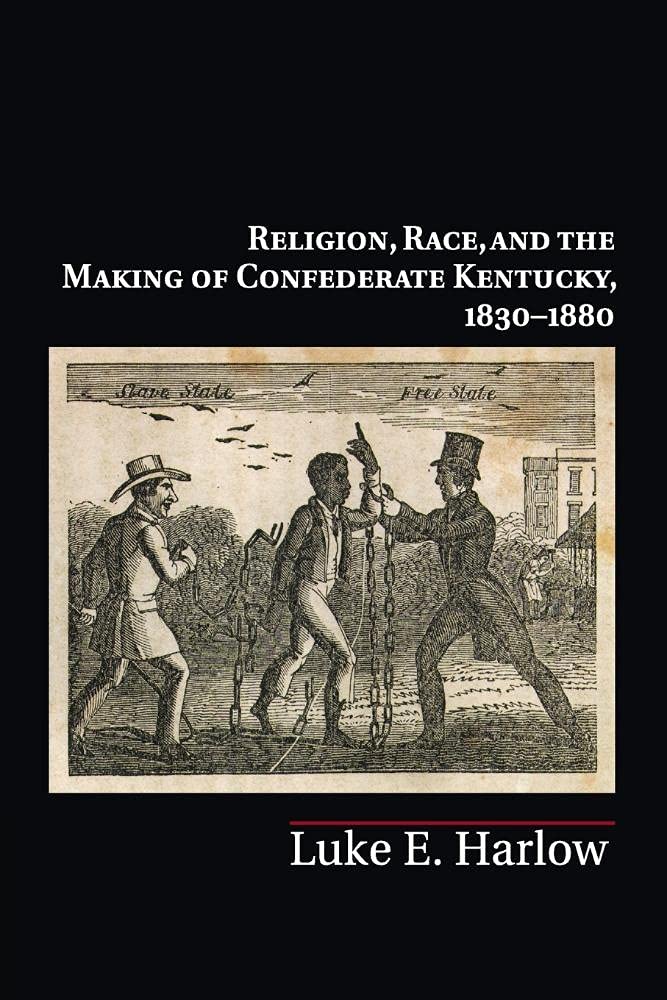
Religion, Race, and the Making of Confederate Kentucky, 1830–1880 (Cambridge Studies on the American South)
$31.49
by Luke E. Harlow



This book sheds new light on the role of religion in the nineteenth-century slavery debates. In it, Luke E. Harlow argues that ongoing conflict over the meaning of Christian “orthodoxy” constrained the political and cultural horizons available for defenders and opponents of American slavery. The central locus of these debates was Kentucky, a border slave state with a long-standing antislavery presence. Although white Kentuckians famously cast themselves as moderates in the period and remained with the Union during the Civil War, their religious values showed no moderation on the slavery question. When the war ultimately brought emancipation, white Kentuckians found themselves in lockstep with the rest of the Confederate South. Racist religion thus paved the way for the making of Kentucky's Confederate memory of the war, as well as a deeply entrenched white Democratic Party in the state. "Harlow makes a significant contribution to our developing understanding of the unfortunate historical relationship between evangelical Christianity, slavery, and race throughout America … [A] masterful telling … Each assertion and point of analysis is amply documented, and the end result is both refreshingly source-based and absolutely convincing. In every way that matters, Religion, Race, and the Making of Confederate Kentucky, 1830–1880 is a seamless monograph." The American Historical Review "Harlow's book joins a small but significant literature recasting the relationship between Christianity and politics in the nineteenth century. He masterfully shows how religion can be a vital field of inquiry for unraveling the political peculiarities of the era … Religion, Race, and the Making of Confederate Kentucky, 1830–1880, is a very fine book richly deserving a place on the shelf any student of the nineteenth-century South." Journal of Southern History "… a welcome contribution … persuasively argued and well-documented … Harlow's study answers recent calls to integrate religion into political narratives, and it exemplifies the valuable insights gained by doing so." The Journal of American History "The legacies of slavery are still with us, and they include the assumption that whiteness is somehow close to godliness. Works like Harlow's … give us food for thought at a time when we need more sustenance to keep fighting and hoping that God will make right, for might has failed to do so." The Christian Century "… with uncommon skill, intelligence, and sensitivity, [Harlow] has deconstructed and re-centered the arguments of conservative evangelicals to show that for all their differences both antislavery gradualists and proslavery advocates worked from a common theological foundation." Journal of Southern Religion "Writing in clear, crisp prose, and drawing upon a rich arsenal of primary sources, including periodicals, archival materials, and primary texts, Harlow correctly notes that the commonwealth 'stood at the center of the nineteenth-century American debate over race, slavery, and abolition'." Ohio Valley History "Luke Harlow has written an important and ultimately sobering book on the relationship between religion, slavery, and race in a vitally important border state. By focusing on a number of key leaders, he exposes both the nature and limits of antislavery sentiment in the church and how the conservatism and timidity of religious leaders led Kentucky along a path toward proslavery Unionism and ironically greater identity with the Confederacy after the Civil War. A first-rate monograph with considerable interpretative bite." George C. Rable, Charles Summersell Chair in Southern History, University of Alabama, and author of God's Almost Chosen Peoples: A Religious History of the American Civil War "Highly original and deeply researched, Religion, Race, and the Making of Confederate Kentucky, 1830–1880 reveals how this border state was neither a moderate middle ground nor an outlier in the nineteenth century, but rather was a key front in the nation’s long-standing battle over slavery. Harlow painstakingly reconstructs a diverse array of arguments that vied for supremacy along the pro- and antislavery spectrum - and reveals the crucial position of evangelical religion at the root of it all. The result is a masterful journey through the tangled history of race and religion in nineteenth-century America." Amy Murrell Taylor, University of Kentucky "Luke Harlow's powerful book shows how the political theologies of slavery and white supremacy drove the Unionist state of Kentucky to 'become' Confederate after the Civil War. He ingeniously lays bare the long and contentious transition from the view of slavery as a 'necessary evil' to a full-throated embrace of white supremacy among white Kentucky Protestants, carefully demonstrating exactly how the faith that sustained slavery long outlived emancipation." Beth Barton Schweiger, University of Arkansas "Luke Harlow's carefully researched and gracefully argued boo