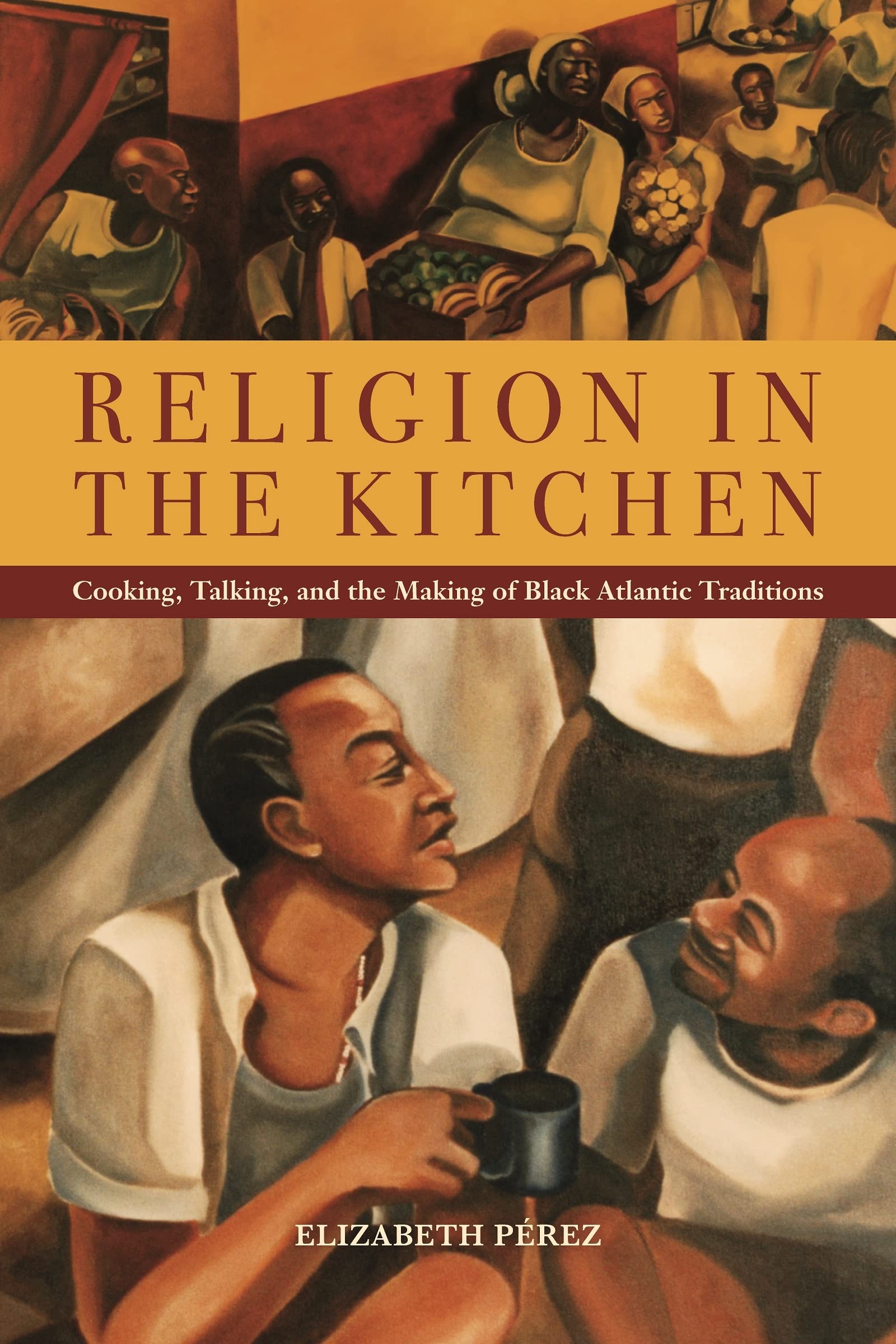
Religion in the Kitchen: Cooking, Talking, and the Making of Black Atlantic Traditions (North American Religions)
$30.00
by Elizabeth Pérez



Honorable Mention, 2019 Barbara T. Christian Literary Award, given by the Caribbean Studies Association Winner, 2017 Clifford Geertz Prize in the Anthropology of Religion, presented by the Society for the Anthropology of Religion section of the American Anthropological Association Finalist, 2017 Albert J. Raboteau Prize for the Best Book in Africana Religions presented by the Journal of Africana Religions An examination of the religious importance of food among Caribbean and Latin American communities Before honey can be offered to the Afro-Cuban deity Ochún, it must be tasted, to prove to her that it is good. In African-inspired religions throughout the Caribbean, Latin America, and the United States, such gestures instill the attitudes that turn participants into practitioners. Acquiring deep knowledge of the diets of the gods and ancestors constructs adherents’ identities; to learn to fix the gods’ favorite dishes is to be “seasoned” into their service. In this innovative work, Elizabeth Pérez reveals how seemingly trivial "micropractices" such as the preparation of sacred foods, are complex rituals in their own right. Drawing on years of ethnographic research in Chicago among practitioners of Lucumí, the transnational tradition popularly known as Santería, Pérez focuses on the behind-the-scenes work of the primarily women and gay men responsible for feeding the gods. She reveals how cooking and talking around the kitchen table have played vital socializing roles in Black Atlantic religions. Entering the world of divine desires and the varied flavors that speak to them, this volume takes a fresh approach to the anthropology of religion. Its richly textured portrait of a predominantly African-American Lucumí community reconceptualizes race, gender, sexuality, and affect in the formation of religious identity, proposing that every religion coalesces and sustains itself through its own secret recipe of micropractices. "Religion in the Kitchenis the product of Pe´rez longstanding interest in the religious phenomena of Black Atlantic communities, and builds on a number of prior projects, revisiting, revising, and creating a thoughtful and fascinating ethnographic text . . . [W]ill fascinate both the academic community and the interested layperson." ― Journal of Religious History "[A] major contribution to the scholarship of Black Atlantic traditions, bringing much needed attention to cooking, talking, and the women and gay men who do both . . . With an accessible introduction and opening chapters, Pe´rezs careful, erudite analysis offers methodological direction and a theoretical vocabulary for all scholars interested in the intersection of everyday practice with religious subject formation." ― Nova Religio "[W]ell crafted, theoretically engaging, and insightful . . . Pérez adroitly maps those interstitial spaces often historically relegated solely to women and their labor. This book provides a rare view into the liminal space of the Lucumí cloister and the coded dialogues therein . . . By queering her analysis inReligion in the Kitchen, Pérez substantively and subtly illuminates the temple-house communitys cohesion across its various subject positions . . . The role and signification of who cooks, what they cook, for whom they are cooking, who gets to eat and why suddenly opens up new avenues for inquiry and analysis under Pérezs gaze." ― Food, Culture & Society "Chapter three is my favorite in the book . . . a prime example of Geertzs model of thick description as applied to religion and food. Readers will no doubt find themselves comparing Pe´rezs work to that of Karen McCarthy Brown (2001) inMama Lola: A Vodou Priestess in Brooklyn, which has become a classic in the field. Pe´rezs questions and conclusions are different than Browns, but I suspect that likeMama Lola, Pe´rezs Religion in the Kitchen will become a go-to book for the study of Afro-Caribbean traditions in the USA." ― Material Religion "With clear description and sharp analysis Pérez highlights ways in which cookingand its related activities such as conversationis the stuff of religious engagement and a symbol of connection between humanity and divinity. Anyone concerned with better understanding how ordinary spaces and practices take on religious significance will value this book." -- Anthony Pinn, Agnes Cullen Arnold Professor of Humanities and Professor of Religion, Rice University "A deeply researched, contextually rich and ambitious intervention into the literature on Black Atlantic religions. While most scholars of Santería and other Black Atlantic traditions have focused on initiation as the paradigmatic site where religious values are inculcated and religious subjects are `reborn, Pérez directs her attention to a more prosaicand unjustly overlookedsetting: the kitchen. By cooking for the orishas, Pérez asserts, participants are themselves being cooked; that is, they are being socialized into the complex world of