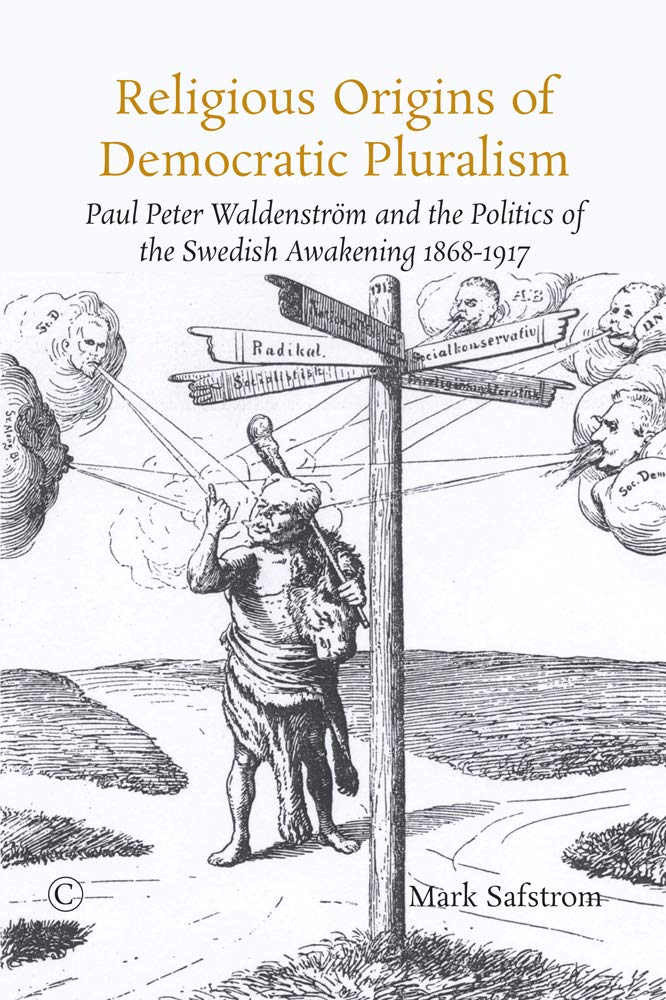
Religious Origins of Democratic Pluralism: Paul Peter Waldenström and the Politics of the Swedish Awakening 1868–1917
$41.00
by Mark Safstrom



The Religious Origins of Democratic Pluralism focuses on explaining one of the riddles that fascinated historians and political scientists for much of the twentieth century, namely, the origin and development of Swedish social democracy. While other countries in Europe experienced dramatic swings between radical and conservative political parties, which resulted in tragic experiments with totalitarian regimes, Sweden, by contrast, miraculously seemed to avoid these extremes, and instead maintained space for democratic discussion and even dissent. This peaceful transformation was facilitated by political actors who crafted the discourse of their debates in such a way that pluralism came to be valued as an ethical good and then vigorously defended. This study examines the decades leading up to the emergence of social democracy in Sweden, and in particular, the career of one prominent politician, Paul Peter Waldenström (1838-1917). Waldenström was a clergyman, revival preacher, educator, author, and newspaper editor, whose political career began in 1868 with his participation in the Church Assembly of the Church of Sweden. His role expanded during his years of service in the Swedish parliament, the Riksdag, from 1884-1905. This study places Waldenström in dialogue with his contemporaries and opponents as a means of identifying how the theological values and priorities of the religious awakening were articulated in the public sphere and contributed to the development of a new political order. Table of Contents List of Figures and Tables Acknowledgments Introduction Part I: Crafting a Strategy of Pluralism Chapter 1: Locating “The Middle Way” in Waldenström’s Discourse Chapter 2: Modeling Pluralism through Allegory—Squire Adamsson Part II: Separating Church and State Chapter 3: Pietism as the Re-Emergence of Religious Pluralism in Sweden Chapter 4: Print Media and the Mobilization of Reform Chapter 5: Religion in Public: “Private Matter” or “Matter of Conscience”? Chapter 6: On Conscience and the Rights of Dissenters Chapter 7: The Limits of Democracy in the Kingdom of Christ Part III: Brokering Confrontation and Exchange: Pietism and Socialism Chapter 8: Pluralism as Productive Tension Chapter 9: Branting v. Waldenström: The Debate to Define Absolutism and Moralism Chapter 10: The Impact of the Free-Church Vote Chapter 11: Majoritarianism v. Proportionalism: Making Space for Dissent Chapter 12: An Exchange of Words: A Re-Socialized Christian Vocabulary and a Democratized Socialist One Part IV: Tempering the Politics of Temperance Chapter 13: Defining Moderate v. Absolutist Abstinence Politics Chapter 14: Pragmatism and Experimentation with Best Practices Chapter 15: A Preference for Education over Legislation Conclusion Endnotes Bibliography "Plurality - of perspectives, principles, and persons - is a fact, not an option. So is the intense religiosity of millions amidst a 'secular age.' Safstrom's measured and finely written study of Waldenstrom not only vindicates a largely forgotten thinker, preacher, and politician, but makes one of the best cases I have read for pluralism as an ethic fit for the facts of plurality, and Christianity as a basis for democracy." Ned O'Gorman, Conrad Humanities Professorial Scholar, University of Illinois, Urbana-Champaign "In the nineteenth century, Sweden went through a fundamental social and economic transformation and by the mid-twentieth century, it had emerged as an influential model of social progress. In this fresh and insightful book, Safstrom highlights the interrelations between religion and politics for these processes." Dag Blanck, Swedish Institute for North American Studies, Department of English at Uppsala University Mark Safstrom, PhD, is Lecturer of Swedish and Scandinavian Studies at the University of Illinois at Urbana-Champaign. His research focuses on various aspects of the history of social movements and revivalism in Scandinavia. He has previously published The Swedish Pietists: A Reader and a translation of Paul Peter Waldenström’s allegorical novel, Squire Adamsson: Or, Where Do You Live? This book is based on his dissertation of the same title.