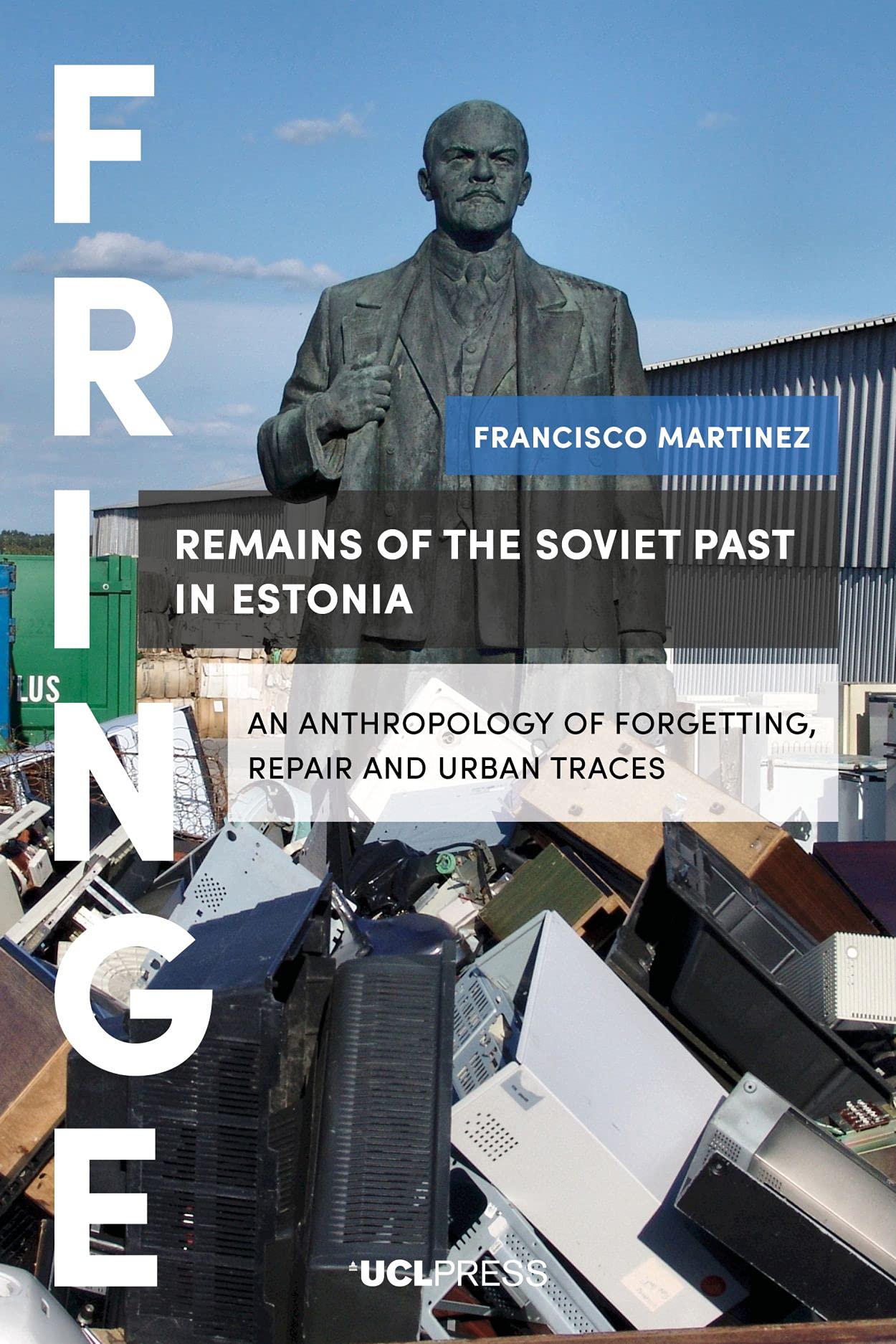
Remains of the Soviet Past in Estonia: An Anthropology of Forgetting, Repair and Urban Traces (FRINGE)
$45.00
by Francisco Martinez



What happens to legacies that do not find any continuation? In Estonia, a new generation that does not remember the socialist era and is open to global influences has grown up. As a result, the impact of the Soviet memory in people's conventional values is losing its effective power, allowing for new opportunities for recuperation. Francisco Martinez brings together a number of sites of interest to explore the vanquishing of the Soviet legacy in Estonia: a street market in Tallinn where concepts such as "market" and "employment" take on distinctly different meanings from their Western use; Linnahall, a multi-purpose venue, whose Soviet heritage now poses difficult questions of how to present the building’s history; Tallinn’s cityscape, where the social, spatial, and temporal coevolution of the city can be viewed and debated; Narva, a city that marks the border between the Russian Federation, NATO, and the European Union and represents a place of continual negotiation; and the new Estonian National Museum in Raadi, an area on the outskirts of Tartu that has avoided promoting a single narrative of the past. By exploring these places of cultural and historical significance, which all contribute to our understanding of how the new generation in Estonia is not following the expectations and values of its predecessor, the book also demonstrates how we can understand generational change in a material sense. 'A powerful book about the complex refashioning of identities in today's Estonia escaping simplistic and unilinear renderings of what is, contrariwise, a fleeting process constituted by contingency, negligence, and forgetting. The different ethnographic vignettes that intersect with the more theoretical discussions in the book have the merit to illustrate that identity is the product of a complex dialectics of playfulness, re-appropriation, and confrontation. Throughout the book, the author observes, interprets, and engages with the multiple sites and material structures where old and new ideas and generations are colliding but also being sutured, namely the identity playgrounds and battlefields of post-post-Soviet Estonia.' Anthropological Journal of European Cultures 'Winner of the 2018 EASA Early Career Award, this book makes substantial contributions to multiple anthropological arenas, both methodologically, in its development of innovative strategies for researching the complex and elusive realms of memory and forgetting, and thematically, in relation to the politics and poetics of the ongoing transformations in the post‐post socialist world.' Social Anthropology Francisco Martínez is a postdoctoral researcher in cultural heritage at the University of Helsinki and part of the editorial teams of the Anthropological Journal of European Cultures and Suomen Antropologi: Journal of the Finnish Anthropological Society .