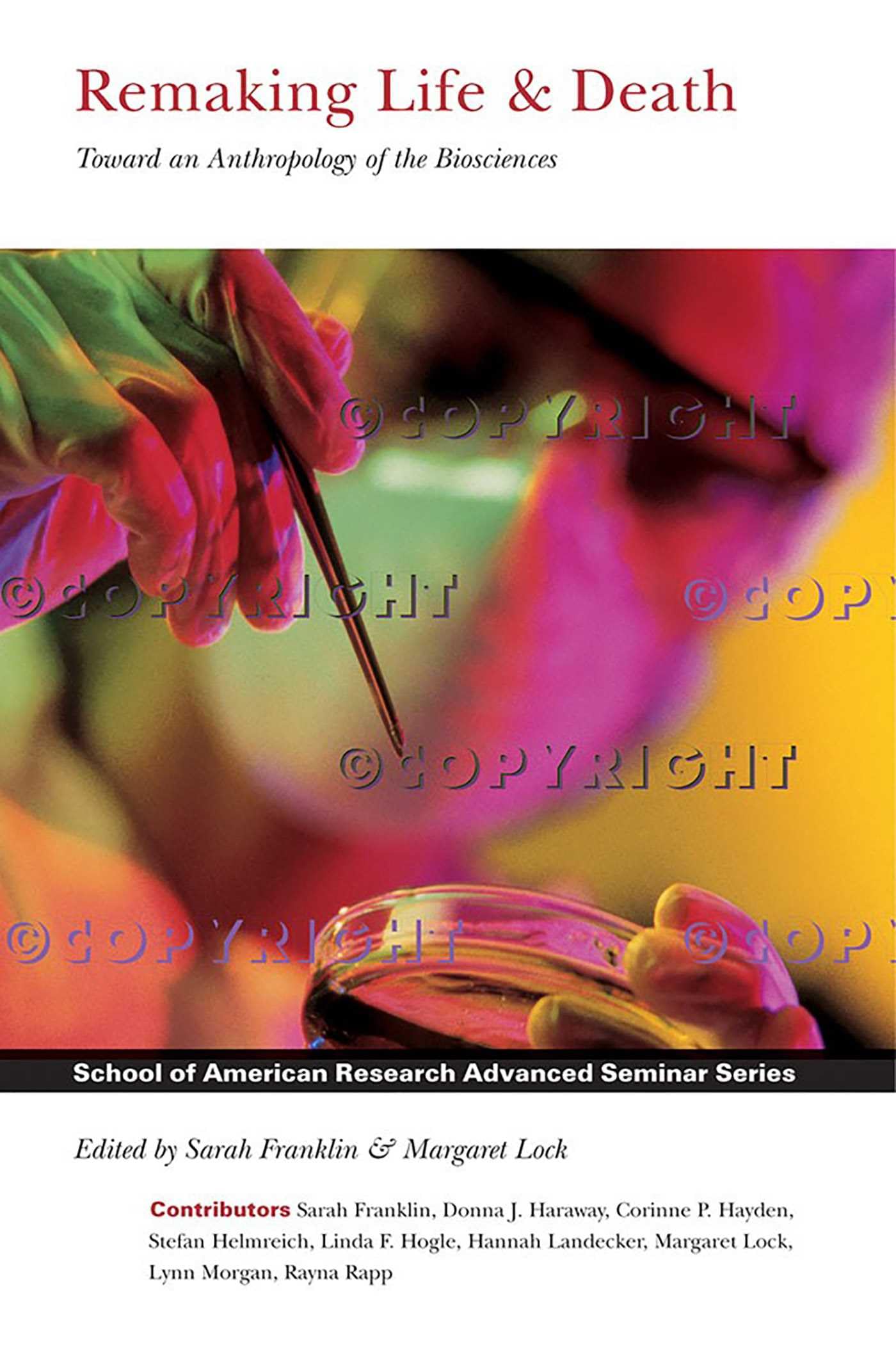
Remaking Life and Death: Toward an Anthropology of the Biosciences (School for Advanced Research Advanced Seminar Series)
$34.95
by Sarah Franklin



The boundaries of life now occupy a place of central concern among biological anthropologists. Because of the centrality of the modern biological definition of life to Euro-American medicine and anthropology, the definition of life itself and its contestation exemplify competing uses of knowledge. Ten contributions from biological and medical anthropologists consider the social implications of recent advances in biotechnology. A sampling of topics includes the commodification of the organs of brain dead patients; the reactions of various governments to cloning technologies; and the medical experiences of persons with genetic illnesses. --SciTech Book News December 2004 The essays compiled in this book map broad changes in the continuously evolving conceptions of life and death as brought about by developments in contemporary science . . . [E]ach chapter might potentially have a formative influence on its own field and related literature. The book is therefore a seminal contribution to the broader field of inquiry. --Diana Gibson, Medische Antropologie This volume...is an impressive deepening and specification of the sort of systematic work that is being done in and on biosciences. The command of complex developments in scientific research is impressive, and it is a model of what a synthetic report on an emerging research field should be. It will not only be read widely by scholars in science studies, but also...by a wide range of anthropologists. --George Marcus, Rice University The essays compiled in this book map broad changes in the continuously evolving conceptions of life and death as brought about by developments in contemporary science….[E]ach chapter might potentially have a formative influence on its own field and related literature. The book is therefore a seminal contribution to the broader field of inquiry. --Diana Gibson, Medische Antropologie This volume...is an impressive deepening and specification of the sort of systematic work that is being done in and on biosciences. The command of complex developments in scientific research is impressive, and it is a model of what a synthetic report on an emerging research field should be. It will not only be read widely by scholars in science studies, but also...by a wide range of anthropologists. --George Marcus, Rice University