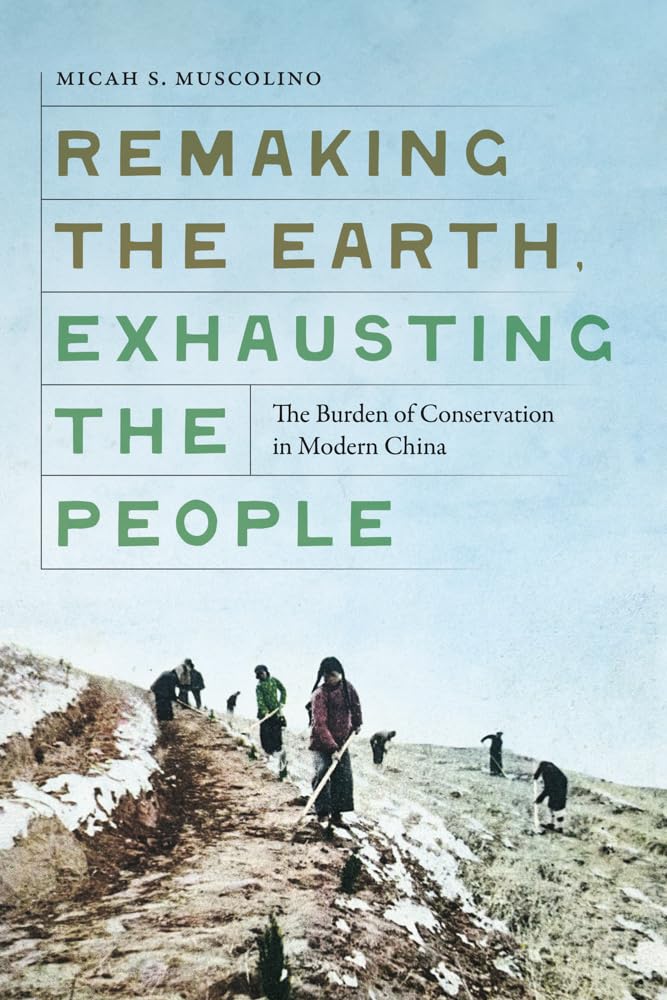
Remaking the Earth, Exhausting the People: The Burden of Conservation in Modern China
$26.30
by Micah S Muscolino



State-led conservation transformed Gansu's landscape―rural communities bore the costs From the 1940s to the 1960s, soil and water conservation measures transformed both the arid, erosion-prone environment of China’s Loess Plateau and the lives of rural people. Remaking the Earth, Exhausting the People explores how the Chinese state imposed the burden of conservation on rural communities and how the communities navigated those demands. Weaving together archival research and oral history interviews, Micah S. Muscolino demonstrates that for the inhabitants of China’s countryside, conservation programs became part of an extractive mode of accumulation that intensified labor demands and entailed loss of control over resources. Muscolino recounts how changes to the physical environment played out in villages, on farms, and within households. His multitiered investigation uncovers the relationship between the forces of nature, Chinese state policies, and the embodied experiences of rural men and women. The book also highlights the contestations and compromises that the state’s environmental interventions triggered in rural society. By illustrating how state-building and revolution in modern China altered human relationships with the natural world, Muscolino shows that examining everyday interactions with the environment is integral to understanding history from the perspectives of China’s common people. He offers a timely reminder that environmental protection cannot come at the cost of marginalized communities’ dignity, interests, or aspirations. "A remarkably nuanced and textured picture of agricultural policies, and their implementation, in post-1949 China. For quite some time, the predominate narrative has characterized agriculturalists of post-1949 as largely the faceless victims at the mercy of party-state policies and directives. The author challenges this type of thinking by arguing that conservation was an entangled and entangling undertaking that reflected a complex range of reactions from compliance to resistance."―David Pietz, author of The Yellow River: The Problem with Water in China "In 1950s Gansu, prodded by an expansive state, farmers set out to improve their lives through ambitious projects of soil and water conservation. Muscolino provides a searing analysis of what happens when state goals, however laudable, do not center the welfare of those who perform the backbreaking labor required to achieve them. A complex and devastating story."―Gail Hershatter, author of Women and China’s Revolutions Micah S. Muscolino is professor and Paul G. Pickowicz Endowed Chair in Modern Chinese History at the University of California, San Diego. His publications include The Ecology of War in China: Henan Province, the Yellow River, and Beyond, 1938–1950 .