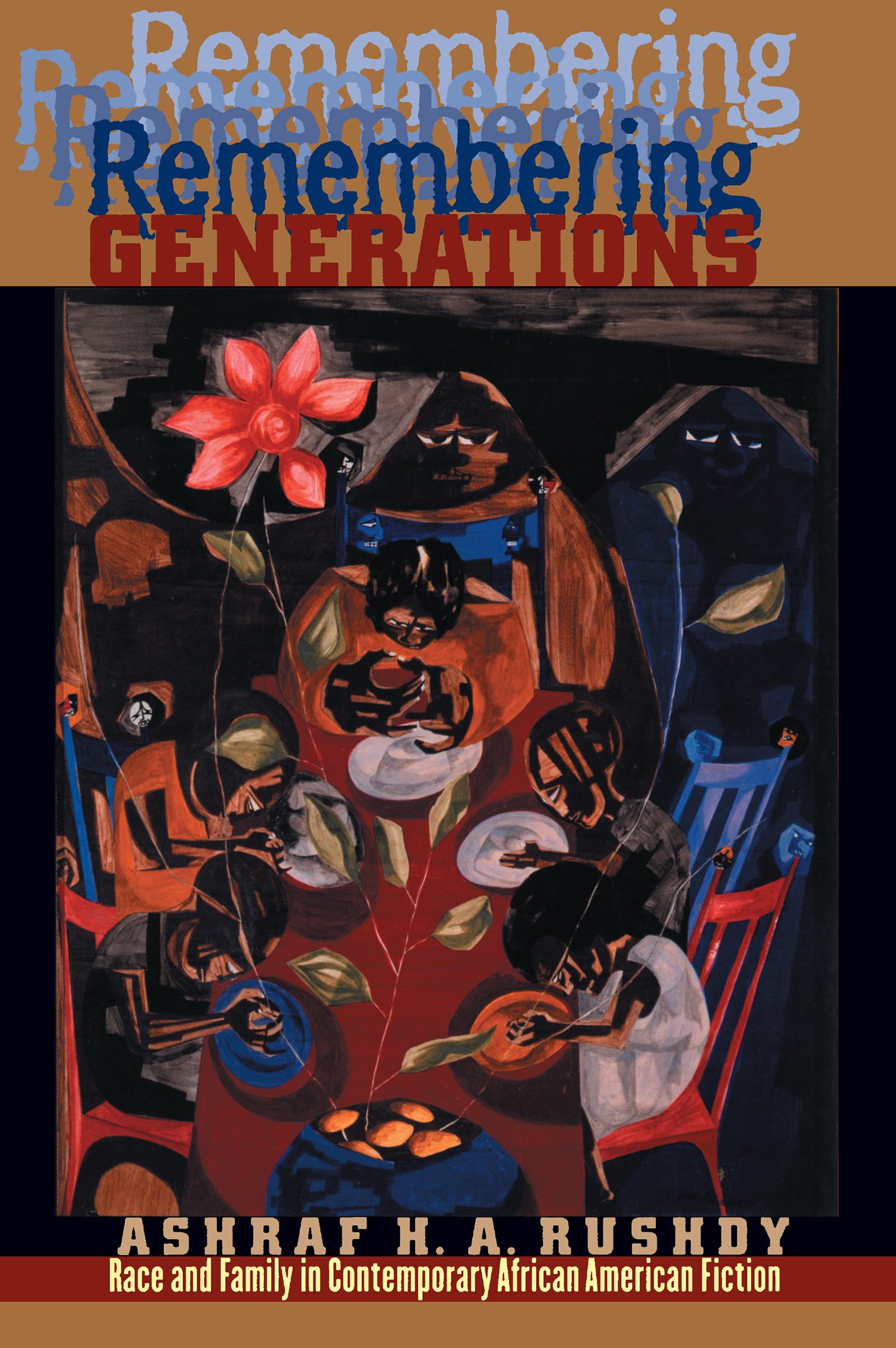
Remembering Generations: Race and Family in Contemporary African American Fiction
$42.50
by Ashraf H. A. Rushdy



Slavery is America’s family secret, a partially hidden phantom that continues to haunt our national imagination. Remembering Generations explores how three contemporary African American writers artistically represent this notion in novels about the enduring effects of slavery on the descendants of slaves in the post–civil rights era. Focusing on Gayl Jones’s Corregidora (1975), David Bradley’s The Chaneysville Incident (1981), and Octavia Butler’s Kindred (1979), Ashraf Rushdy situates these works in their cultural moment of production, highlighting the ways in which they respond to contemporary debates about race and family. Tracing the evolution of this literary form, he considers such works as Edward Ball’s Slaves in the Family (1998), in which descendants of slaveholders expose the family secrets of their ancestors. Remembering Generations examines how cultural works contribute to social debates, how a particular representational form emerges out of a specific historical epoch, and how some contemporary intellectuals meditate on the issue of historical responsibility — of recognizing that the slave past continues to exert an influence on contemporary American society. In "Remembering Generations", Ashraf Rushdy investigates yet another important dimension of the neo-slave narrative tradition of the late twentieth century: the African American 'palimpsest' narratives of the post-Black Power movement. (William L. Andrews, University of North Carolina at Chapel Hill) In "Remembering Generations," Ashraf Rushdy investigates yet another important dimension of the neo-slave narrative tradition of the late twentieth century: the African American 'palimpsest' narratives of the post-Black Power movement. (William L. Andrews, University of North Carolina at Chapel Hill) In "Remembering Generations, Ashraf Rushdy investigates yet another important dimension of the neo-slave narrative tradition of the late twentieth century: the African American 'palimpsest' narratives of the post-Black Power movement. (William L. Andrews, University of North Carolina at Chapel Hill) “In Remembering Generations , Ashraf Rushdy investigates yet another important dimension of the neo-slave narrative tradition of the late twentieth century: the African American 'palimpsest' narratives of the post–Black Power movement. The tapping of tense 'family secrets' of race and memory in the United States — which has led to a good deal of recent controversy — was launched in the African American novel of the 1970s, Rushdy tellingly argues. Remembering Generations shows us why and how such secrets began to get told in the fiction of David Bradley, Octavia Butler, and Gayl Jones, and why our understandings of blackness, whiteness, and national history have been haunted ever since.” — William L. Andrews, University of North Carolina at Chapel Hill African American writers explore the enduring effects of slavery on American society Ashraf H. A. Rushdy is professor in the African American Studies Program and the English Department at Wesleyan University in Middletown, Connecticut. He is author of Neo-Slave Narratives: Studies in the Social Logic of a Literary Form . Used Book in Good Condition