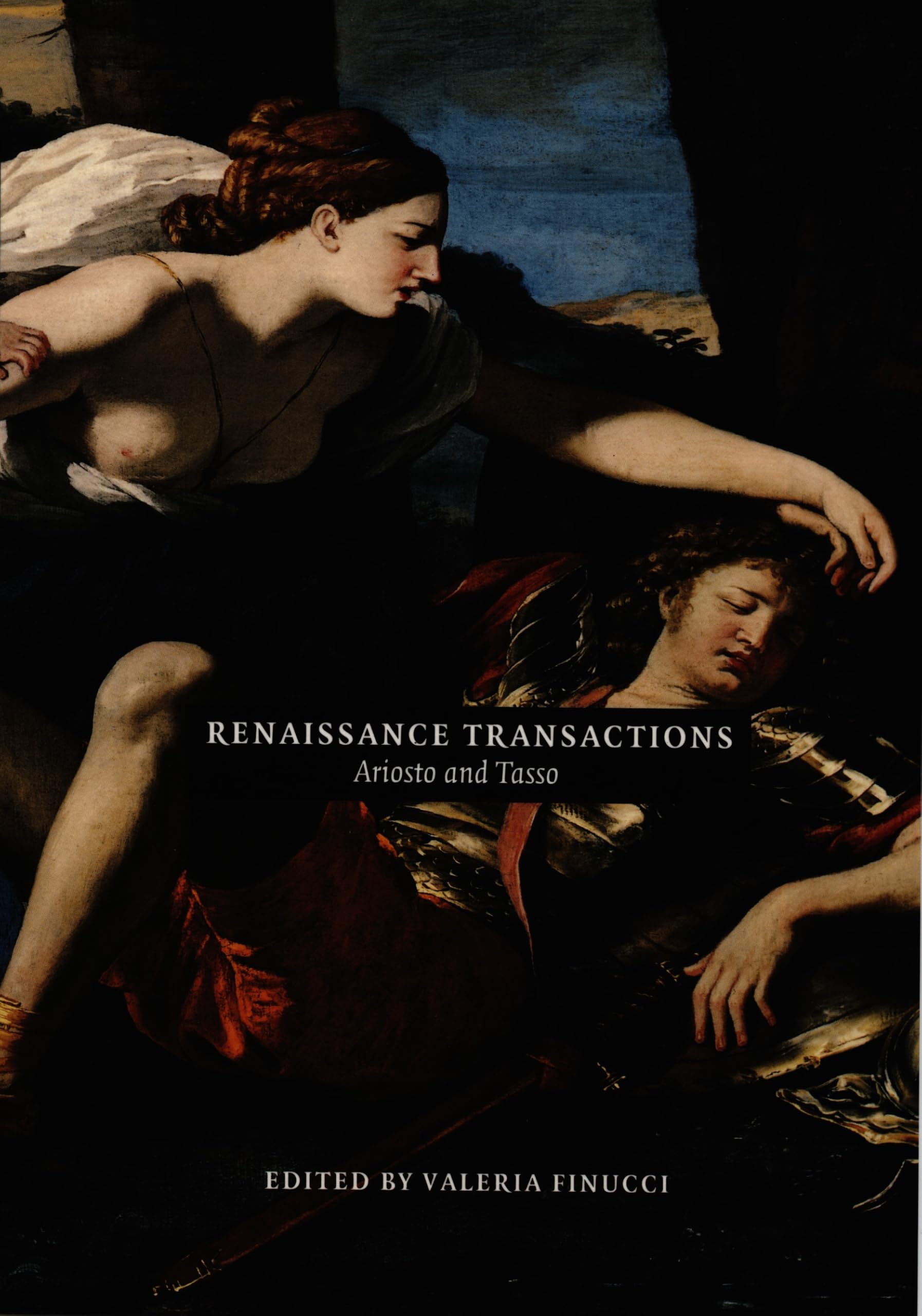
Renaissance Transactions: Ariosto and Tasso (Duke Monographs in Medieval and Renaissance Studies)
$34.95
by Valeria Finucci



The controversy generated in Italy by the writings of Ludovico Ariosto and Torquato Tasso during the sixteenth century was the first historically important debate on what constitutes modern literature. Applying current critical theories and tools, the essays in Renaissance Transactions reexamine these two provocative poet-thinkers, the debate they inspired, and the reasons why that debate remains relevant today. Resituating these writers’ works in the context of the Renaissance while also offering appraisals of their uncanny “postmodernity,” the contributors to this volume focus primarily on Ariosto’s Orlando furioso and Tasso’s Gerusalemme liberata . Essays center on questions of national and religious identity, performative representation, and the theatricality of literature. They also address subjects regarding genre and gender, social and legal anthropology, and reactionary versus revolutionary writing. Finally, they advance the historically significant debate about what constitutes modern literature by revisiting with new perspective questions first asked centuries ago: Did Ariosto invent a truly national, and uniquely Italian, literary genre—the chivalric romance? Or did Tasso alone, by equaling the epic standards of Homer and Virgil, make it possible for a literature written in Italian to attain the status of its classical Greek and Latin antecedents? Arguing that Ariosto and Tasso are still central to the debate on what constitutes modern narrative, this collection will be invaluable to scholars of Italian literature, literary history, critical theory, and the Renaissance. Contributors . Jo Ann Cavallo, Valeria Finucci, Katherine Hoffman, Daniel Javitch, Constance Jordan, Ronald L. Martinez, Eric Nicholson, Walter Stephens, Naomi Yavneh, Sergio Zatti “Most of the leading and well-known scholars of the Italian Renaissance are represented here with their sundry and complementary viewpoints. . . . The presence of so many different critical voices conveys a sense of this volume as a summa of current Renaissance criticism.”—Giuseppe Mazzotta, Yale University "Most of the leading and well-known scholars of the Italian Renaissance are represented here with their sundry and complementary viewpoints. . . . The presence of so many different critical voices conveys a sense of this volume as a "summa" of current Renaissance criticism."--Giuseppe Mazzotta, Yale University Valeria Finucci is Associate Professor of Italian at Duke University. She is the author of The Lady Vanishes: Subjectivity and Representation in Castiglione and Ariosto and the coeditor of Desire in the Renaissance: Psychoanalysis and Literature . Renaissance Transactions Ariosto and Tasso By Valeria Finucci Duke University Press Copyright © 1999 Duke University Press All rights reserved. ISBN: 978-0-8223-2295-5 Contents Acknowledgments, Introduction Ariosto, Tasso, and Storytelling, Works Cited, I Crossing Genres, II The Politics of Dissimulation, III Acting Out Fantasies, Contributors, Index, CHAPTER 1 Two Odysseys: Rinaldo's Po Journey and the Poet's Homecoming in Orlando furioso RONALD L. MARTINEZ * * * Rinaldo's journey from Paris to Lipadusa frames the concluding episodes of the 1516 Orlando furioso, leading directly into the final exordium and its presentation of the narrator arriving by ship in port after the long, forty-canto excursion of his poem. As the longest and most complex episode in the poem, Rinaldo's episode offers narrative, ethical, and cultural implications I propose to discuss in this essay. Beyond the intrinsic interest of Rinaldo's character and of the two novelle he hears on the subject of jealousy, the final position of the episode makes it important for critics interested in epic and romance closure; more recently, Dave Henderson has suggested that in its original form the episode was composed as early as 1507, making it one of the germs of the Furioso. The poem began, then, with its end. In the midst of a journey that had begun with Charlemagne in Paris, and continued via the Ardennes, the city of Basel, and the headwaters of the Rhone, Rhine, Danube, and Po, an anonymous Mantuan host delays Rinaldo and proposes he drink of the testing cup that would determine if his wife, Clarice, is faithful. To compensate for the delay, Rinaldo's host offers him overnight passage down the Po to Ravenna in a swift riverboat furnished with an informative helmsman, who narrates for the paladin the tale of Anselmo's comeuppance as a sequel to the host's own tale of misfortune caused by jealousy. After a refreshing night's sleep on the boat, Rinaldo continues overland to Urbino, Rome, and Ostia, and from there by sea to Trapani, site of Anchises' tomb, arriving finally in Lipadusa, though too late to save the life of Brandimarte, killed, at the tragic climax of Ariosto's narrative, by Gradasso wielding Orlando's sword, Durindana. But the place where Rinaldo wakes up duri