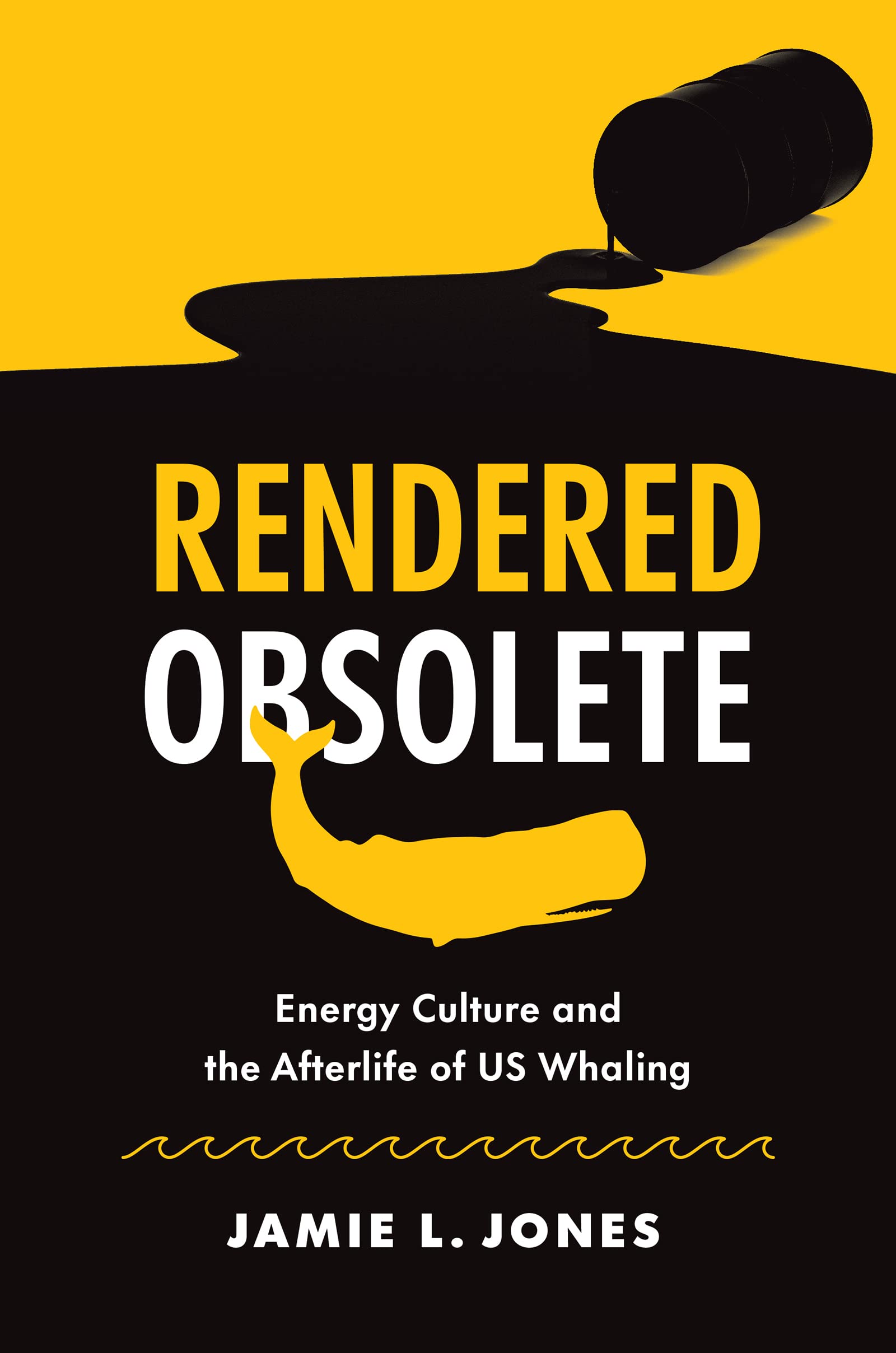



Through the mid-nineteenth century, the US whaling industry helped drive industrialization and urbanization, providing whale oil to lubricate and illuminate the country. The Pennsylvania petroleum boom of the 1860s brought cheap and plentiful petroleum into the market, decimating whale oil’s popularity. Here, from our modern age of fossil fuels, Jamie L. Jones uses literary and cultural history to show how the whaling industry held firm in US popular culture even as it slid into obsolescence. Jones shows just how instrumental whaling was to the very idea of “energy” in American culture and how it came to mean a fusion of labor, production, and the circulation of power. She argues that dying industries exert real force on environmental perceptions and cultural imaginations. Analyzing a vast archive that includes novels, periodicals, artifacts from whaling ships, tourist attractions, and even whale carcasses, Jones explores the histories of race, labor, and energy consumption in the nineteenth-century United States through the lens of the whaling industry’s legacy. In terms of how they view power, Americans are, she argues, still living in the shadow of the whale. “With today’s intensifying climate crisis and the absolute necessity of abating fossil fuels, Rendered Obsolete presents a thought-provoking interpretation of the earlier shift from organic to fossil energy and the obstacles inherent in transitioning to a greener environment.”— Journal of American History “ Rendered Obsolete is a densely argued work of energy humanities scholarship and critique that demands close reading. Jones’s unique cultural approach to the history of energy transitions offers a provocative energy lens for thinking through some key themes of early twentieth century history. . . . Jones has written a book that is, in many ways, a powerful analysis of energy regimes as cultural forces, one that other scholars can build on thanks to its deep engagement with a broad range of energy humanities scholarship.”— American Historical Review “ Rendered Obsolete is an outstanding work of scholarship, pushing the field of energy humanities in fresh, interdisciplinary directions by bringing together literary analysis, material and print cultures, museum studies, archival work, and visual studies to demonstrate the ubiquity of fossil modernity in patterns of thought as much as in objects, energy habits, and logistics networks.”— Transatlantica “Combined, these chapters offer a nuanced, novel take on how whaling and whaling culture reflect ‘the flickering associations of modernity and obsolescence’ (p. 113) in the late nineteenth and early twentieth centuries.”— Technology and Culture “Evocative. . . . Rendered Obsolete successfully argues for recognizing that ‘obsolete’ energies and industries do not disappear and continue to have cultural and political significance. Although Rendered Obsolete is categorized as a monograph in literary studies, it is very much an environmental history text as well. . . . [H]ighly interdisciplinary. . . . [A] significant contribution to energy history and energy humanities more broadly.”— Environmental History “ Rendered Obsolete successfully delivers on its mission of sketching the affective dimensions of energy transition. . . . [A]n effective reminder that energy is not immaterial, not easily fungible, but rather inheres in the stormy affective and aesthetic experiences of real human beings.”— New England Quarterly “Excellent and deeply absorbing. . . . Rendered Obsolete convincingly shows that the decline and fall of the US whaling industry, following the petroleum boom of the 1860s, is far better understood as a series of transformations and transitions, its apparent obsolescence a sign of its enduring and shifting significance for a late nineteenth- and twentieth-century (and, for the most part, white and masculine) US cultural imaginary.”— International Journal of Maritime History “ Rendered Obsolete provides a compelling perspective on the history of whaling and how we understand energy consumption. The history of the American whaling industry is the history of extractive capitalism, and Jamie Jones’s book is a fascinating account of how Americans came uncritically to affirm the narratives of technological progress promoted by the architects of energy regimes. This book will provide a crucial argument for thinking our way out of such narratives.”—Hester Blum, Penn State University “Jamie Jones makes a powerful argument against obsolescence, highlighting how outdated or outmoded cultural forms linger and persist long after their demise and, most importantly, continue to perform cultural work. Rendered Obsolete makes a very persuasive case for the ways that whaling culture, despite the prolonged demise of whaling, helped shape our current era of intense fossil fuel consumption.”—Jeffrey Insko, Oakland University “Jamie Jones makes a powerful argument against obsolescence