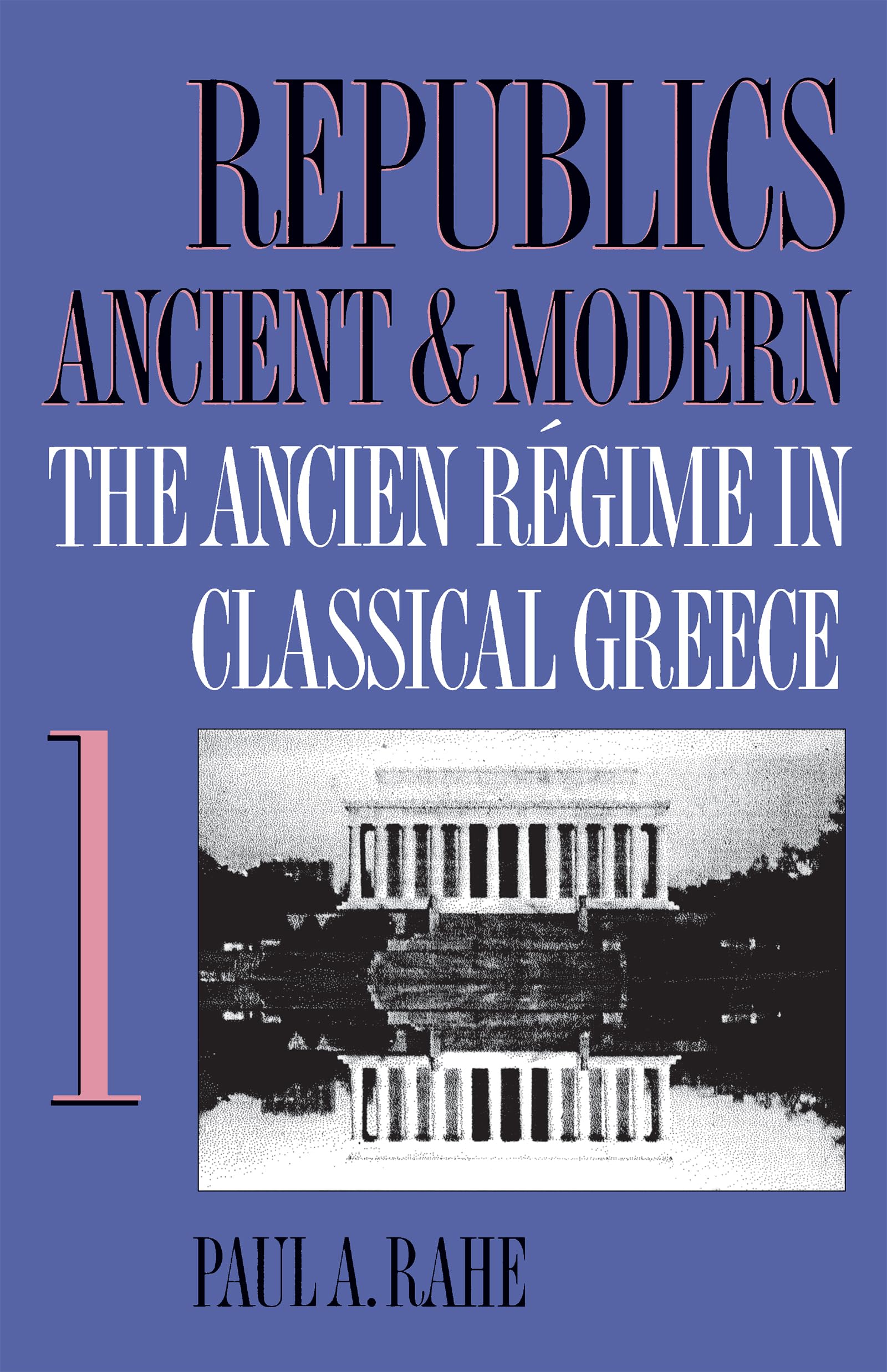
Republics Ancient & Modern, Vol. 1: The Ancien Régime in Classical Greece
$44.97
by Paul A. Rahe



An assessment of the ancient Greek city and its subsequent influence. A masterwork of political theory and comparative politics for the classroom. “In a series of sketches touching on everything from the lust for honor to the suspicion of commerce and philosophy, from the role of homoerotic bonds in maintaining military formations to the distrust of technological innovation, Rahe brilliantly reminds us how utterly committed the Greeks were to a politics in which the distribution of honors, education and culture in all their forms, and economic activity were all designed to preserve civic solidarity.” — Jack N. Rakove, American Historical Review “[An] extraordinary book. . . . It is a great achievement and will stay as a landmark.” — Patrick Leigh Fermor, The Spectator (London) “A work of magisterial erudition.” — Journal of American History “In a series of sketches touching on everything from the lust for honor to the suspicion of commerce and philosophy, from the role of homoerotic bonds in maintaining military formations to the distrust of technological innovation, Rahe brilliantly reminds us how utterly committed the Greeks were to a politics in which the distribution of honors, education and culture in all their forms, and economic activity were all designed to preserve civic solidarity.” — Jack N. Rakove, American Historical Review “[An] extraordinary book. . . . It is a great achievement and will stay as a landmark.” — Patrick Leigh Fermor, The Spectator (London) “A work of magisterial erudition.” — Journal of American History “This extraordinary book enters the generation-old controversy concerning the influence of classical republicanism on the American Revolution. . . . Rahe’s text is a splendid series of learned lectures for interested citizens, while his notes are a home school course for graduate study in the foundation of the American republic.” — Journal of the Early Republic “This is the first comprehensive study of republicanism, ancient and modern, written for our time. Among its many virtues is a rediscovery of the difference between ancient and modern republicanism and a critique of the notion of civic humanism.” ― Harvey Mansfield, Harvard University “The subject is enormously important and terribly difficult, requiring a detailed knowledge of the ancient world, of the thinking and experience of the Founding Fathers of the American republic, and of the entire history of western political thought through the eighteenth century. Rahe has that knowledge, an original and convincing understanding of the realities and thinking of life in ancient Greece, and a powerful and compelling thesis that explains how ancient republican ideas have changed almost totally as they have been transformed into the modern republic.” ― Donald Kagan, Yale University “A stunning feat of scholarship, presented with uncommon grace and ease ― the sort of big, important book that comes along a few times in a generation. In an age of narrow specialists, it ranges through the centuries from classical Greece to the new American Republic, unfolding a coherent new interpretation of the rise of modern republicanism. . . . World-class, and sure to have a quite extraordinary impact.” ― Lance Banning, University of Kentucky A stunning feat of scholarship, presented with uncommon grace and ease--the sort of big, important book that comes along a few times in a generation. In an age of narrow specialists, it ranges through the centuries from classical Greece to the new American Republic, unfolding a coherent new interpretation of the rise of modern republicanism. . . . World-class, and sure to have a quite extraordinary impact.--Lance Banning, University of Kentucky Where many intellectual historians discern a revival of the classical spirit in the political speculation of the age stretching from Machiavelli to Adam Smith, Rahe brings to light a self-conscious repudiation of the theory and practice of ancient self-government and an inclination to restrict the scope of politics, to place greater reliance on institutions than on virtuous restraint, and to give free rein to the human's capacities as a toolmaking animal. Paul A. Rahe is professor of history at the University of Tulsa. Used Book in Good Condition