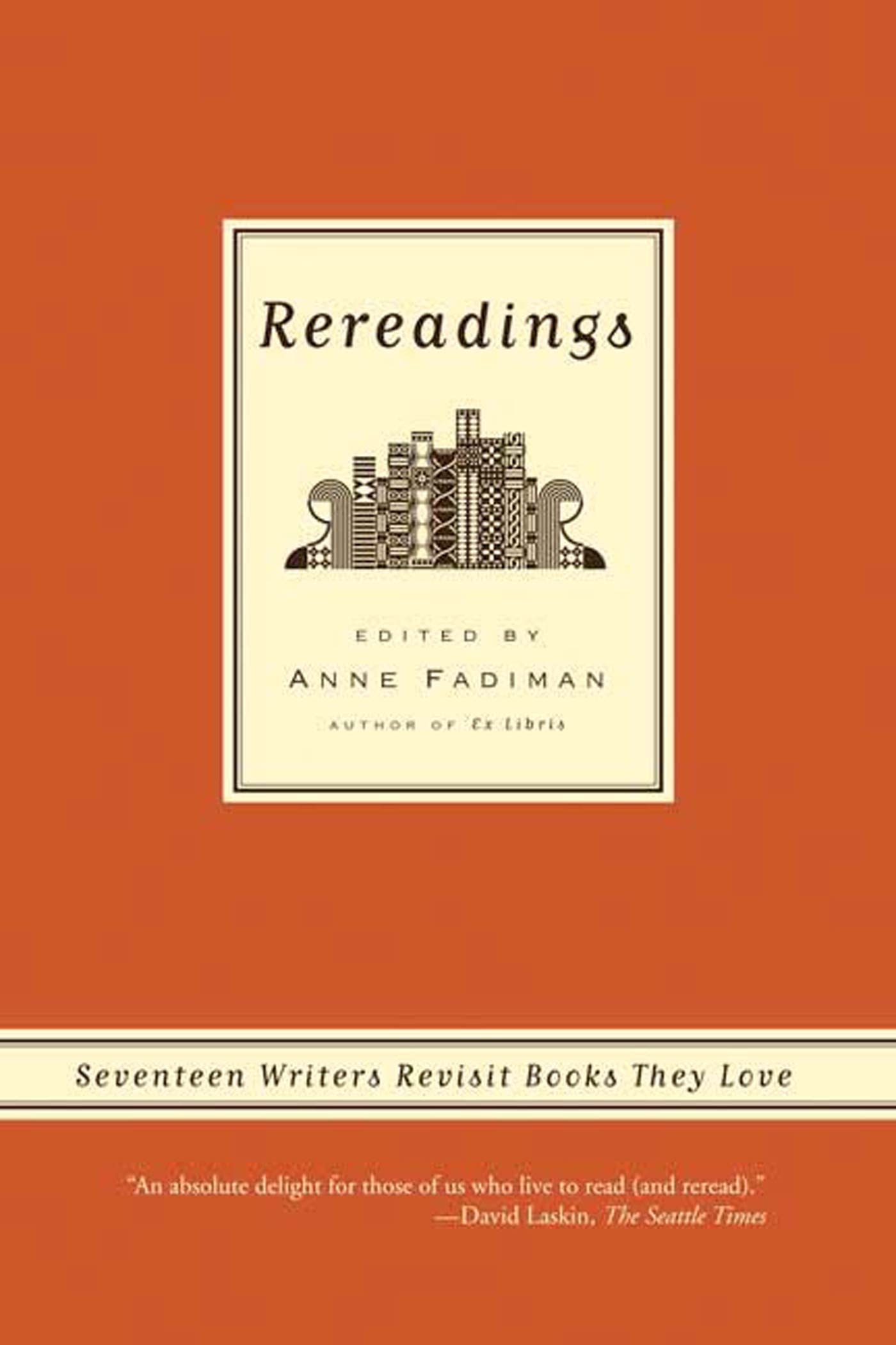



Is a book the same book―or a reader the same reader―the second time around? The seventeen authors in this witty and poignant collection of essays all agree on the answer: Never. The editor of Rereadings is Anne Fadiman, and readers of her bestselling book Ex Libris will find this volume especially satisfying. Her chosen authors include Sven Birkerts, Allegra Goodman, Vivian Gornick, Patricia Hampl, Phillip Lopate, and Luc Sante; the objects of their literary affections range from Pride and Prejudice to Sue Barton, Student Nurse . These essays are not conventional literary criticism; they are about relationships. Rereadings reveals at least as much about the reader as about the book: each is a miniature memoir that focuses on that most interesting of topics, the protean nature of love. And as every bibliophile knows, no love is more life-changing than the love of a book. “An absolute delight for those of us who live to read (and reread) . . . Fadiman has done such a fine job of selecting and arranging these pieces that they become a kind of composite literary coming-of-age memoir from the geeky, horny adolescent madly thumbing Franny and Zooey or Lord Jim in some shag-carpeted suburban basement bedroom to the sadder but wiser critic, novelist, poet who gazes wistfully at the ghost of a younger self rising from the pages of a once-loved book.” ― David Laskin, The Seattle Times “A delightful glimpse into the relationship between reader and book.” ― Teresa K. Weaver, The Atlanta Journal-Constitution “f you’re a fan of Anne Fadiman’s Ex Libris―and who among right-thinking people isn’t?―then your heart will skip a beat over her new anthology, Rereadings . . . thoroughly enjoyable essays” ― Claire Dederer, Newsday “A deep and wonderfully complex story about relationships . . . Anne Fadiman's diverse collection of essays encourages readers to rethink the way we see our favorite books and ultimately the way we see ourselves through them.” ― Jill Marr, Pages Anne Fadiman is the author, most recently, of the essay collection Frog (2026) . Her first book, The Spirit Catches You and You Fall Down (1997), won the National Book Critics Circle Award, the Los Angeles Times Book Prize, and the Salon Book Award. In 2017, she published The Wine Lover’s Daughter , a memoir about her father. Fadiman has also written two essay collections, Ex Libris and At Large and At Small , and edited Rereadings: Seventeen Writers Revisit Books They Love . She is Professor in the Practice of English and Francis Writer in Residence at Yale. Rereadings Seventeen writers revisit books they love By Farrar, Straus and Giroux ISBN: 0374530548 Excerpted from Rereadings, edited by Anne Fadiman. Foreword and editorial work copyright © 2005 by Anne Fadiman. Published in September 2005 by Farrar, Straus and Giroux, LLC. All rights reserved. Foreword: On Rereading W hen my son was eight, I read C. S. Lewis’s The Horse and His Boy aloud to him. I had originally read it when I was eight myself, and although I’d reread the better-known Narnia books— The Lion, the Witch and the Wardrobe; the Magician’s Nephew, The Silver Chair —in the interim, more than forty years had passed since I’d read The Horse and His Boy . Reading a favorite book to your child is one of the most pleasurable forms of rereading, provided the child’s enthusiasm is equal to yours and thus gratifyingly validates your literary taste, your parental competence, and your own former self. Henry loved The Horse and His Boy , the tale of two children and two talking horses who gallop across an obstacle-fraught desert in hopes of averting the downfall of an imperiled kingdom that lies to the north. It’s the most suspenseful of the Narnia books, and Henry, who was at that poignant age when parents are still welcome at bedtime but can glimpse their banishment on the horizon, begged me each night not to turn out the light just yet: how about another page, and then how about another paragraph, and then, come on, how about just one more sentence ? There was only one problem with this idyllic picture. As I read the book to Henry, I was thinking to myself that C. S. Lewis, not to put too fine a point on it, was a racist and sexist pig. I’d read two biographies of Lewis and knew that his relations with women, colored by the death of his mother when he was nine, were pretty peculiar. I’d read “The Shoddy Lands,” a creepy misogynist fantasy in which the (male) narrator encounters a giantess whose nude body makes him gag. However, I remembered The Horse and His Boy only as a rollicking equestrian adventure, sort of like Misty of Chincoteague but with swordfights instead of Pony Penning Day. My jaw dropped when I realized that Aravis, its heroine, is acceptable to Lewis because she acts like a boy—she’s interested in “bows and arrows and horses and dogs and swimming”—and even dresses like one, whereas the book’s only girly girl, a devotee of “cl