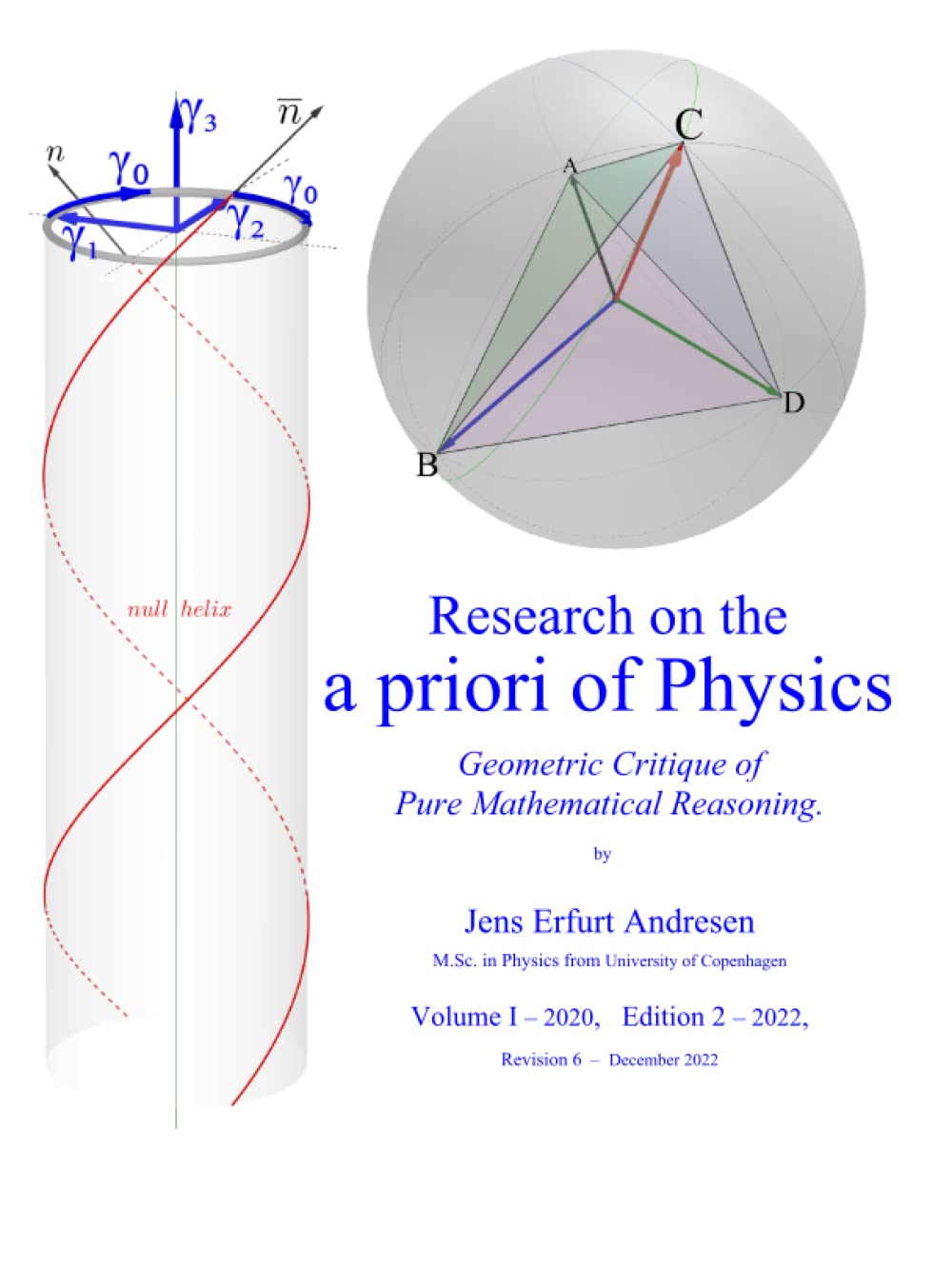
Research on the a priori of Physics: Geometric Critique of Pure Mathematical Reasoning
$53.57
by Jens Erfurt Andresen



An Ethical Attempt at an a priory Epistemology for Physics. The analysis of this book aims to find the fundamental concept ideas for understanding physics. Everything we see has a geometric size and structure in space. Every time cyclic identical things are counted, we get the idea of geometric events in a Space-Time concept for the universal space of Nature. Looking out into the night starry sky, we realise we live in the middle of a big spatial sphere. Pointing a stone, a wall, the page of a book or screen, or even a celestial star, surfaces of everything are across the looking direction as a straight line into the depth . – All these light-transmitting surfaces we see have two dimensions 2D, a length (width), and a breadth (height), as x and y coordinates, or when it comes to the celestial sky the spherical angular coordinates φ and θ . The depth is then the third z coordinate or r as the radius out to the spherical surface. This look into space gives a possibility of active rotation around such a direction as an imaginary thought of a transversal plane. This is in tradition, abstract well described mathematically by the complex exponential function exp( i ψ ) driven by the imaginary unit i of the complex number plan theory. This quality of Space has been purely epistemologically explained especially in modern narratives of physics. This formidable book tries to investigate this quality of physical Space-Time by first approaching the time-energy problem as cyclic rotations getting any information from a universal Nature. Then trying a description of the structure quality of Space using the idea of Geometric Algebra, by well-known geometric vector objects and their multiplication products to describe angular movements in rotations, used as generalised representatives for abstract localised subjects and getting information out from the substance of Space and Time per se. In the heavy use of mathematical concepts, the goal of this book has been to avoid the mysterious mathematical idealism and instead keep the reference to what we can know as the structure of Nature. The development throughout this book mainly follows the working process of the author, and can be read consecutively, but can also be useful as a handbook by searching its extensive index. __________________________ General Prerequisite Disclaimer: It is presumed and recommended that the reader is a graduated physicist. The interpretation of this book is purely the reader's responsibility. __________________________________________ The Author: Jens Erfurt Andresen, born 1947, M.Sc. graduated as a physicist in 1983 from the University of Copenhagen in solid state physics and specialised in experimental superconducting Josephson bridge parametric microwave amplification; having many other skills: analog audio electronic development for decades, house building, agriculture, and some teaching. 28 years of work in Danish national radio network planning for electromagnetic wave propagation and antennas, modelling, measurements, and mapping for cellular and broadcast. In 2002 the author started a private research project investigating the fundamental ideas for a new ethic epistemological philosophy for the science of physics resulting in this book work: Research on the a priori of Physics , Geometric Critique of Pure Mathematical Reasoning . See more at: www.tetraon.dk ___________________________________________________ David Hestenes, who promoted the ideas of Geometric Algebra, has briefly perused this book manuscript and found the " use of Geometric Algebra and Space-Time Algebra with skill and understanding with nice diagrams as well. "