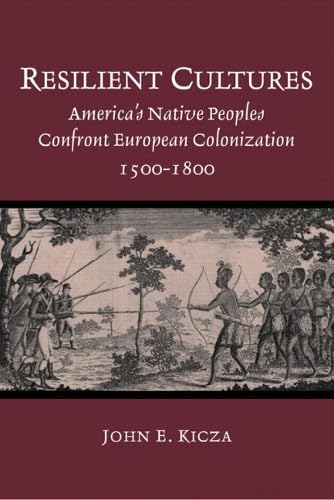
Resilient Cultures: America's Native Peoples Confront European Colonization, 1500-1800
$48.33
by John Kicza



This book provides a comparative perspective of the impact of early European colonization on the native peoples of the Americas. It covers the character of the indigenous cultures before contact, and then addresses the impact of and creative ways in which they adapted to the establishment of colonies by the Spanish, Portuguese, French, Dutch, and English. Paying attention to environmental change, the book considers such issues as the nature of military conflicts, the cultural and material contributions of each side to the other, the importance of economic exchanges, and the demographic transformation. For individuals interested in the history of colonial America, colonial Latin America, and the American Indian. " Resilient Cultures is a triumph of multum in parvo. I do not think students will find a better conspectus of the subject." Felipe Fernandez-Armesto, Queen Mary, University of London, and Faculty of Modern History, Oxford University "In this ambitious and pathbreaking comparative project, John Kicza considers the impact of Spanish, Portuguese, French, Dutch and English colonialism on the diverse indigenous societies of the Americas. He argues that throughout the Americas native peoples responded to the challenges of European colonialismthe precise form it took in any particular region was heavily influenced by the nature of indigenous societies at contactwith creativity and resilience. The emphasis on the significance of Native American societies to the creation of colonial ones within an American-wide comparative context lies at the heart of the innovative and important contribution made by Resilient Cultures. It deserves the attention of every reader interested it) colonialism in the Americas." Rebecca Horn, University of Utah "There are several aspects to the book's organization that I find very appealing. '1lie effort to incorporate North and South America is laudatory. U.S. historians, in particular. are open to charges of provincialism as we rarely go beyond current United States' borders in our investigation of the past. This book would certainly widen our perspective considerably and integrate material that most of us know nothing about." Sherry L. Smith, Southern Methodist University "Resilient Cultures addresses issues relating to native peoples representative of most of the Western Hemisphere, and that is what makes this book so attractive. It ignores the artificial political boundaries that divide countries and which arc not necessarily appropriate indicators of actual cultural entities and the peoples themselves ...this is wonderful history, especially because it undoes stereotypes about conquest and native cultural demise." Susan Schroeder, Tulane University This book provides a comparative perspective of the impact of early European colonization on the native peoples of the Americas. It covers the character of the indigenous cultures before contact, and then addresses the impact ofand creative ways in which they adapted tothe establishment of colonies by the Spanish, Portuguese, French, Dutch, and English. Paying attention to environmental change, the book considers such issues as the nature of military conflicts, the cultural and material contributions of each side to the other, the importance of economic exchanges, and the demographic transformation. For individuals interested in the history of colonial America, colonial Latin America, and the American Indian. The native peoples of the Americas numbered many millions when they first came into contact with persons from the Old World, but they soon suffered grievous losses in population from their initial exposure to a variety of epidemic diseases. Native peoples also often experienced casualties from military conflicts with the European settlers or against other indigenous societies who were responding to the unprecedented upheaval caused by the establishment of the early colonies. However, the devastation and adaptation that were very much part of this process did not erase the physical or cultural presence of the Indian peoples who continue to thrive in many nations in both North and South America. In Canada, the Iroquois flourish to this day, many practicing a distinctive religion that emerged over a century and a half after their initial contact with Europeans. In the eastern United States, over the past quarter century, native peoples have successfully asserted their rights to extensive bodies of landor considerable compensation for the loss of themunder colonial treaties. Tribes once thought to have disappeared have in recent decades gained recognition of their existence from the federal government. In Latin America, native peoples living on their own land have endured, even sometimes prospered, to the present day. Some millions of people still speak indigenous languages as their primary means of communication. Written records in these languages date from ver