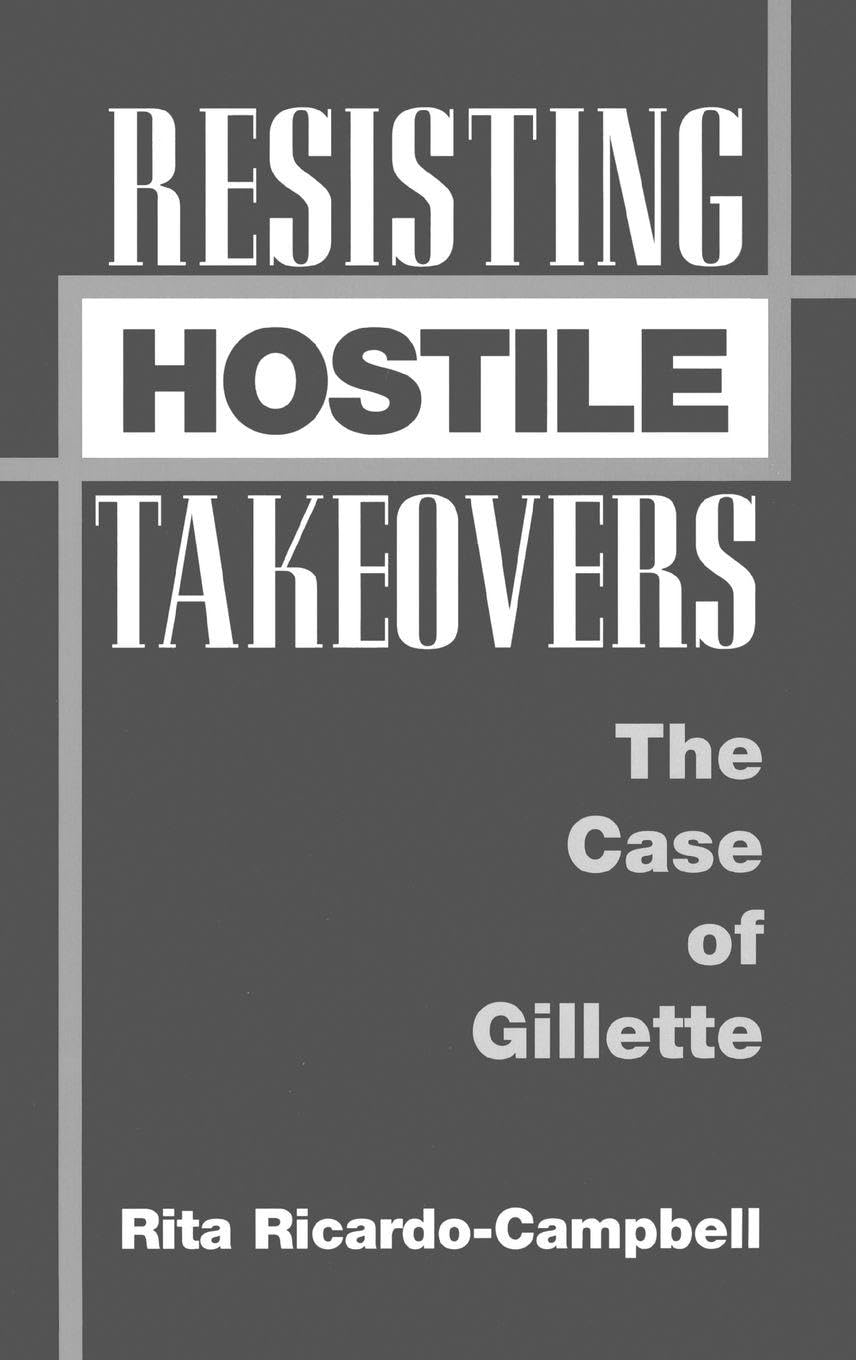



Written by the first woman director of the Gillette Company, this is an exciting first-hand account of Gillette's successful fight against four hostile takeover efforts during the late 1980s. After a brief, insightful history of the company and the growth of its world-famous products―Gillette razors and blades; Braun coffee machines and electric razors; Oral-B toothbrushes; Paper Mate, Waterman, and Parker pens; and cosmetics―the author tells the inside story of Ronald Perelman's three attempts and the Coniston Partners' one attempt to take over Gillette. Ricardo-Campbell, who chaired Gillette's Finance Committee during this period, provides a fascinating look at the ensuing proxy battles and other intricate financial maneuvers. Combining academic theory and first-hand experience in its discussion of topics such as greenmail and poison pills, this work also features such world-renowned corporate figures as Warren Buffett, Joe Flom, and Eric Gleacher. "[This book] is must reading for business executives and students of American business history. With her detailed understanding of Gillette's history from its founding in 1901, through the Great Depression, World War II, the oil crises of the 1970s, the hostile takeover attempts of the 1980s and the more friendly bids in the 1990s, Professor Ricardo-Campbell captures the essential features of the American corporate experience in the 20th century. This superb volume will also serve as a valuable educational resource, as it underscores the importance of courageous leadership, the need for continual product innovation and diversification, and the importance of risk in today's global business environment."-William E. Simon Former Secretary of the Treasury "Ricardo-Campbell has succeeded in making a takeover battle and the boardroom deliberations come alive. Perhaps the most important contribution of the book is that she revised the normal approach. Rather than starting with a theory or conclusion that she wanted to prove, Ricardo-Campbell analyzed the events and then followed the findings wherever they led."- Murray Weidenbaum Former Chairman Council of Economic Advisors ?Resisting Hostile Takeovers is an insider's first-hand narrative of a significant event in contemporary business history... The book takes the reader into the Gillette boardroom and presents the human emotion and drama of corporate economic warfare. For the business economist, there is nothing like it in the literature.... we are given insight into the dilemmas the author faced when reconciling policy decisions driven by general economic theory versus choices that are mandated by specific business situations.... The book allows the rest of us to share a part of the excitement, drama, and personal experiences of a fellow business economist who was an active participant in this interesting story.?-Business Economics "Resisting Hostile Takeovers is an insider's first-hand narrative of a significant event in contemporary business history... The book takes the reader into the Gillette boardroom and presents the human emotion and drama of corporate economic warfare. For the business economist, there is nothing like it in the literature.... we are given insight into the dilemmas the author faced when reconciling policy decisions driven by general economic theory versus choices that are mandated by specific business situations.... The book allows the rest of us to share a part of the excitement, drama, and personal experiences of a fellow business economist who was an active participant in this interesting story."-Business Economics RITA RICARDO-CAMPBELL is Senior Fellow Emerita at the Hoover Institution, Stanford University. She was the first woman director of the Gillette Company, held positions at Tufts University and Harvard University, and has written numerous books and articles. 1. Introduction The Gillette Company was 94 years old in 1996. It took the name "Gillette Safety Razor Company" a year after its inception. The patent on its remarkable innovation, the Gillette safety razor, was granted in 1904. Gillette was a target of hostile takeovers from November 1986 until August 1989, when investor Warren Buffett purchased $600 million worth of its newly issued preferred stock (11 percent of the company). One of the questions I will attempt to answer in this book is: Why was The Gillette Company an unrelenting takeover target during this period? Many theories have been developed by economists and others to explain why a specific company becomes a target of takeovers. The most common explanation is that the company is poorly managed, and a would-be acquirer believes he or she could do better. But as stated in a Forbes magazine cover article, published the day before the unexpected and untimely death on January 25, 1991, of Gillette CEO Colman Mockler, Jr., "Gillette was not a flabby company that needed its belt tightened. It was a tightly run outfit. [Colman M.] Mockler took over in 1975 and sold