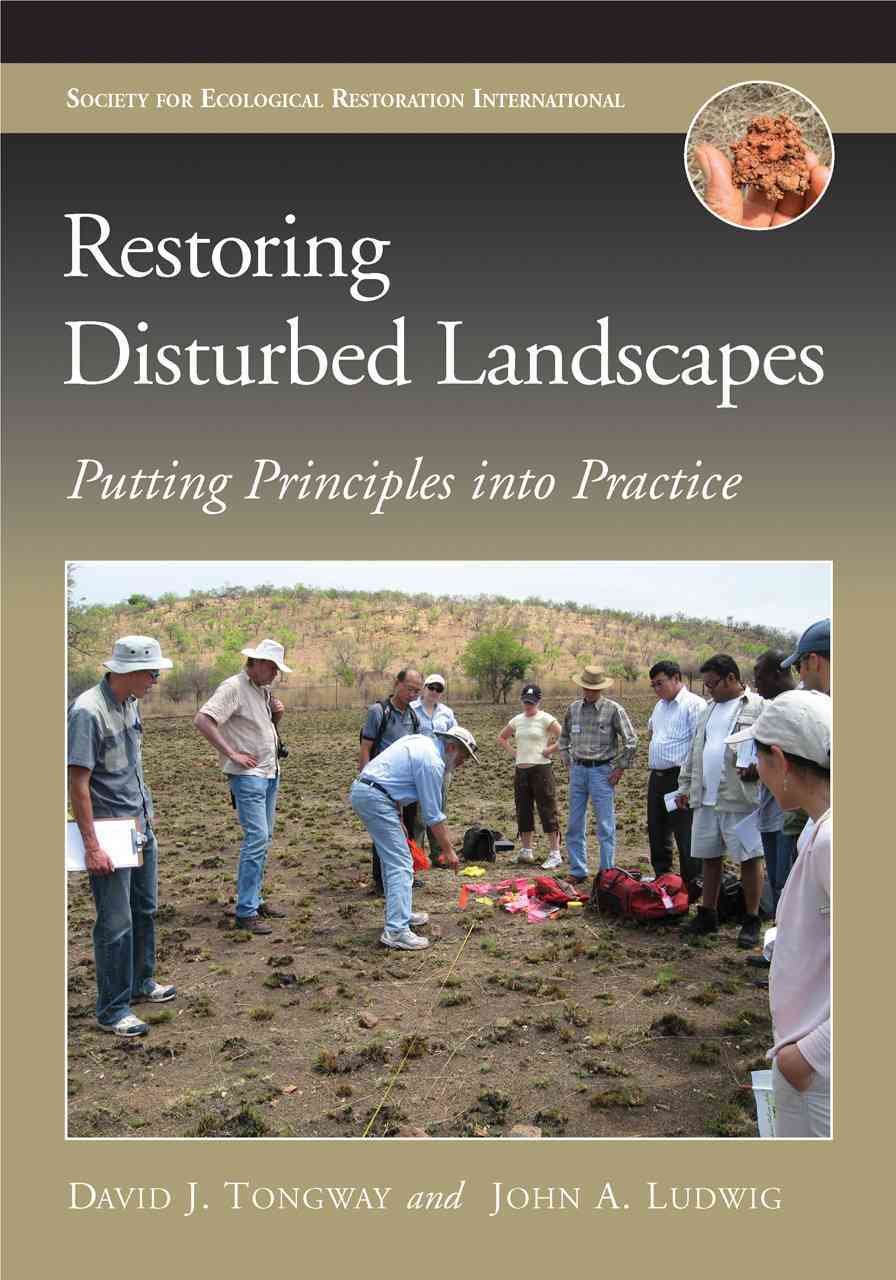
Restoring Disturbed Landscapes: Putting Principles into Practice (The Science and Practice of Ecological Restoration Series)
$46.53
by David J Tongway



Restoring Disturbed Landscape s is a hands-on guide for individuals and groups seeking to improve the functional capacity of landscapes. The book presents a five-step, adaptive procedure for restoring landscapes that is supported by proven principles and concepts of ecological science. Written by restoration experts with a wealth of experience teaching restoration principles and techniques to practitioners and would-be practitioners from a variety of backgrounds, the book offers: an outline of a science-based, ecologically sound approach to restoration - discussion of the conceptual framework and rigorous principles that underlie the approach - case studies of two types of restoration projects (restoring mined landscapes and restoring damaged rangelands) that illustrate how the approach, framework, and four key principles for restoring landscapes have been implemented - a variety of scenarios that represent typical restoration problems and how those problems can be handled - indicators for monitoring and how landscape function can be tracked and analyzed as part of a comprehensive monitoring program. Abundantly illustrated with photos and figures that clearly explain concepts outlined in the book, Restoring Disturbed Landscapes is an engaging and accessible work designed specifically for restoration practitioners with limited training or experience in the field. It tells restorationists where to start, what information they need to acquire, and how to apply this information to their specific situations. "This is an excellent guide on how to restore degraded landscapes. Tongway and Ludwig have brought together their insights from three decades of research on landscape function. They are uniquely qualified to provide this readable account of the determinants of functional versus dysfunctional landscapes, and their five-step procedure for how to restore the latter has an impressive record." -- Brian Walker ― research fellow, CSIRO Australia and The Stockholm Resilience Center "Many countries, including Australia, suffer the loss of billions of dollars from land degradation every year from problems of the kind Tongway and Ludwig address in Restoring Disturbed Landscapes . This wonderful book will trigger a revolution in land-use strategies and should be in the hands and minds of everyone, from graziers to academics, who wants a secure future for our world." -- Michael Archer ― Professor, University of New South Wales, Australia "Restoring landscape function, so vital to ecosystem services, is the next frontier for restorationists, and Tongway and Ludwig describe that future eloquently. Their in-depth treatment of function and case studies are especially helpful, and the photos clearly demonstrate that the authors walk their talk. As a restoration practitioner and researcher, I find that this book has filled a critical gap for me. It should be a part of every restorationist's arsenal." -- Michael Hogan ― Founder, Integrated Environmental Restoration Services, Lake Tahoe, California "Experts in the field of landscape restoration, the authors share their extensive knowledge and experiences for the purpose of encouraging ecosystem rehabilitation. They present a report on their concepts and tested methods that can be used in sites around the world in order to 'repair damaged landscape to an acceptable level of functionality.' The five-step procedure will serve as a useful guide to professionals and those interested in restoration practices in a broad range of problems." -- Marilyn K. Alaimo ― garden writer and volunteer, Chicago Botanic Garden "...the authors succeeded in their objective. That is, to make the reader think more about function or process and less about the simple presence or abundance of species and life forms as measures of restoration success." ― Ecological Management & Restoration David Tongway is a soil scientist and landscape ecologist who worked for Australia’s Commonwealth Scientific and Industrial Research Organisation (CSIRO) for 38 years. He is an Honorary Fellow at CSIRO’s Gungahlin Laboratory in the Australian Capital Territory. John Ludwig is a plant and landscape ecologist who worked in the Biology Department, New Mexico State University, in Las Cruces,1969–1985 and for CSIRO, 1985–2007. He is currently an Honorary Fellow at CSIRO’s laboratory in Atherton, Queensland. Restoring Disturbed Landscapes Putting Principles into Practice By David J. Tongway, John A. Ludwig ISLAND PRESS Copyright © 2011 David J. Tongway and John A. Ludwig All rights reserved. ISBN: 978-1-59726-581-2 Contents FOREWORD James Aronson, PREFACE, ACKNOWLEDGMENTS, PART I A Function-Based Approach to Restoring Disturbed Landscapes, Chapter 1 Our Approach to Restoring Disturbed Landscapes: Five-Step Adaptive Procedure, Chapter 2 A Framework for How Landscapes Function, Chapter 3 Principles for Restoring Landscape Functionality, PART II Case Studies on Restoring Landscapes: Mi