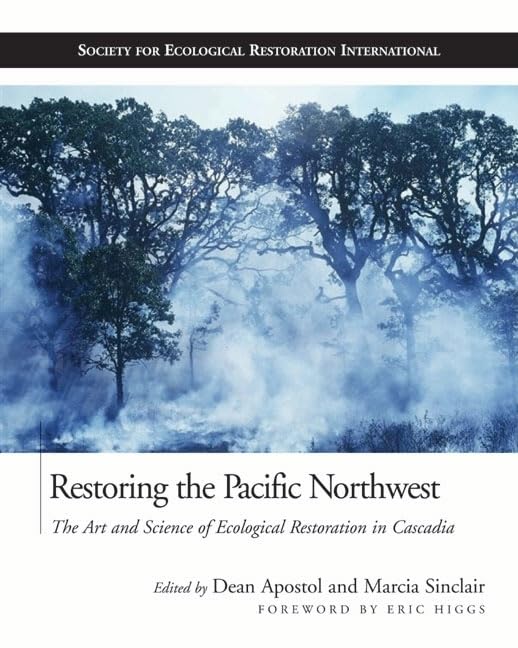
Restoring the Pacific Northwest: The Art and Science of Ecological Restoration in Cascadia (The Science and Practice of Ecological Restoration Series)
$87.00
by Dean Apostol



The Pacific Northwest is a global ecological "hotspot" because of its relatively healthy native ecosystems, a high degree of biodiversity, and the number and scope of restoration initiatives that have been undertaken there. Restoring the Pacific Northwest gathers and presents the best examples of state-of-the-art restoration techniques and projects. It is an encyclopedic overview that will be an invaluable reference not just for restorationists and students working in the Pacific Northwest, but for practitioners across North America and around the world. "This work summarizes scientific research and presents case studies of applications of ecological restoration in the Pacific Northwest, composed for the purposes of this work of all of the watersheds that flow to the Pacific Ocean through North America's temperate rainforest zone." ― Reference & Research Book News "This courageous and ambitious work makes us recognize that restoration should no longer be seen as many small, piecemeal attempts at site restoration, but as a massive and coordinated movement to revive and strengthen the networks of natural capital and landscape that sustain our cultures, communities, and economies. The multiple authors are to be commended for pulling together in one place such a comprehensive, deep, and ultimately practical guide to what can and should be done to restore a whole region." -- Stephen R. J. Sheppard ― Director of Collaborative for Advanced Landscape Planning, University of British Columbia, Vancouver "Interest in environmental restoration has exploded in the Pacific Northwest in the last decade. Legions of volunteers and professionals, biologists and planners have been getting their hands dirty, combining science with practice to learn what really works. Restoring the Pacific Northwest is the inspirational, practical, essential reference we all have been waiting for." -- Sara Vickerman ― senior director of biodiversity partnerships, Defenders of Wildlife "Showcasing nine seminal habitat types and illustrating six distinct restoration approaches through more than three dozen case studies, Dean Apostol and Marcia Sinclair have assembled a tour de force, state-of-ecosystem-restoration practice in the Pacific Northwest. All who care about the world our grandchildren inherit owe the authors a heartfelt thanks." -- David W. Hulse ― Philip H. Knight Professor in Landscape Architecture, University of Oregon Dean Apostol is a landscape architect, natural resource planner, writer, and teacher, who lives and works on a small farm near Portland, Oregon. Restoring the Pacific Northwest The Art and Science of Ecological Restoration in Cascadia By Dean Apostol, Marcia Sinclair ISLAND PRESS Copyright © 2006 Island Press All rights reserved. ISBN: 978-1-55963-078-8 Contents Title Page, Copyright Page, Dedication, FOREWORD, PREFACE, ACKNOWLEDGMENTS, INTRODUCTION, PART I - The Big Picture, Chapter 1 - Northwest Environmental Geography and History, Chapter 2 - Ecological Restoration, PART II - Pacific Northwest Ecosystems, Chapter 3 - Bunchgrass Prairies, Chapter 4 - Oak Woodlands and Savannas, Chapter 5 - Old-Growth Conifer Forests, Chapter 6 - Riparian Woodlands, Chapter 7 - Freshwater Wetlands, Chapter 8 - Tidal Wetlands, Chapter 9 - Ponderosa Pine and Interior Forests, Chapter 10 - Shrub Steppe, Chapter 11 - Mountains, PART III - Crossing Boundaries, Chapter 12 - Urban Natural Areas, Chapter 13 - Stream Systems, Chapter 14 - Landscape and Watershed Scale, Chapter 15 - Restoring Wildlife Populations, Chapter 16 - Managing Northwest Invasive Vegetation, Chapter 17 - Traditional Ecological Knowledge and Restoration Practice, Conclusion: - The Status and Future of Restoration in the Pacific Northwest, About the Contributors, Supporters and Partners, INDEX, CHAPTER 1 Northwest Environmental Geography and History DEAN APOSTOL It is not bragging to claim that the Pacific Northwest is one of the world's most spectacular regions. Our mountains and glaciers would make the Swiss envious, and our jagged, rocky coast washed by crashing ocean surf is the equal of New Zealand, Norway, or western Ireland. Our old- growth conifer forests have some of the world's tallest trees and highest levels of biomass. The vast sagebrush steppe is a land of national park- scale superlatives. One of the least populated places in North America, it boasts the deepest canyon (Hell's Canyon of the Snake River) and largest natural fault (Steens Mountain) on the continent. Our human history and cultural development are equally impressive and fascinating. Northwest Indians attained a unique and very sophisticated level of art and culture that reflected the material abundance of the land and sea. The journals of Lewis and Clark reveal the land as it was before Euro-Americans set about changing it. Pioneers on the Oregon Trail bypassed nearly 3,000 miles of central continent to reach