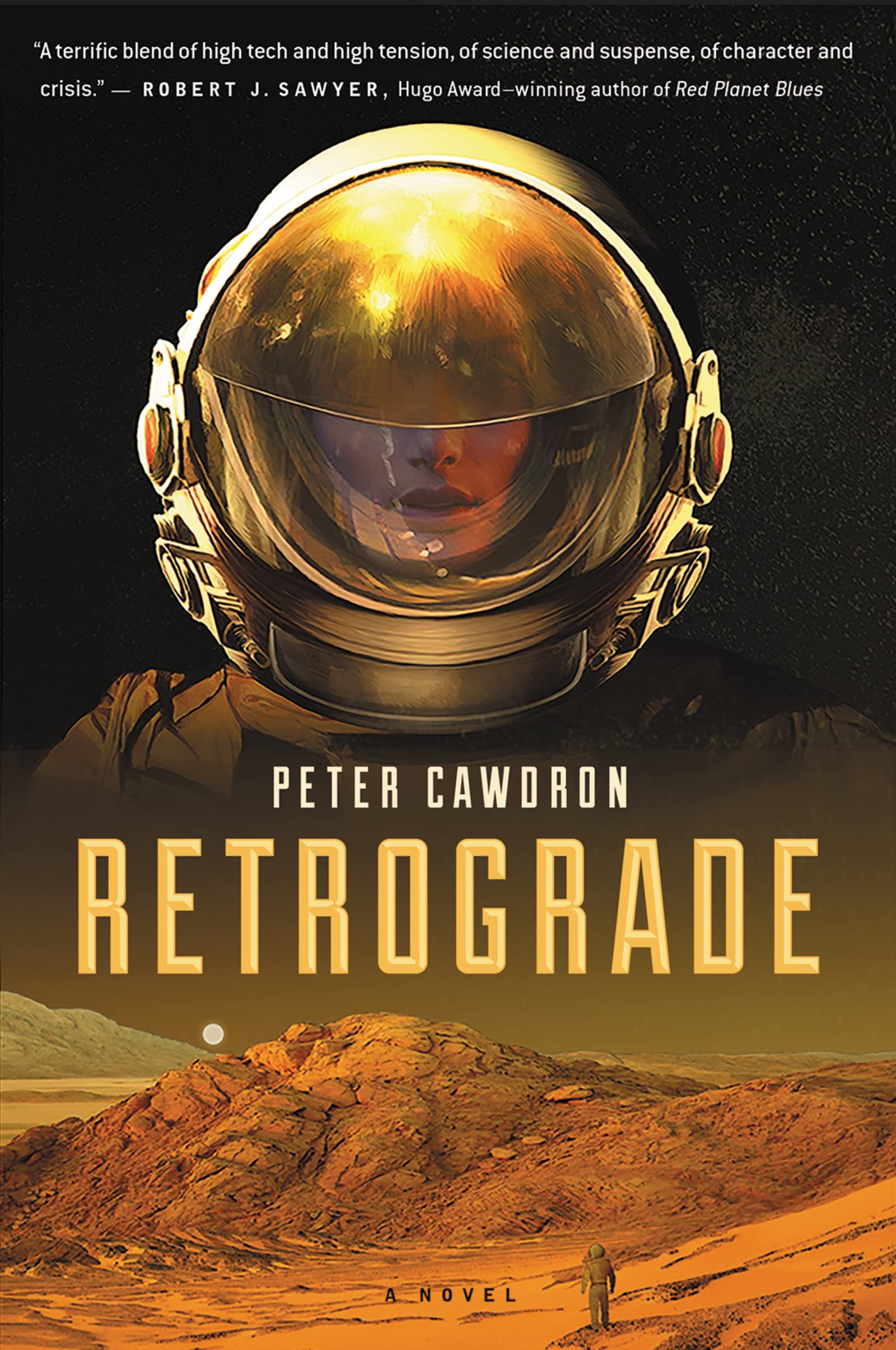
Retrograde: Gripping Hard Sci-Fi – Mars Astronauts Face Nuclear War and Survival
$11.07
by Peter Cawdron



“For lovers of Andy Weir’s The Martian , here’s a true hard-science-fiction tale set on the red planet — a terrific blend of high tech and high tension, of science and suspense, of character and crisis.” — Robert J. Sawyer, Hugo Award–winning author of Red Planet Blues “Post-apocalyptic disaster meets fractured utopian space exploration in this terrifying tale, which Cawdron ( Anomaly ) sets in a scientific outpost on Mars . . . This tense cat-and-mouse game plays off fears . . . to satisfying result.” — Publishers Weekly Venturing into space and traveling to Mars sounds like an exotic adventure, but the reality of living on a rocky, frozen, lifeless planet is exacting on the Mars Endeavour crew. The exhilaration of reaching the surface of Mars has worn off for the public, and the exploration has moved into its scientific phase. The only viable option for long-term habitation lies hundreds of feet beneath the surface, in lava caves that shield humans from harsh cosmic radiation. Connor, Harrison, and Liz are senior members of the U.S. module. When war breaks out on Earth and rumors spread to Mars, their core principles are rocked by the devastation and loss of friends and family. Whom can you trust on an international mission when your countries are at war? As colonists from different nations struggle to figure out what really happened on Earth, grief and anger become pitted against camaraderie and the spirit of exploration. “Science fiction as it should be. Retrograde combines realistic characters with depictions of Mars as our explorers will one day find it in a powerful story. A must-read!” — Ben Bova, Hugo Award winner and author of the Grand Tour series “For lovers of Andy Weir’s The Martian , here’s a true hard-science-fiction tale set on the red planet—a terrific blend of high tech and high tension, of science and suspense, of character and crisis.” - Robert J. Sawyer, Hugo Award–winning author of Red Planet Blues “Post-apocalyptic disaster meets fractured utopian space exploration in this terrifying tale, which Cawdron ( Anomaly ) sets in a scientific outpost on Mars . . . This tense cat-and-mouse game plays off fears . . . to satisfying result.” - Publishers Weekly “Science fiction as it should be. Retrograde combines realistic characters with depictions of Mars as our explorers will one day find it in a powerful story. A must-read!” - Ben Bova, Hugo Award winner and author of the Grand Tour series PETER CAWDRON is an Australian science fiction writer and author of numerous novels. He lives in Queensland, Australia. 1 Devils I’m giddy with rice wine. “Okay, deal the cards again,” James says, circling his hand around the table. “I get this. I can fool the landlord.” “It is dou di zhu,” Su-shun replies. “?‘Fight the landlord,’ not ‘fool.’?” I laugh as Jianyu pours me another tiny glass. “Are you trying to get me drunk?” I ask. Jianyu replies, but I can’t hear him over the noise of the card game and James calling out, “To fool is to fight without being seen, my friend. To fool is as good as a fight. Sometimes, it’s better.” “Sometimes it is,” Su-shun admits, dealing cards around the table. Jianyu smiles at me and then turns to James, saying, “You sound like Sun Tzu in The Art of War.” “Did he say that?” James asks with innocence in his voice. “No,” Su-shun replies, and everyone bursts out laughing. “You’ve had too much to drink,” I say to James, but I’m the one swaying under the influence of alcohol in the light Martian gravity. I hold on to the edge of the table with one hand, feeling as though I could float away. The rest of the Chinese crew gather around, yelling and placing bets ?— ?speaking so fast I find it hard to believe anyone can follow the conversation. All I can tell is that there’s a lot of excitement around James and his grossly misplaced bravado, with the Chinese betting both for and against him, but I suspect it’s mostly against. Like smoke in some seedy Shanghai restaurant, water vapor drifts around us, rising up from humidifiers wafting homemade incense throughout the Chinese module. I love the ambience. For a Midwestern girl like me, immersing myself in another culture is as intoxicating as alcohol, and I find myself torn between staying and leaving. I’ve got thirty kilos of rock samples to sift through tomorrow ?— ?that’s easily eight to ten hours of work. “We should be going,” I say, tapping James on the shoulder and pointing at the digital clock on the wall. It’s showing 12:00 a.m., but the seconds counter has gone well beyond 60 ?— ?it’s at 2,344 and climbing. I forget exactly how many seconds there are in the Martian time-slip, but a day on Mars is roughly forty minutes longer than it is on Earth, so our clocks are set to pause for the best part of an hour from 12:00 to 12:01. In theory, it means we can sleep in an extra half hour or so each day, but in practice, that gets channeled into our work. Our biological clocks are like those of drifters constantly tr