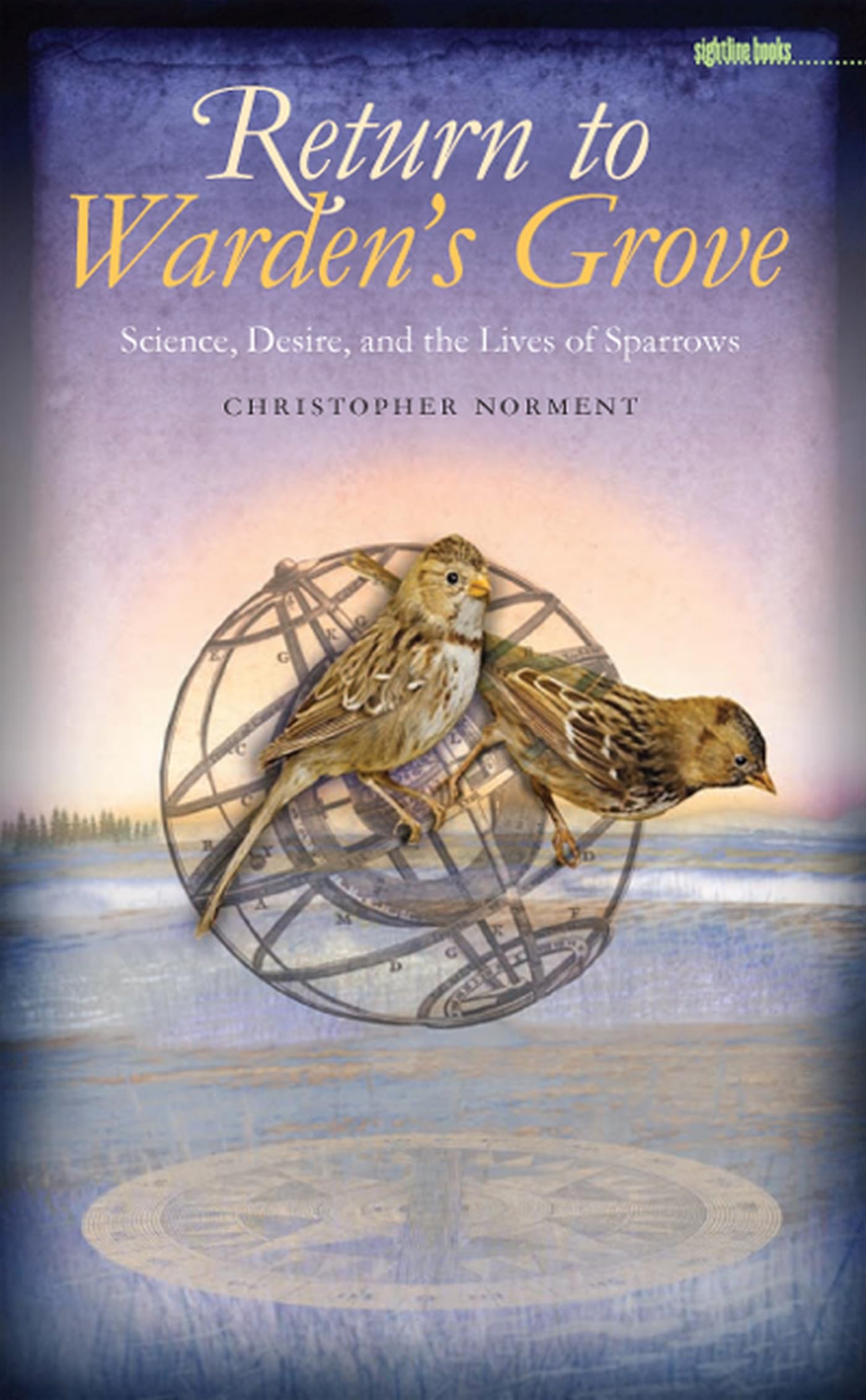
Return to Warden's Grove: Science, Desire, and the Lives of Sparrows (Sightline Books)
$26.00
by Christopher Norment



Based on three seasons of field research in the Canadian Arctic, Christopher Norment’s exquisitely crafted meditation on science and nature, wildness and civilization, is marked by bottomless prose, reflection on timeless questions, and keen observations of the world and our place in it. In an era increasingly marked by cutting-edge research at the cellular and molecular level, what is the role for scientists of sympathetic observation? What can patient waiting tell us about ourselves and our place in the world? His family at home in the American Midwest, Norment spends months on end living in isolation in the Northwest Territories, studying the ecology of the Harris’s Sparrow. Although the fourteenth-century German mystic Meister Eckhardt wrote, “God is at home, we are in the far country,” Norment argues that an intellectual, emotional, and spiritual “far country” can be found in the lives of animals and arctic wilderness. For Norment, “doing science” can lead to an enriched aesthetic and emotional connection to something beyond the self and a way to develop a sacred sense of place in a world that feels increasingly less welcoming, certain, and familiar. Norment recounts his three seasons studying the Harris’s Sparrow in a remote section of Canada’s Northwest Territory in a way that is appealing both for its ornithological insight and extraordinarily personal revelations. Given his often solitary sojourns in nature, opportunities for comparisons to Thoreau abound, but Norment not only observes and describes the sparrows; he also ruminates on the scientific naming of things, which he compares to a map connecting all living creatures. He witnesses the mournful death of a musk ox and performs a postmortem to satisfy his need to understand what has gone wrong in the wild. His own contribution to the unnatural death of wildlife is a source of inner conflict. He wonders if museum specimens might represent nothing more than “our species’ passion for collecting things” and can only accept the need to collect and study while also lamenting the loss of so many living things. Norment is a man of conscience, and his book will speak to all who have a passion for wild things. --Colleen Mondor “Norment is clearly beguiled and enchanted by his wild landscape, fascinated and mystified by the conundrum of the paradoxical dynamic between the human invader and the endlessly seductive notion of the land without invaders, as well as the problem of the human’s ‘right’ place—is it with people, or without them? He discusses this thoroughly and thoughtfully and gives a vivid portrayal of the field experience—its dramas, labors, vicissitudes, and sublime delights. The birds, the landscape, the weather, the solitude, and the tasks form the great cornerposts of this saga and make it solid, complex, and powerful.”—Roxana Robinson, author, Arctic Circle “Norment has crafted that rarest of all books, the study of a creature that demonstrates to know it is to know ourselves, but that also shows how such a task is far too important to delegate solely to science or art. It is an act that requires both. Norment’s parsing of poems and art is on par with his ability to gather field observations, and our world is larger for it.”—William L. Fox, author, Terra Antarctica “Norment’s cabin, like Thoreau’s, opens into the widest prospects of hearts and minds. Return to Warden’s Grove is a story of fortitude, love of truth, and a wandering, wondering heart. The picture appears gradually, humbly, in the repeated daily acts of minute observational and intellectual honesty from which science is built. He is willing to feel and question everything. What good is science? How much of science secretly draws from intuition, heart, and that mysterious connectedness to the natural world that no one can explain, or explain away? And how can a person really be at home anywhere? I don’t know of another work that better engages these foundational questions.”—David Oates, essayist and poet, author, Paradise Wild: Reimagining American Nature and City Limits: Walking Portland’s Boundary "Chris Norment's narrative of his summers studying Harris's Sparrows in the far north is one of the most stirring accounts of biological fieldwork I've read. It memorably conveys both the clarity of his scientific methods and findings and the complications of their philosophical, ethical, and emotional context. Norment's discussion of the relationship between scientific nomenclature and a vivid awareness of nature was particularly impressive for me." —John Elder, author, Reading the Mountains of Home and Pilgrimage to Vallombrosa "The life history of the Harris's sparrow ( Zonotrichia querela ) is the framework for a story that, almost by surprise, takes the reader on a grand tour of key themes that define our current juncture in the life sciences. . . .What comes out clearly above all in Warden's Grove is the "goodness' of natural history work."— Science Christ