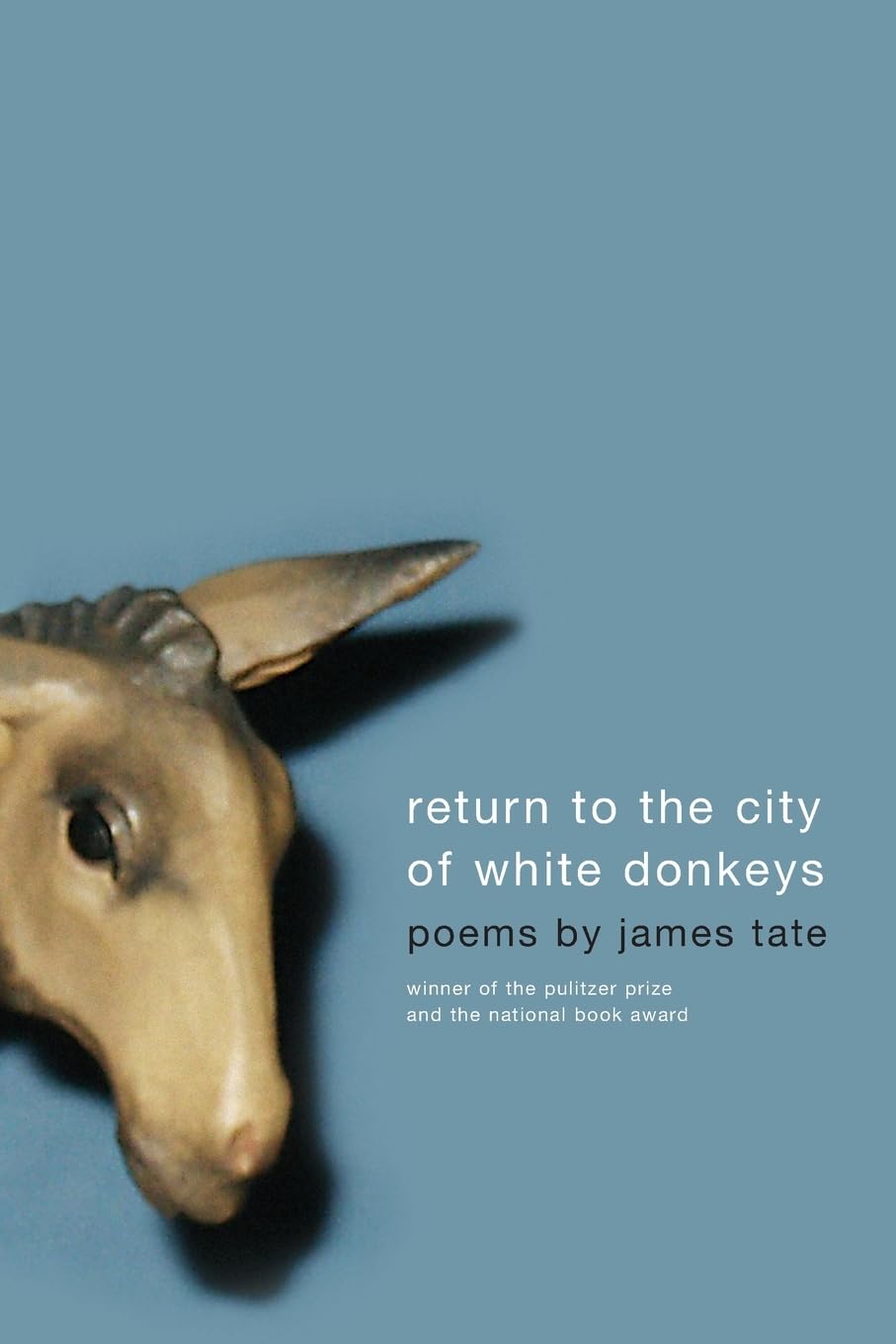
Return to the City of White Donkeys: Poems – Peculiar and Brilliant Verse from a Pulitzer Prize Winner
$12.99
by James Tate



In his fourteenth collection of poetry, Pulitzer Prize and National Book Award winner James Tate continues exploring his own peculiar brand of poetry, transforming our everyday world, a world where women give birth to wolves, wild babies are found in gardens, and Saint Nick visits on a hot July day. Tate's signature style draws on a marvelous variety of voices and characters, all of which sound vaguely familiar, but are each fantastically unique, brilliant, and eccentric. Yet, as Charles Simic observed in the New York Review of Books, "With all his reliance on chance, Tate has a serious purpose. He's searching for a new way to write a lyric poem." He continues, "To write a poem out of nothing at all is Tate's genius. For him, the poem is something one did not know was there until it was written down. . . . Just about anything can happen next in this kind of poetry and that is its attraction. . . . Tate is not worried about leaving us a little dazed. . . . He succeeds in ways for which there are a few precedents. He makes me think that anti-poetry is the best friend poetry ever had." “[James Tate] never ceases to astonish, dismay, delight, confuse, tickle, and generally improve the quality of our lives.” - John Ashbery “Tate’s poems are meditative, introverted, self-reliant, funny, alarming, strange, difficult, intelligent, and beautifully crafted.” - New York Times Book Review In his fourteenth collection of poetry, Pulitzer Prize and National Book Award winner James Tate continues exploring his own peculiar brand of poetry, transforming our everyday world, a world where women give birth to wolves, wild babies are found in gardens, and Saint Nick visits on a hot July day. Tate's signature style draws on a marvelous variety of voices and characters, all of which sound vaguely familiar, but are each fantastically unique, brilliant, and eccentric. Yet, as Charles Simic observed in the New York Review of Books, "With all his reliance on chance, Tate has a serious purpose. He's searching for a new way to write a lyric poem." He continues, "To write a poem out of nothing at all is Tate's genius. For him, the poem is something one did not know was there until it was written down. . . . Just about anything can happen next in this kind of poetry and that is its attraction. . . . Tate is not worried about leaving us a little dazed. . . . He succeeds in ways for which there are a few precedents. He makes me think that anti-poetry is the best friend poetry ever had." James Tate 's poems have been awarded the National Book Award, the Pulitzer Prize, the Wallace Stevens Award, the William Carlos Williams Award, the Yale Younger Poets Award, and the National Institute of Arts and Letters Award, and have been translated across the globe. Tate was a member of the American Academy of Arts and Letters; his many collections include The Lost Pilot, The Oblivion Ha-Ha, Absences, Distance from Loved Ones, Worshipful Company of Fletchers, and The Ghost Soldiers. Born in Kansas City, Missouri, he made his home in Pelham, Massachusetts. Return to the City of White Donkeys Poems By James Tate HarperCollins Publishers, Inc. Copyright ©2005 James Tate All right reserved. ISBN: 0060750022 Long-Term Memory I was sitting in the park feeding pigeons when a man came over to me and scrutinized my face right up close. "There's a statue of you over there," he said. "You should be dead. What did you do to deserve a statue?" "I've never seen a statue of me," I said. "There can't be a statue of me. I've never done anything to deserve a statue. And I'm definitely not dead." "Well, go look for yourself. It's you alright, there's no mistaking that," he said. I got up and walked over where it was. It was me alright. I looked like I was gazing off into the distance, or the future, like those statues of pioneers. It didn't have my name on it or anything, but it was me. A lady came up to me and said, "You're looking at your own statue. Isn't that against the law, or something?" "It should be," I said, "but this is my first offense. Maybe they'll let me off light." "It's against nature, too," she said, "and bad manners, I think." "I couldn't agree with you more," I said. "I'm walking away right now, sorry." I went back to my bench. The man was sitting there. "Maybe you're a war hero. Maybe you died in the war," he said. "Never been a soldier," I said. "Maybe you founded this town three hundred years ago," he said. "Well, if I did, I don't remember it now," I said. "That's a long time ago," he said, "you coulda forgot." I went back to feeding the pigeons. Oh, yes, founding the town. It was coming back to me now. It was on a Wednesday. A light rain, my horse slowed . . . The Memories of Fish Stanley took a day off from the office and spent the whole day talking to fish in his aquarium. To the little catfish scuttling along the bottom he said, "Vacuum that scum, boy. Suck it up, that's your job." The