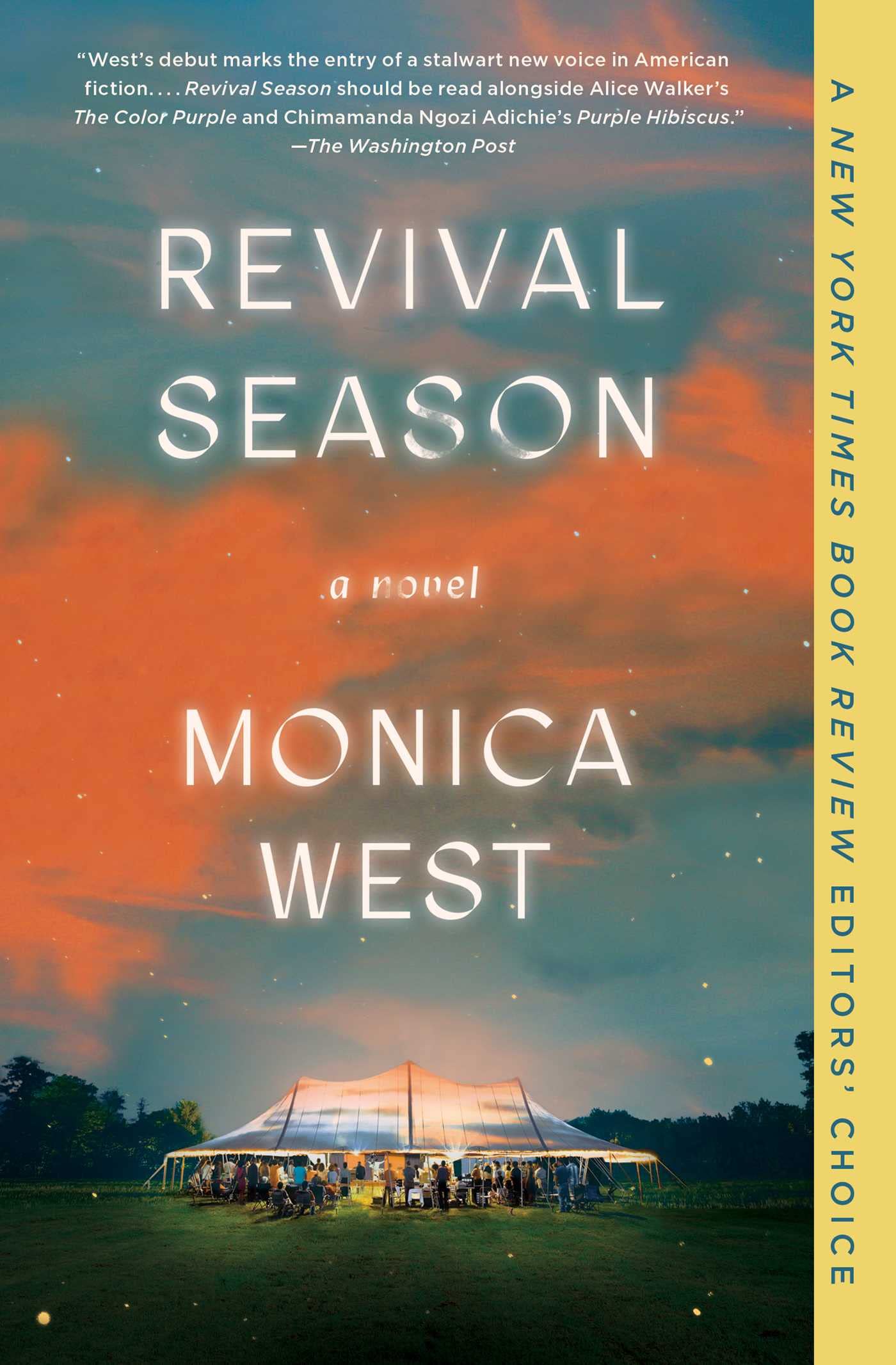



The daughter of one of the South’s most famous Baptist preachers discovers a shocking secret about her father that puts her at odds with both her faith and her family in this debut novel. “Spellbinding… Revival Season should be read alongside Alice Walker’s The Color Purple and Chimamanda Ngozi Adichie’s Purple Hibiscus .” — The Washington Post A New York Times Book Review Editors’ Choice Every summer, fifteen-year-old Miriam Horton and her family pack themselves tight in their old minivan and travel through small southern towns for revival season: the time when Miriam’s father—one of the South’s most famous preachers—holds massive healing services for people desperate to be cured of ailments and disease. But, this summer, the revival season doesn’t go as planned, and after one service in which Reverend Horton’s healing powers are tested like never before, Miriam witnesses a shocking act of violence that shakes her belief in her father—and her faith. When the Hortons return home, Miriam’s confusion only grows as she discovers she might have the power to heal—even though her father and the church have always made it clear that such power is denied to women. Over the course of the following year, Miriam must decide between her faith, her family, and her newfound power that might be able to save others, but if discovered by her father, could destroy Miriam. Celebrating both feminism and faith, Revival Season is a “tender and wise” (Ann Patchett) story of spiritual awakening and disillusionment in a Southern, Black, Evangelical community. Born and raised in Cleveland, Ohio, Monica West received her BA from Duke University, her MA from New York University, and her MFA from the Iowa Writers’ Workshop where she was a Rona Jaffe Graduate Fellow. She was a Southern Methodist University Kimbilio Fellow in 2014, and she will be a Hedgebrook Writer in Residence in 2021. Revival Season is her first novel. Chapter One ONE We rumbled toward Georgia from the west, the direction from which all great and powerful things originated. “Except the sun,” Caleb said, feeling particularly feisty as the novelty of another revival season settled in. Ma turned and shot him the look where her dark eyes narrowed into slits. Then she spun back around, closed her eyes, and mumbled a prayer: “Lord, watch over these Your children. Use us to do Your will. Amen.” Done praying, Ma refocused her attention to the map she was holding in the air; her finger landed on a bold black dot, far from the big star at the center of the state. We always went to smaller cities—tiny dots that surrounded the capital’s star like satellites. Her stubby, unmanicured nail tracing the winding path to Americus, Georgia, was nothing like the polished nails in the magazines that I snuck glimpses of in the library. Nails that we would never be able to have, since vanity was an unforgivable sin. I’d learned that lesson the hard way last spring when my best friend, Micah, and I had sat in the middle of her bedroom floor, an open bottle of nail polish between us. Micah lifted the wand and smoothed the shiny orb of light pink lacquer on my thumbnail. So faint no one will notice , she said. When I got home the next morning and linked my hand with Papa’s to pray for breakfast, he forced me to remove the polish under his watchful eye before anyone could lift a fork to their mouths. I watched Ma in the rearview mirror as the minivan merged onto the Texas highway. Papa turned up the radio as our van became one of an anonymous throng of vehicles barreling beneath an overpass. But none of the other cars had the important task that we did: driving nine hundred miles to bring the word of God to people who needed to be saved from their sins. The exhilaration before the first revival of a new season meant I could barely sit still between the cracked windows whose building pressure buffeted my ears. We’d been doing this for years—twelve, to be exact—but somehow this first moment of revival season, when everything was possible, never got old. We pulled into our ceremonial first stop—a tacky diner 281 miles away from our house in East Mansfield, Texas. Soon, conversation flowed as we pierced straws through plastic lids and drank the syrupy sweet soda we were only allowed to have during this inaugural revival season meal. With our hands curled around sweaty paper cups, Papa dreamed out loud. “I might break the two-thousand-soul mark this year. Wouldn’t that be a blessing?” It would be more than a blessing—it would be a miracle. The two-thousand-soul mark had been elusive for all of Papa’s years of leading revivals; it was three times more than last year’s soul count, and it would be even harder to accomplish this year. “There will be lines around the tent waiting for me when I arrive. This is the year, Hortons.” My eyes searched the table’s shiny surface as I took another deep sip. The caffeine made the lights extra bright as they bounced off the or