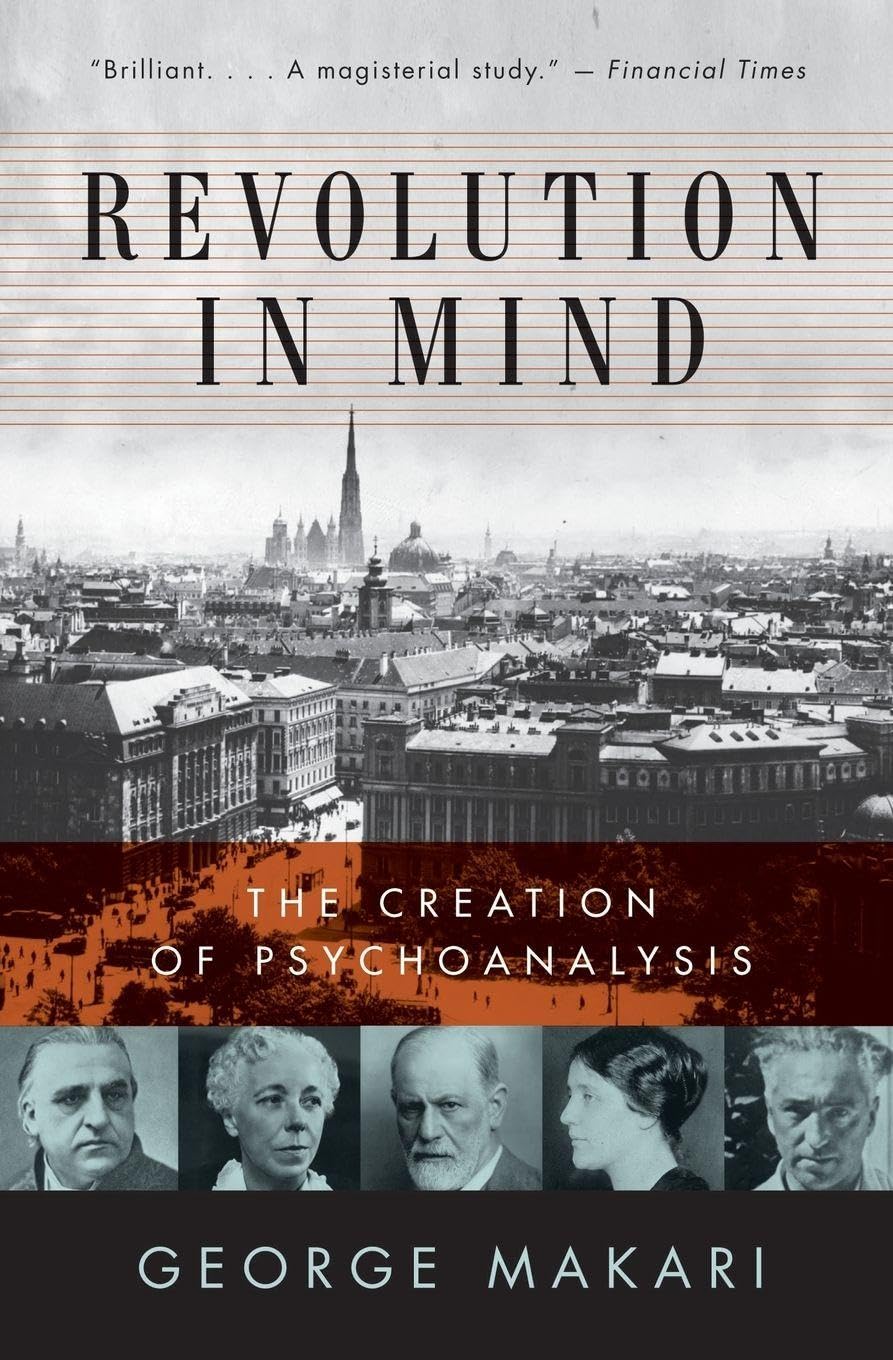
Revolution in Mind: The Creation of Psychoanalysis – A Groundbreaking History of the Intellectual Endeavor that Transformed Twentieth Century Thought
$15.62
by George Makari



Groundbreaking, insightful, and compulsively readable, Revolution in Mind goes beyond myth and polemic to give us the story of one of the most controversial and important intellectual endeavors of the twentieth century. In this masterful history, George Makari demonstrates how a new way of thinking about inner life coalesced and won followers who spread this body of thought throughout the West. Along the way he introduces the reader to a fascinating array of characters, many of whom have been long ignored or forgotten. Revolution in Mind is a brilliant, engaging, and radically new work—the first ever to account fully for the making of psychoanalysis. “George Makari has written nothing less than a history of the modern mind.” - Paul Auster “The best informed history of psychoanalysis. Freud’s context is more fully elaborated by Makari than ever before.” - Harold Bloom “An excellent, fascinating, and definitive history of psychoanalysis up to 1945. A tour de force.” - Murray Gell Mann “A lucid history. . . . Makari’s book projects a pleasing orderliness onto a tangled tale.” - The New York Times Book Review Groundbreaking, insightful, and compulsively readable, Revolution in Mind goes beyond myth and polemic to give us the story of one of the most controversial and important intellectual endeavors of the twentieth century. In this masterful history, George Makari demonstrates how a new way of thinking about inner life coalesced and won followers who spread this body of thought throughout the West. Along the way he introduces the reader to a fascinating array of characters, many of whom have been long ignored or forgotten. Revolution in Mind is a brilliant, engaging, and radically new work—the first ever to account fully for the making of psychoanalysis. George Makari is director of Cornell's Institute for the History of Psychiatry, associate professor of psychiatry at Weill Medical College, adjunct associate professor at Rockefeller University, and a faculty member of Columbia University's Psychoanalytic Center. His writings on the history of psychoanalysis have won numerous awards. He lives in New York City Revolution in Mind The Creation of Psychoanalysis By George Makari HarperCollins Publishers, Inc. Copyright © 2008 George Makari All right reserved. ISBN: 9780061346620 Chapter One A Mind for Science It's wrong to say I think. Better to say: I am thought?.?.?.?I is an other. ?Arthur Rimbaud, 1871 As the Enlightenment cast scientific rationalism up to celestial bodies and down to squirming microscopic life, there was one object that seemed impossible to penetrate: the mind. The French champion of science and rational skepticism, René Descartes, established this in his Discourse on Method when he declared the "I" was beyond rational inquiry, being nothing other than the immaterial soul described by Church fathers. Religious beliefs regarding inner life would prove durable and influential, but during the second half of the nineteenth century such notions began to lose some credence, and in that ceded ground a science of mental life took root. When Sigmund Freud arrived in Paris in 1885, France had established itself as the center for cutting-edge research on psychological matters. Few scientists in Berlin or Vienna bothered to investigate the psyche, the "I," the soul, the self, or the mind—realms tainted by religion or speculative metaphysics. In Paris, however, scientists were drawn to the study of the inner world, thanks to a new method. That method, the psychologie nouvelle , transformed France into a hotbed of study for somnambulism, human automatisms, multiple personality, double consciousness, and second selves, as well as demonic possessions, fugue states, faith cures, and waking dreams. The marvelous and miraculous made their way from isolated villages and abbeys and carnival halls, from exorcists and charlatans and old mesmerists, into the great halls of French academic science. The birth of this new psychology came as France itself was being reborn. Nearly a century after its revolution, the French suffered a humiliating defeat to the Prussians in 1870, resulting in the fall of Emperor Louis Napoleon III and the birth of the Third Republic. Many blamed this military debacle on French science and its failure to keep up with the advances made in German lands. French Republicanism combined anticlericalism with a commitment to revitalizing science. As the authority of the French Catholic Church to dictate thinking on the soul waned, a bold, new scientific psychology emerged. At the time, psychology was considered a branch of philosophy, not science, but the champion of the psychologie nouvelle , Théodule Ribot, set out to change that. Born in 1839, the son of a provincial pharmacist, Théodule was forced by his father to become a civil servant. After three years of drudgery, he announced that he was off to Paris to try and gain entrance into the elite École Norm