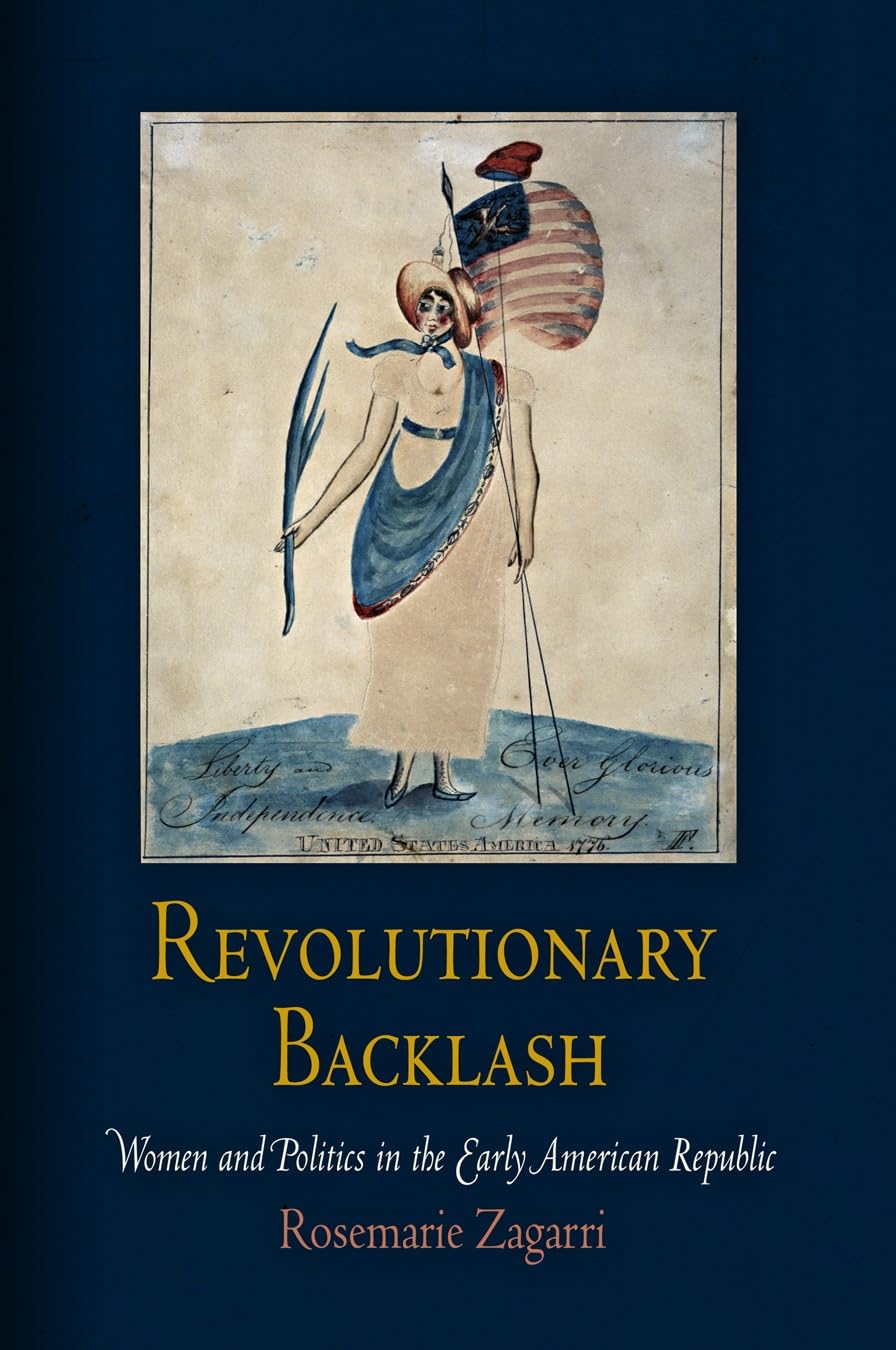
Revolutionary Backlash: Women and Politics in the Early American Republic (Early American Studies)
$20.23
by Rosemarie Zagarri



The Seneca Falls Convention is typically seen as the beginning of the first women's rights movement in the United States. Revolutionary Backlash argues otherwise. According to Rosemarie Zagarri, the debate over women's rights began not in the decades prior to 1848 but during the American Revolution itself. Integrating the approaches of women's historians and political historians, this book explores changes in women's status that occurred from the time of the American Revolution until the election of Andrew Jackson. Although the period after the Revolution produced no collective movement for women's rights, women built on precedents established during the Revolution and gained an informal foothold in party politics and male electoral activities. Federalists and Jeffersonians vied for women's allegiance and sought their support in times of national crisis. Women, in turn, attended rallies, organized political activities, and voiced their opinions on the issues of the day. After the publication of Mary Wollstonecraft's A Vindication of the Rights of Woman , a widespread debate about the nature of women's rights ensued. The state of New Jersey attempted a bold experiment: for a brief time, women there voted on the same terms as men. Yet as Rosemarie Zagarri argues in Revolutionary Backlash , this opening for women soon closed. By 1828, women's politicization was seen more as a liability than as a strength, contributing to a divisive political climate that repeatedly brought the country to the brink of civil war. The increasing sophistication of party organizations and triumph of universal suffrage for white males marginalized those who could not vote, especially women. Yet all was not lost. Women had already begun to participate in charitable movements, benevolent societies, and social reform organizations. Through these organizations, women found another way to practice politics. "'Pathbreaking' is an appellation reserved for few books; 'field-changing' is an even rarer designation. Nonetheless Rosemarie Zagarri's Revolutionary Backlash deserves both. She transforms the field of women's history and the standard political narrative that still dominates United States history." ― William & Mary Quarterly "Widely researched, gracefully written, and nicely illustrated. . . . A welcome corrective to both the usual women's history (without politics) and traditional political history (without women)." ― North Carolina Historical Review "This book makes a significant contribution to the literature of American women's history by defining a period that has received too little attention. The writing is gorgeous. The research is first-rate." ― Edith B. Gelles, author of Abigail Adams: A Writing Life "An engaging book that successfully marries political practice and political theory with gender ideology. It is also a persuasive book. . . . What makes [Zagarri's] study compelling is the pervasive presence of women; we hear their voices as they communicate privately in letters and as they argue publicly for rights. Visual evidences let us see them at political gatherings." ― American Historical Review Spanning the first fifty years of the nation's history, Revolutionary Backlash uncovers women's forgotten role in early American politics and explores an alternative explanation for the emergence of the first women's rights movement. Rosemarie Zagarri is Professor of History at George Mason University. Introduction More than three decades after the American Revolution ended, a Maryland newspaper published an article with the reassuring headline "Revolutions Never Go Backward." Expressing the hope that the world had "wearied" of revolutions, the author maintained that people throughout the world were now ready to "settle down in quiet for the purpose of enjoying what little good there may be mingled with the evil in this naughty world." Yet if American women and men felt that the gains of their political Revolution had been secured, its effects on women were less certain. In the immediate wake of the Revolution, women's prospects seemed promising. Writing in 1798, Massachusetts author Judith Sargent Murray congratulated her "fair country-women" on what she called "the happy revolution which the few past years has made in their favour." At long last, she said, "'the Rights of Women' begin to be understood; we seem, at length, determined to do justice" to women. Such was her "confidence" that she expected even more changes to be forthcoming. "Our young women," Murray declared, are "forming a new era in female history." Just a few years later, however, the effects of the French Revolution and the upheavals of domestic political strife seemed to be taking a toll. A male writer viewed the situation, particularly with respect to women, with alarm. "That revolutionary mania," he maintained, "which of late has so forcibly extended its deleterious effects to almost every subject" had infected women as well. "Blind t