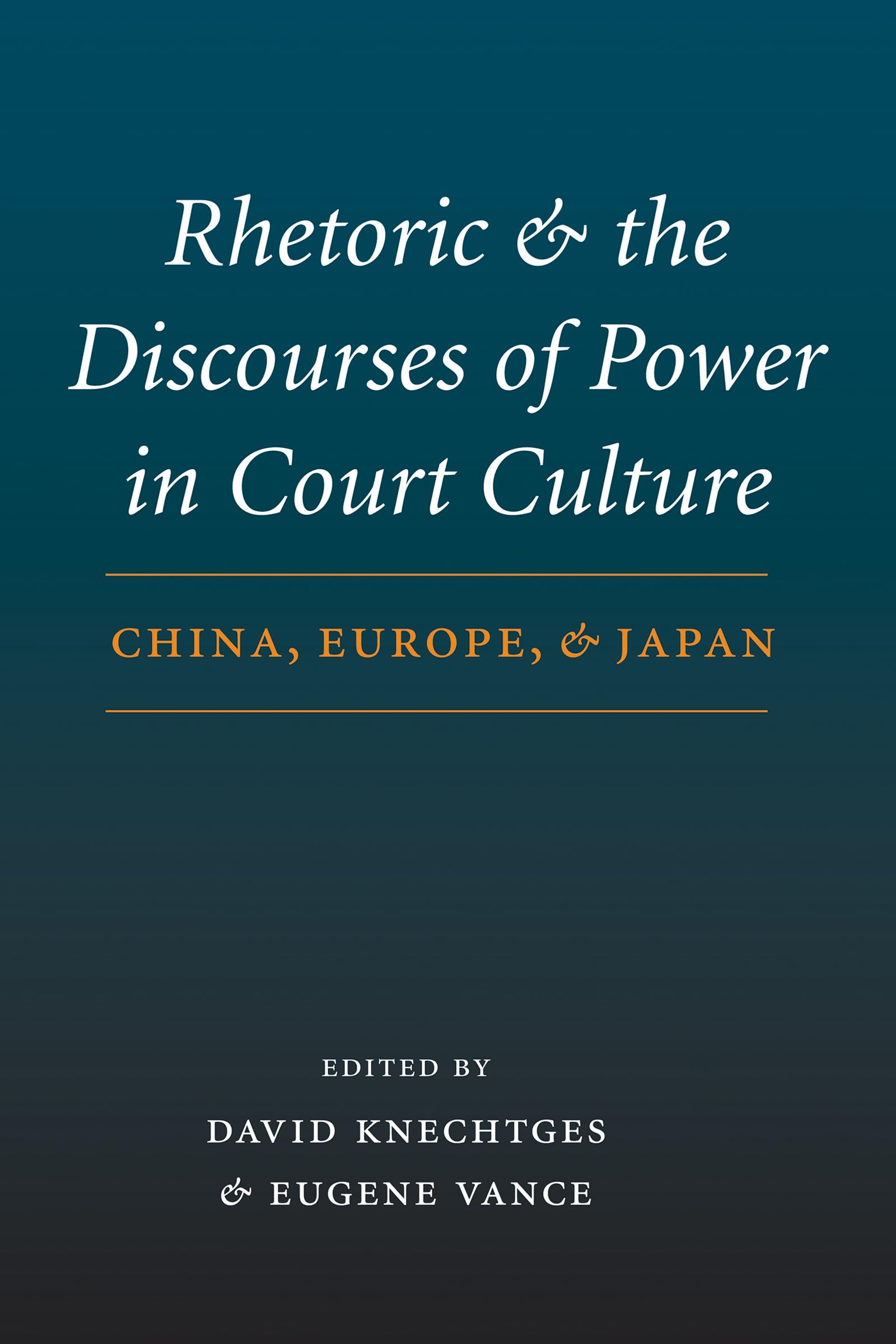
Rhetoric and the Discourses of Power in Court Culture: China, Europe, and Japan
$57.95
by David R. Knechtges



Key imperial and royal courts―in Han, Tang, and Song dynasty China; medieval and renaissance Europe; and Heian and Muromachi Japan―are examined in this comparative and interdisciplinary volume as loci of power and as entities that establish, influence, or counter the norms of a larger society. Contributions by twelve scholars are organized into sections on the rhetoric of persuasion, taste, communication, gender, and natural nobility. Writing from the perspectives of literature, history, and philosophy, the authors examine the use and purpose of rhetoric in their respective areas. In Rhetoric of Persuasion, we see that in both the third-century court of the last Han emperor and the fourteenth-century court of Edward II, rhetoric served to justify the deposition of a ruler and the establishment of a new regime. Rhetoric of Taste examines the court’s influence on aesthetic values in China and Japan, specifically literary tastes in ninth-century China, the melding of literary and historical texts into a sort of national history in fifteenth-century Japan, and the embrace of literati painting innovations in twelfth-century China during a time when the literati themselves were out of favor. Rhetoric of Communication considers official communications to the throne in third-century China, the importance of secret communications in Charlemagne’s court, and the implications of the use of classical Chinese in the Japanese court during the eighth and ninth centuries. Rhetoric of Gender offers the biography of a former Han emperor’s favorite consort and studies the metaphorical possibilities of Tang palace plaints. Rhetoric of Natural Nobility focuses on Dante’s efforts to confirm his nobility of soul as a poet, surmounting his non-noble ancestry, and the development of the texts that supported the political ideologies of the fifteenth-century Burgundian dukes Philip the Good and Charles the Bold. " Rhetoric and the Discourses of Power in Court Culture represents a significant achievement. All the essays contained in the volume are lucid and generally jargon-free. Students and scholars of rhetoric and related fields will find it engaging, thought-provoking, and rewarding."― Rhetorical Review "An excellent volume on an important but understudied topic. The research is original and the prose thoughtful and jargon―free."―Martin Kern, Princeton University "Nothing quite like this has been published before. The essays serve admirably to begin a discussion of ‘court culture’: What is it? How should it be defined? Who creates it and for whom?"―Paul W. Kroll, University of Colorado Twelve scholars discuss the use of rhetoric in the royal courts of China, Europe, and Japan ― University of Washington Press David Knechtges is professor of Chinese literature and Eugene Vance is professor of French and Italian studies, both at the University of Washington. Other contributors are Robert Borgen (University of California, Davis), Steven D. Carter (University of California, Irvine), Robert Joe Cutter (University of Wisconsin-Madison), Paul Dutton (Simon Fraser University), Ronald Egan (University of California, Santa Barbara), Stephen Owen (Harvard University), Arjo Vanderjagt (University of Groningen), Kuo-ying Wang (National Taiwan University), Scott Waugh (University of California, Los Angeles), and Pauline Yu (University of California, Los Angeles).