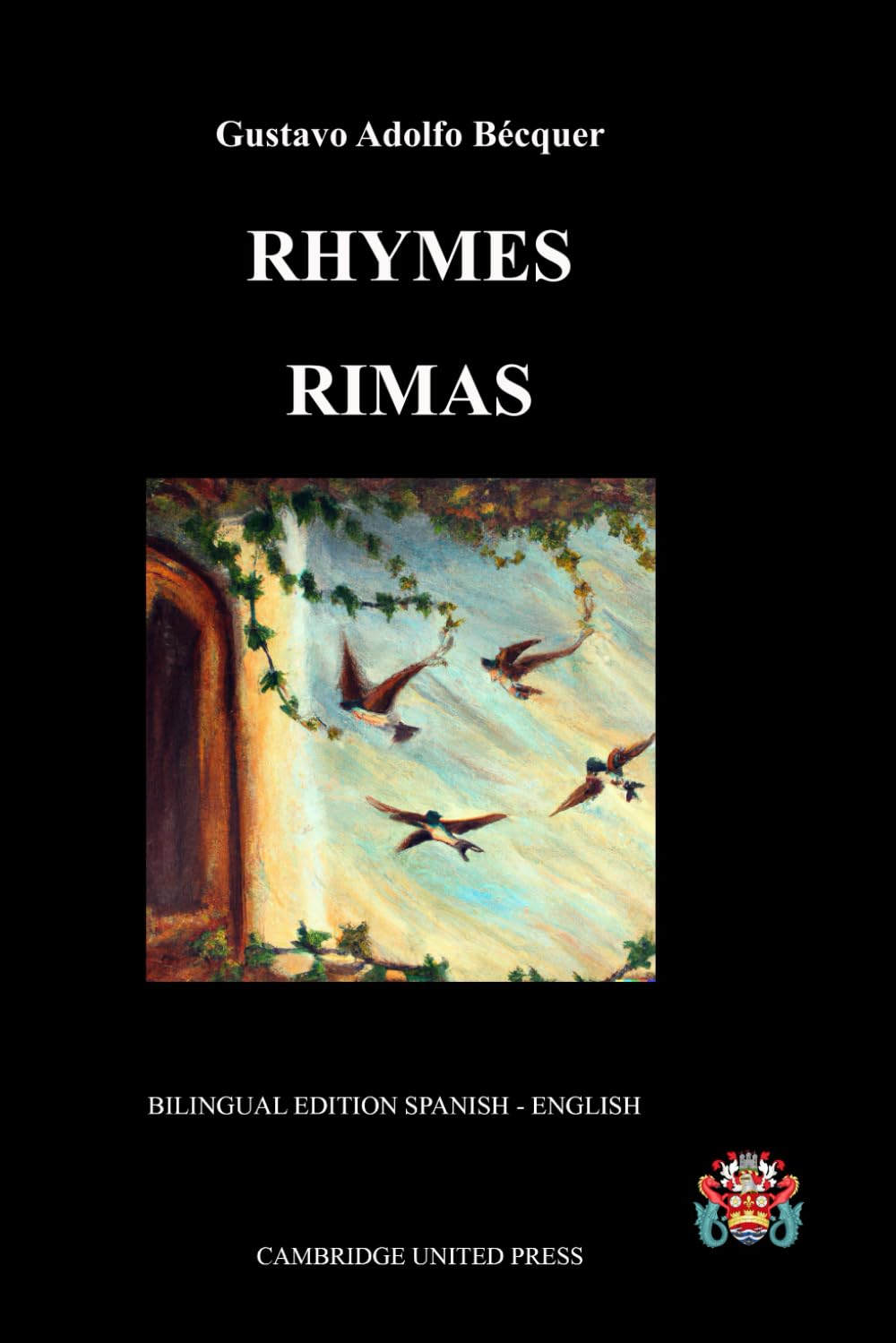



The most relevant poetry book of Spanish Romanticism. This is the most popular book of poems in Spanish Language. Universally recognized as "the deepest and finest poetry of the 19th century, in a minor key," it was ridiculed by Núñez de Arce, praised by Antonio Machado, admired by Alberti and Lorca, and honored by Rubén Darío and Juan Ramón Jiménez. Among the classic studies carried out on the Rimas (Rhymes), which initially consisted of barely 76 short poems in its first edition, although subsequent editions gathered up to 96 poetic pieces, notable works include those by Rafael Montesinos, José Luis Cano, or Luis Cernuda. In its formal aspect (meter and rhyme), the abundance of consonant rhyme and free verse is refreshing and innovative. The Book of the Sparrows Bécquer left composed the manuscript titled "Libro de los gorriones: colección de proyectos, argumentos, ideas y planes de cosas diferentes que se concluirán o no según sople el viento" (Book of the Sparrows: collection of projects, arguments, ideas, and plans for different things that will or will not be concluded depending on the wind), signed in 1868 by "Gustavo Adolfo Claudio D. Bécquer," as can be read in the original manuscript preserved in the National Library of Spain, in Madrid. After the poet's death, and apparently being unaware of the lost manuscript, his friends Narciso Campillo and Augusto Ferrán compiled Bécquer's work – which they organized and revised with varying, debatable, and debated success – published in a first edition titled "Obras" (Works) in 1870. In 1871, a new edition was made – with a prologue by Rodríguez Correa – in two volumes, which included, under the title "Rimas," the 76 compiled poems alongside his prose Legends, to help the widow and her children. Manuel Altolaguirre considered Bécquer's poetry as the most human of Spanish Romanticism. Chronologically and stylistically positioned at the birth of modern poetry, Bécquer himself seemed to sense the enormous popular impact that his verses would acquire over time when he wrote: "popular poetry is the synthesis of poetry." At the beginning of 1861, in a review published on January 20 in El Contemporáneo, regarding the work "La Soledad" by Augusto Ferrán, a poet and friend, Bécquer writes: "There is magnificent and sonorous poetry; poetry born of meditation and art, adorned with all the splendors of language, moving with a rhythmic majesty, speaking to the imagination, completing its pictures, and leading it at will along an unknown path, seducing it with its harmony and beauty. There is another kind, natural, brief, dry, emerging from the soul like an electric spark, striking the sentiment with a word and fleeing, and devoid of artifice, unburdened within a free form, awakening, with a touch, the thousand ideas that sleep in the unfathomable ocean of fantasy (...) The first has a given value: it is the poetry of everyone. The second lacks absolute measure; it takes on the proportions of the impressed imagination: it can be called the poetry of poets (...) One is the divine fruit of the union of art and fantasy. The other is the inflamed spark that springs from the collision of sentiment and passion." Gustavo Adolfo Bécquer Critical studies also highlight the purification of Romanticism that the Sevillian poet carried out, stripping expression of bombast or histrionics and opening a new poetic style or voice that was often evoked by later great poets such as Antonio Machado, José Martí, or Pablo Neruda.