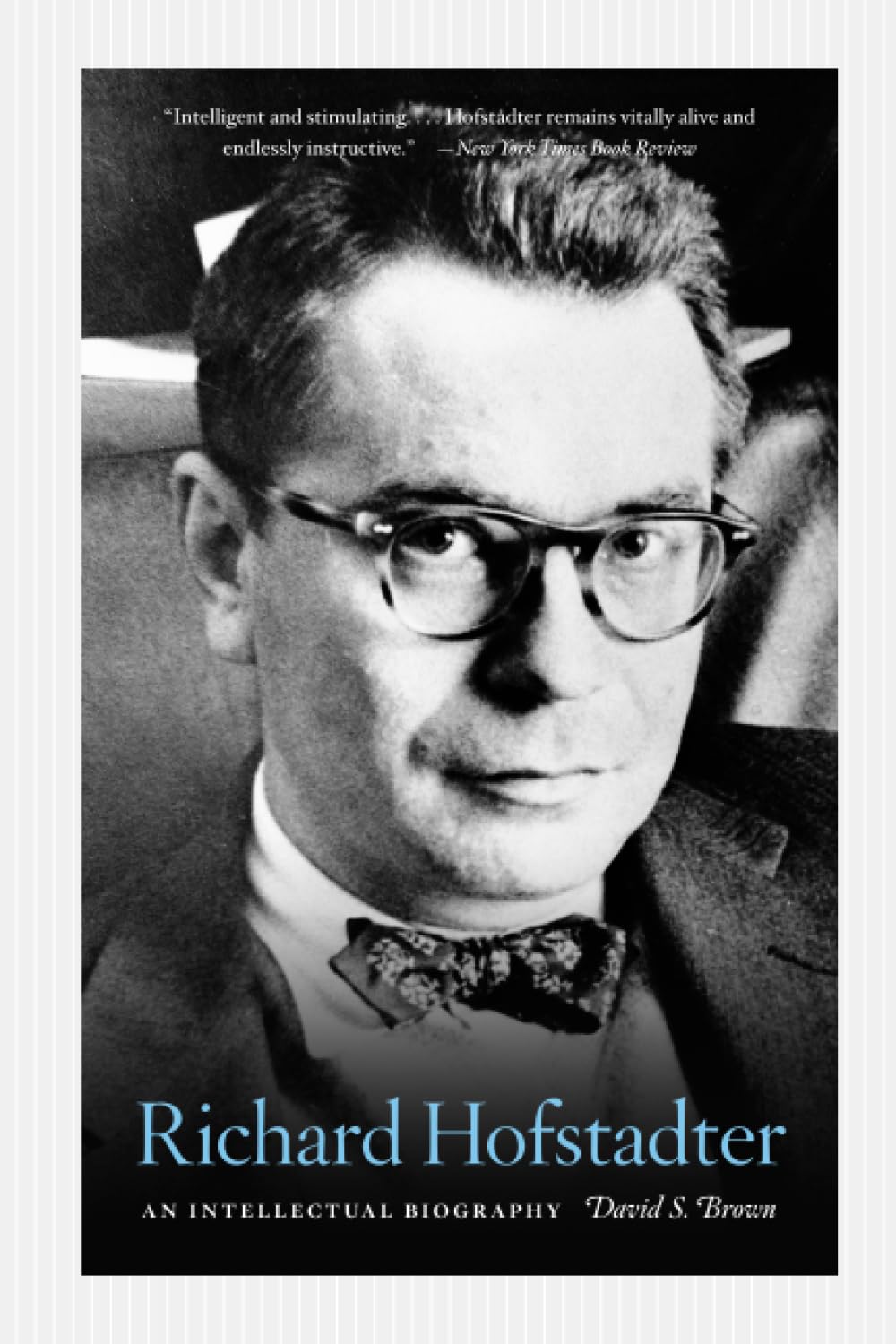



Richard Hofstadter (1916-70) was America’s most distinguished historian of the twentieth century. The author of several groundbreaking books, including The American Political Tradition , he was a vigorous champion of the liberal politics that emerged from the New Deal. During his nearly thirty-year career, Hofstadter fought public campaigns against liberalism’s most dynamic opponents, from McCarthy in the 1950s to Barry Goldwater and the Sun Belt conservatives in the 1960s. His opposition to the extreme politics of postwar America—articulated in his books, essays, and public lectures—marked him as one of the nation’s most important and prolific public intellectuals. In this masterful biography, David Brown explores Hofstadter’s life within the context of the rise and fall of American liberalism. A fierce advocate of academic freedom, racial justice, and political pluralism, Hofstadter charted in his works the changing nature of American society from a provincial Protestant foundation to one based on the values of an urban and multiethnic nation. According to Brown, Hofstadter presciently saw in rural America’s hostility to this cosmopolitanism signs of an anti-intellectualism that he believed was dangerously endemic in a mass democracy. By the end of a life cut short by leukemia, Hofstadter had won two Pulitzer Prizes, and his books had attracted international attention. Yet the Vietnam years, as Brown shows, culminated in a conservative reaction to his work that is still with us. Whether one agrees with Hofstadter’s critics or with the noted historian John Higham, who insisted that Hofstadter was “the finest and also the most humane intelligence of our generation,” the importance of this seminal thinker cannot be denied. As this fascinating biography ultimately shows, Hofstadter’s observations on the struggle between conservative and liberal America are relevant to our own times, and his legacy challenges us to this day. David S. Brown is professor of history at Elizabethtown College in Pennsylvania. He is the author of Thomas Jefferson: A Biographical Companion and Richard Hofstadter: An Intellectual Biography , the latter published by the University of Chicago Press. Richard Hofstadter An Intellectual Biography By David S. Brown University of Chicago Press Copyright © 2007 David S. Brown All right reserved. ISBN: 9780226076416 Introduction Interior, Exterior In a liberal society the historian is free to try to dissociate myths from reality, but that same impulse to myth-making that moves his fellow man is also at work in him. -Richard Hofstadter, 1956 There is a certain mystique to Richard Hofstadter. For nearly thirty years, the legend goes, he wrote the best books for the best publisher, won the best prizes, and taught in the best city, at the best school, at the best time. Among historians, The American Political Tradition , House of Knopf, Pulitzer, New York, Columbia University, and postwar America evoke a hazy attachment to a lost world of scholarly giants confident in the curative powers of the enlightened mind. This was a world raised in the collective memory of the Depression thirties, tormented by the anti-intellectualism of the McCarthy fifties, and rejected in the student wars of the radical sixties. Along the way, American society changed and historical writing changed, too. The older generation's preference for exploring the politics and ideas of elite personalities yielded before a broad canopy of studies focusing on race, class, and gender that revolutionized the academy's presentation of the past. Now, as the last great historians of the postwar period leave the scene, it seems particularly useful to candidly assess the greatest among them. Richard Hofstadter's career as a professional historian paralleled the heyday of twentieth-century liberalism (1933-68). Tracing his life reveals a complex tapestry of internal and external motivations that merged to produce a uniquely insightful mind, alert to the promise and perils of American democracy. As the academy moved to the left, the nation's political culture lurched to the right, leaving liberals clinging to an ever-shrinking center. That Hofstadter, a symbol of the postwar consensus, is still commonly quoted in the pages of the nation's most popular general interest and political periodicals attests to his unusual hold on the public's imagination. More than three decades after his untimely death from leukemia at the age of fifty-four, legions of journalists and Internet bloggers routinely adopt social-psychological concepts-status anxiety, paranoid style, anti-intellectualism-popularized by Hofstadter. Among professional historians, only the distinguished Progressive thinkers Frederick Jackson Turner and Charles Beard and postwar notables C. Vann Woodward and Arthur Schlesinger, Jr., made as lasting impressions on their culture. Like these men, Hofstadter exhibited an enviable ability to connec